Huge Health Gains from Vaccines


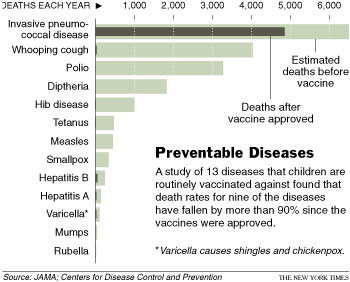
VaccineReducesDeaths90PercentGraph.jpg   Source of graphic:  online version of the WSJ article quoted and cited below.


I hypothesize that most of the health gains from modern medicine come from a few advances, with vaccines being a very prominent example.  (My hypothesis implies that many health care procedures do relatively little to increase health and longevity.) 


(p. A18)  Death rates for 13 diseases that can be prevented by childhood vaccinations are at all-time lows in the United States, according to a study released yesterday.

The study, by the Centers for Disease Control and Prevention in Atlanta, and published in The Journal of the American Medical Association, is the first time that the agency has searched historical records going back to 1900 to compile estimates of cases, hospitalizations and deaths for all the diseases children are routinely vaccinated against.

In nine of the diseases, rates of death or hospitalization declined more than 90 percent since vaccines against them were approved, and in the cases of smallpox, diphtheria and polio, by 100 percent.

In only four diseases — hepatitis A and B, invasive pneumococcal diseases and varicella (the cause of chickenpox and shingles) — did deaths and hospitalizations fall less than 90 percent. Those vaccines are all relatively new — the one for chickenpox, for example, was adopted nationally only in 1995. Also, some diseases like hepatitis typically strike adults, who are less likely to be immunized.

The results “are a testament to the fact that vaccines can drive diseases down to near nil,” said Dr. Gregory A. Poland, chief of the vaccine research group at the Mayo Clinic.


For the full story, see:
DONALD G. McNEIL Jr.  "Sharp Drop Seen in Deaths From Ills Fought by Vaccine."  The New York Times  (Thurs., November 14, 2007):  A23. 


Schumer Defends Rich Hedge Fund Democratic Donors, While Criticizing Selfish Republican “Plutocrats”


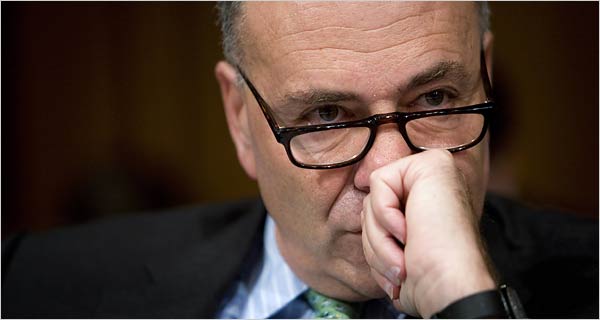
   Hedge fund defender, and recipient of hedge fund donations, Democratic Senator Charles E. Schumer.  Source of photo:  online version of the NYT article quoted and cited below.


The story quoted below, reminds me of a story I told earlier about the famous democratic economist John Kenneth Galbraith ridiculing the wealth of Republicans.

Schumer’s behavior exemplifies the "public choice" theory of economics that suggests that the motives of politicians will generally be similar to the motives of the rest of us.  In other words, incentives often matter. 


(p. A1)  WASHINGTON, July 29 — June was a busy month for Senator Charles E. Schumer. On the phone, at large parties and small gatherings around the nation, he raised more than $1 million from the booming private equity and hedge fund industries for the Democratic Senatorial Campaign Committee, of which he is chairman.

But there is another way Mr. Schumer has been busy with hedge fund and private equity managers, an important part of his constituency in New York. He has been reassuring them that he will resist an effort led by members of his own party to single out the industry with a plan that would more than double the taxes on the enormous profits reaped by its executives.

Mr. Schumer has considerable say on the issue. In addition to being the third-ranking Democrat in the Senate leadership, he is the only Democrat serving on both of the major committees, Banking and Finance, that have jurisdiction in the matter.

He has long been a pro-business Democrat and a fund-raising machine for the party, as well as a vociferous supporter of Wall Street issues in Washington, much the way Michigan lawmakers defend the auto industry and Iowa politicians work on behalf of corn farmers.

But in the case of the tax proposals, the strategy behind Mr. Schumer’s efforts is putting to the test another set of principles he is known for. He has regularly portrayed himself as a progressive politician who identifies with the struggles of the middle class and is sharply critical of the selfish “plutocrats” who he says control the Republican Party.


For the full story, see: 

RAYMOND HERNANDEZ and STEPHEN LABATON.  "In Opposing Tax Plan, Schumer Breaks With Party."  The New York Times  (Mon., July 30, 2007 ):  A1 & A14. 


Prominent Transplant Surgeon Endorses Market for Kidneys


KidneyTransplantWaitingListGraph.gif   Source of graphic:  online version of the WSJ article quoted and cited below.
 

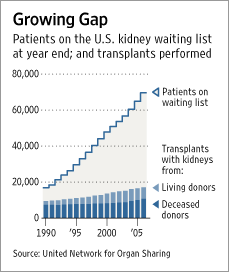
(p. A1)  Amid a severe kidney-donor shortage, an idea long considered anathema in the medical community is gaining new currency: payments for people willing to give up a kidney. 

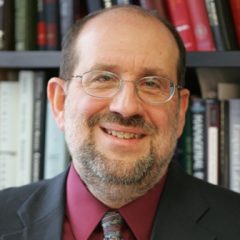
One of the most outspoken voices on the topic isn’t a free-market libertarian, but a prominent transplant surgeon named Arthur Matas.

Dr. Matas, 59 years old, is a Canadian-born physician best known for his research at the University of Minnesota. Lately, he’s been traveling the country trying to make the case that barring kidney sales is tantamount to sentencing some patients to death.

"There’s one clear argument for sales," Dr. Matas told a gathering of surgeons earlier this year. The practice, currently illegal in the U.S., "would increase the supply of kidneys, save lives and improve the quality of life for those with end-stage renal disease."

The doctor supports a regulated market only for kidneys, since live donors can give one up and survive without excessive health risks. (Transplants of other organs, such as livers and lungs, pose greater complications to a living donor.) And Dr. Matas doesn’t rule out financial incentives for the families of deceased donors.


For the full story, see:

LAURA MECKLER.  "Kidney Shortage Inspires A Radical Idea: Organ Sales As Waiting List Grows, Some Seek to Lift Ban; Exploiting the Poor?"  The Wall Street Journal  (Tues., November 13, 2007):  A1 & A22.


MatasArthurTransplantSurgeon.jpg  Source of image:  online version of the WSJ article quoted and cited above.