
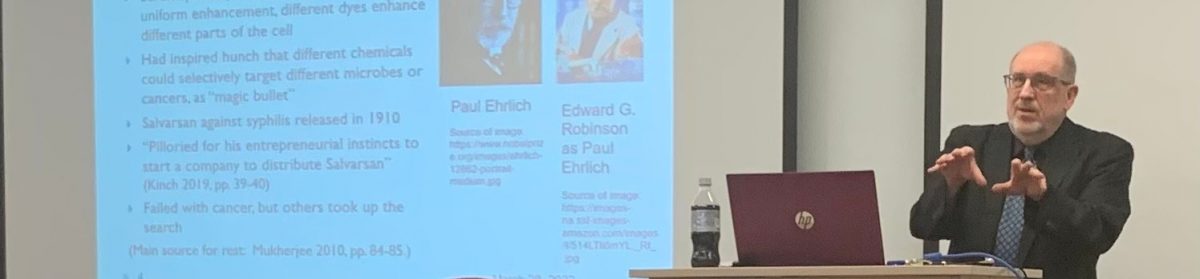
In my Openness book, I argue that the innovative entrepreneur is a key agent of the innovative dynamism that brings us the new goods and the process innovations through which we flourish. The Theory of the Adjacent Possible, devised by Stuart Kauffman, Roger Koppl, and collaborators, and popularized by Steven Johnson, aims to “deflate” the innovative entrepreneur, and argues that technological progress is an inevitable result of a stochastic process. I have written an extended critique of the TAP, and have posted the latest version to the SSRN working paper archive. In some ways the working paper, especially the last half, can be viewed as further elaboration and illustration of some of the points made in Openness.
The citation for, and link to, my working paper is:
My book mentioned in my initial comments is:
Diamond, Arthur M., Jr. Openness to Creative Destruction: Sustaining Innovative Dynamism. New York: Oxford University Press, 2019.