Entrepreneur Frederic Tudor Spent Family Fortune to Make Ice Obsession a Business Success

(p. 71) Lake ice was a marvelous product. It created itself at no cost to the producer, was clean, renewable, and infinite in supply. The only drawbacks were that there was no infrastructure to produce and store it, and no market to sell it to. In order to make the ice industry exist, it was necessary to work out ways to cut and lift ice on a large scale, build storehouses, secure trading rights, and engage a reliable chain of shippers and agents (p. 72) and, above all, create a demand for ice in places where ice had seldom or never been seen, and was most assuredly not something anyone was predisposed to pay for. The man who did all this was a Bostonian of good birth and challenging disposition named Frederic Tudor. Making ice a commercial proposition became his overweening obsession.
The notion of shipping ice from New England to distant ports was considered completely mad – ‘the vagary of a disordered brain’, in the words of one of his contemporaries. The first shipment of ice to Britain so puzzled customs officials as to how to classify it that all 300 tons of it melted away before it could be moved off the docks. Shipowners were highly reluctant to accept it as cargo. They didn’t relish the humiliation of arriving in a port with a holdful of useless water, but they were also wary of the very real danger of tons of shifting ice and sloshing melt-water making their ships unstable. These were men, after all, whose nautical instincts were based entirely on the idea of keeping water outside the ship, so they were loath to take on such an eccentric risk when there wasn’t even a certain market at the end of it all.
Tudor was a strange and difficult man – ‘imperious, vain, contemptuous of competitors and implacable to enemies’, in the estimation of Daniel J. Boorstin. He alienated all his closest friends and betrayed the trust of colleagues, almost as if that were his life’s ambition. Nearly all the technological innovations that made the ice trade possible were actually the work of his retiring, compliant, long-suffering associate Nathaniel Wyeth. It cost Tudor years of frustrated endeavour, and all of his family fortune, to get the ice business up and running, but gradually it caught on and eventually it made him and many others rich. For several decades, ice was America’s second biggest crop, measured by weight. If securely insulated, ice could last a surprisingly long while. It could even survive the 16,000-mile, 130-day trip from Boston to Bombay – or at least about two-thirds of it could, enough to make the long trip profitable. Ice went to the furthest corners of South America and from New England to California via Cape Horn. Sawdust, a product previously without any value at all, proved to be an excellent insulator, providing useful extra income for Maine lumber mills.

Source:
Bryson, Bill. At Home: A Short History of Private Life. New York: Doubleday, 2010.
Banker Rhodes Saved Murdoch from Bankruptcy

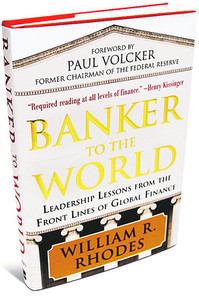
BankerToTheWorldBK.jpg

Source of book image: online version of the WSJ review quoted and cited below.

(p. A13) In “Banker to the World,” Mr. Rhodes tries to distil the “leadership lessons” he has learned from his remarkable career on the “front lines of global finance.”
. . .
. . . , Mr. Rhodes does succeed in hammering home three lessons that we need to take to heart if we are to have any chance of navigating the troubled waters that lie ahead. The first is that there is no substitute for the human touch: For all banking’s bells and whistles today, it is much the same business it was in Florentine Italy. Consider one of Mr. Rhodes’s greatest exploits: coordinating the rescue of Rupert Murdoch’s News Corp. from bankruptcy in 1990. Mr. Rhodes was worried that the collapse of Mr. Murdoch’s heavily-indebted media empire would tip the world economy back into recession. But he decided to bet on Mr. Murdoch only after the two had sat down for a three-hour heart-to-heart over dinner in New York.

For the full review, see:
ADRIAN WOOLDRIDGE. “BOOKSHELF; A Conspiracy of Hunches; A rare master of both the financial and political realms reports on what a half-century of experience taught him.” The Wall Street Journal (Weds., June 8, 2011): A15.
(Note: ellipsis added.)
(Note: online version of article had the date JULY 13, 2011.)

Book being reviewed:
Rhodes, William R. Banker to the World: Leadership Lessons from the Front Lines of Global Finance. New York: McGraw-Hill, 2011.

Robert Lucas Sees Lower Growth Due to Too Much Regulation and Taxes

(p. A15) Robert Lucas, the 1995 Nobel laureate in economics, has spent his career thinking about why economies grow, and in particular about the effect of policy making on growth. From his office at the University of Chicago, Prof. Lucas has been wondering, like the rest of us, why, if the recession officially ended in the first half of 2009, there hasn’t been more growth in the U.S. economy. He’s also been wondering why this delayed recovery resembles the long non-recovery years of the 1930s. And he has been thinking about the U.S. and Europe.

In May, Bob Lucas pulled his thoughts together and delivered them as the Milliman Lecture at the University of Washington, an exercise he described to me this week as “intelligent speculation.”
Here is the lecture’s provocative final thought: “Is it possible that by imitating European policies on labor markets, welfare and taxes, the U.S. has chosen a new, lower GDP trend? If so, it may be that the weak recovery we have had so far is all the recovery we will get.”
. . .
“If we’re going to move to a European welfare state,” says Prof. Lucas, “we’re going to have to pay a European price.” And that price could be a permanently lower level of GDP per person. The U.S.’s amazing 100-year ride would slow.
Among the many things any such drop in GDP will siphon away is America’s relentless productive vitality. “So much new happens in the United States,” Prof. Lucas says. But will it still?

For the full commentary, see:
DANIEL HENNINGER. “The Disappearing Recovery; What if the weak recovery is all the recovery we are going to get?” The Wall Street Journal (Thurs., JULY 14, 2011): A15.
(Note: ellipsis added.)
(Note: online version of article had the date JULY 13, 2011.)

To Succeed in the Car Business, It Helps if You Care about Cars

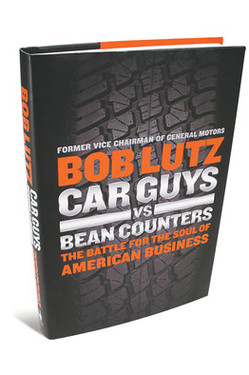
CarGuysBK.jpg

Source of book image: online version of the WSJ review quoted and cited below.

(p. B1) . . . , General Motors embarked on a series of initiatives to overcome both the perception and reality of the growing import threat. The 1950s and ’60s marked the decline of the “product guy” at GM and the ascendancy of “professional management,” often individuals with a strong financial background.

It’s not that senior GM management disliked cars. It was more an atmosphere of “benign neglect,” a generalized consensus that we were, after all, primarily in the business of making money, and cars were merely a transitory form of money: put a certain quantity in at the front end, transform it into vehicles, and sell them for more money at the other (p. B12) end. The company cared about “the other two ends”–minimizing cost and maximizing revenue–but assumed that customer desire for the product was a given.
Responsibility for creation of the right product was delegated to lower levels in the organization, often to people with little understanding of quality design or great driving characteristics. I maintain that without a passionate focus on great products from the top of the company on down, the “low cost” part will be assured but the “high revenue” part won’t happen, just as it didn’t at GM for so many years.

For the full excerpt, see:
Bob Lutz. “Japan’s Advantage and How the Cadillac Lost Its Shine.” The Wall Street Journal (Mon., JUNE 13, 2011): B1 & B12.
(Note: ellipsis added.)

The excerpt is excerpted from:
Lutz, Bob. Car Guys Vs. Bean Counters: The Battle for the Soul of American Business. New York: Portfolio, 2011.

Refuting Claims of Bread Adulteration

(p. 67) . . . : The Nature of Bread, Honestly and Dishonestly Made, by Joseph Manning, M.D., . . . reported that it was common for bakers to add bean meal, chalk, white lead, slaked lime, and bone ash to every loaf they made.

These assertions are routinely reported as fact, even though it was demonstrated pretty conclusively over seventy years ago by Frederick A. Filby, in his classic work Food Adulteration (1934), that the claims could not possibly be true. Filby took the interesting and obvious step of baking loaves of bread using the accused adulterants in the manner and proportions described. In every case but one the bread was either as hard as (p. 68) concrete or failed to set at all, and nearly all the loaves smelled or tasted disgusting. Several needed more baking time than conventional loaves and so were actually more expensive to produce. Not one of the adulterated loaves was edible.

Source:
Bryson, Bill. At Home: A Short History of Private Life. New York: Doubleday, 2010.
(Note: ellipses added; italics in original.)

Ralph Nader Blasts Cisco for NOT Maximizing Shareholder Value

(p. C1) Ralph Nader, the scourge of American business and onetime presidential candidate, has found his next corporate demon: Cisco Systems Inc.

Mr. Nader isn’t calling for a router recall or claiming the company’s networks are unsafe at any speed. Instead, he wants the tech company to pay a bigger dividend to boost its shares.
The consumer advocate’s motives are far from altruistic. He is a longtime disgruntled Cisco investor who called the company’s share performance “appalling.” In a private letter to Cisco Chief Executive John Chambers sent June 13, Mr. Nader blasted the CEO for not doing enough to lift shares of the technology company and said “it is time for a long overdue Cisco shareholder revolt against a management that is oblivious to building or even maintaining shareholder value,” according to the letter.
. . .
The 77-year-old Mr. Nader, who rose to fame in the 1960s on his claims that American automobiles were unsafe, admitted the letter is a departure from his typical antibusiness stance. He said he has been an “adversary of corporate capitalism,” but he is a believer in capitalism, so long as shareholders have a voice. He wrote the letter to Mr. Chambers, he said, because he objects to the “powerlessness of owner shareholders.”

For the full story, see:
SUSAN PULLIAM. “Nader Kindles Fires of Revolt.” The Wall Street Journal (Fri., JUNE 24, 2011): C1-C2.
(Note: ellipsis added.)

Findings “Strongly Suggest” Cholera in Haiti Due to United Nations

(p. 5A) PORT-AU-PRINCE, Haiti (AP) — Scientists have presented the strongest evidence yet that U.N. peacekeepers imported the chol­era strain that has killed more than 5,500 people in Haiti.
A report published in the July issue of the Emerging Infectious Diseases journal says research findings “strongly suggest” that the U.N. contingent from Nepal contaminated a Haitian river because of poor sanitation at a base. Author Renaud Piarroux had previously blamed peace­keepers. This study is more com­plete and its methodology was reviewed by other scientists.

Source:
AP. “U.N. may have brought cholera strain to Haiti.” Omaha World-Herald (Thursday, June 30, 2011): 5A.

Capitalism Was Not Inevitable

RelentlessRevolutionBK.jpg

Source of book image:
http://ecx.images-amazon.com/images/I/519PfT2oUtL.jpg

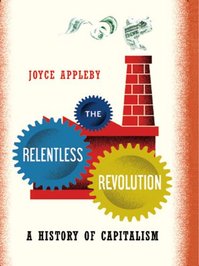
(p. 15) What is the nature of capitalism? For Joseph Schumpeter, the Austrian-born economist whose writings have acquired a special relevance in the past year or two, this most modern of economic systems “incessantly revolutionizes the economic structure from within, incessantly destroying the old one, incessantly creating a new one.” Capitalism, Schumpeter proclaimed, cannot stand still; it is a system driven by waves of entrepreneurial innovation, or what he memorably described as a “perennial gale of creative destruction.”

Schumpeter died in 1950, but his ghost looms large over Joyce Appleby’s splendid new account of the “relentless revolution” unleashed by capitalism from the 16th century onward. Appleby, a distinguished historian who has dedicated her career to studying the origins of capitalism in the Anglo-American world, here broadens her scope to take in the global history of capitalism in all its creative — and destructive — glory.
She begins “The Relentless Revolution” by noting that the rise of the economic system we call capitalism was in many ways improbable. It was, she rightly observes, “a startling departure from the norms that had prevailed for 4,000 years,” signaling the arrival of a new mentality, one that permitted private investors to pursue profits at the expense of older values and customs.
In viewing capitalism as an extension of a culture unique to a particular time and place, Appleby is understandably contemptuous of those who posit, in the spirit of Adam Smith, that capitalism was a natural outgrowth of human nature. She is equally scornful of those who believe that its emergence was in any way inevitable or inexorable.
. . .
. . . , she captures how a new generation of now forgotten economic writers active long before Adam Smith built a case “that the elements in any economy were negotiable and fluid, the exact opposite of the stasis so long desired.” This was a revolution of the mind, not machines, and it ushered in profound changes in how people viewed everything from usury to joint stock companies. As she bluntly concludes, “there can be no capitalism . . . without a culture of capitalism.”
. . .
The individual entrepreneur is at the center of her analysis, and her book offers thumbnail sketches of British innovators from James Watt to Josiah Wedgwood. She continues on to the United States and Germany, giving readers a whirlwind tour of the lives and achievements of a host of men whom she calls “industrial leviathans” — Vanderbilt, Rockefeller and Carnegie in the United States; Thyssen, Siemens and Zeiss in Germany. All created new industries while destroying old ones.

For the full review, see:
STEPHEN MIHM. “Capitalist Chameleon.” The New York Times Book Review (Sun., January 24, 2010): 15.
(Note: ellipses added except for the one in the “there can be no capitalism . . . without a culture of capitalism” quote.)
(Note: the online version of the review is dated January 22, 2010.)

Book under review:
Appleby, Joyce. The Relentless Revolution: A History of Capitalism. New York: W. W. Norton & Company, 2010.

Resistance to New Technology

(p. 59) . . . , not everyone was happy with the loss of open hearths. Many people missed the drifting smoke and were convinced they had been healthier when kept “well kippered in wood smoke,” as one observer put it. As late as 1577, a William Harrison insisted that in the days of open fires our heads did never ake.” Smoke in the roof space discouraged nesting birds and was believed to strengthen timbers. Above all, people complained that they weren’t nearly as warm as before, which was true. Because fireplaces were so inefficient, they were constantly enlarged. Some became so enormous that they were built with benches in them, letting people sit inside the fireplace, almost the only place in the house where they could be really warm.

Source:
Bryson, Bill. At Home: A Short History of Private Life. New York: Doubleday, 2010.
(Note: ellipsis added.)

Zuckerberg Has Most Followers on Google+

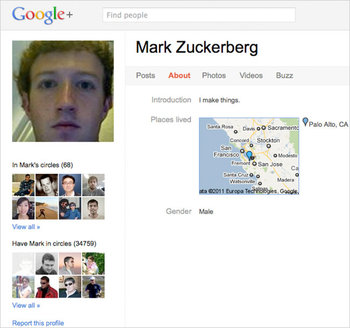
ZuckerbergGooglePlusPage2011-07-16.jpg

“The profile page of Mark Zuckerberg on Google+, a service created to compete with Facebook.” Source of caption and image: online version of the NYT article quoted and cited below.

(p. B1) Any guesses as to who is the most popular person on Google+, the company’s new social networking service? Ashton Kutcher, perhaps? Or Lady Gaga?

Actually, that title is currently held by Mark Zuckerberg, the founder and chief executive of Facebook — the very service that Google+ was meant to challenge.
As of Tuesday evening, Mr. Zuckerberg had nearly 35,000 people following his updates on the service, more than anyone else in a broad survey of Google+ profiles by Social Statistics, an outside service. His fan base exceeds that of Larry Page, one of the founders of Google and its recently appointed chief executive, who had only 24,000 people following him.
Google+ is less than a week old and is still not yet widely available to the public. But access to the service, which lets people share photos, links, status updates and video chats with groups of friends, is already in high demand among early adopters who are eager to play with its (p. B8) features. That includes Mr. Zuckerberg, who apparently signed up to keep tabs on his new adversary.

For the full story, see:
JENNA WORTHAM. “Zuckerberg Finds Fans on Google+.” The New York Times (Weds., July 5, 2011): B1 & B8.
(Note: the online version of the story is dated July 6, 2011.)

Cow Burps and Farts Cause 28% of Methane Release “Due to Human Activity”

(p. 6A) LOS ANGELES — Scientists have isolated a bacterium from the gut of Australian Tam­mar wallabies that allows the animals to consume and digest grasses, leaves and other plant material without producing co­pious amounts of methane, as cattle do.
The microbe was discovered through a process described in a report published online recently by the journal Science.
Ultimately, the microbe might be put to use to reduce the car­bon footprint of cows and other ruminants, said report co-author Mark Morrison, a microbial bi­ologist in St. Lucia, Queensland.
. . .
The methane-rich burps and flatulence of cattle have been blamed for 28 percent of that greenhouse gas’s global emis­sions due to human activity. Like other cud-chewing mammals, they produce methane as their systems work to break down and ferment the plant matter they eat.

For the full story, see:
THE LOS ANGELES TIMES. “Wallaby microbe may one day help cut cows’ methane footprint.” Omaha World-Herald (Monday, July 4, 2011): 6A.
(Note: ellipsis added.)