Heart Disease Is Not Just a Malady of Modern Societies, But “Is Part of the Human Condition”

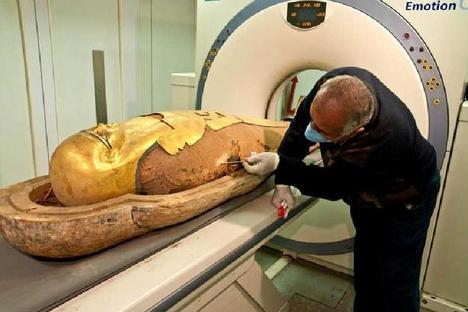
MummyScanHeartDisease2009-12-21.jpg“Scientists scanned 20 mummies, and examined scans of two more, for the study.” Source of caption and photo: online version of the WSJ article quoted and cited below.

(p. A5) ORLANDO, Fla. — Researchers said they found evidence of hardening of the arteries in Egyptian mummies dating as far back as 3,500 years, challenging longstanding assumptions that cardiovascular disease is mainly a malady of modern societies.

A team of heart-imaging experts and Egyptologists examined 22 mummies from the Egyptian National Museum of Antiquities in Cairo in a CT scanning machine, looking for evidence of calcium buildup that could indicate vascular disease.
They were able to identify the hearts, arteries or both in 16 of the mummies, nine of whom had deposits of calcification. An analysis determined the deposits were either definite or probable evidence of atherosclerosis, the condition that leads to heart attacks and strokes.
“Not only do we have atherosclerosis now, it was prevalent as long as 3,500 years ago,” said Gregory Thomas, a cardiologist and imaging specialist at University of California, Irvine, who was principal investigator of the study. “It is part of the human condition.”
The research was presented Tuesday at the American Heart Association scientific meeting here. A report is also scheduled to appear in Wednesday’s issue of the Journal of the American Medical Association.

For the full story, see:
RON WINSLOW. “Heart Disease Found in Egyptian Mummies.” The Wall Street Journal (Weds., NOVEMBER 18, 2009): A5.
(Note: the online version of the article has a date of NOVEMBER 19, 2009 and is titled “Heart Disease Found in Egyptian Mummies.”)

“Claims that Climate Change Is Accelerating Are Bizarre”

The author quoted below on global warming is a Professor of Meteorology at the Massachusetts Institute of Technology.

(p. A19) Is there a reason to be alarmed by the prospect of global warming? Consider that the measurement used, the globally averaged temperature anomaly (GATA), is always changing. Sometimes it goes up, sometimes down, and occasionally–such as for the last dozen years or so–it does little that can be discerned.

Claims that climate change is accelerating are bizarre. There is general support for the assertion that GATA has increased about 1.5 degrees Fahrenheit since the middle of the 19th century. The quality of the data is poor, though, and because the changes are small, it is easy to nudge such data a few tenths of a degree in any direction. Several of the emails from the University of East Anglia’s Climate Research Unit (CRU) that have caused such a public ruckus dealt with how to do this so as to maximize apparent changes.
The general support for warming is based not so much on the quality of the data, but rather on the fact that there was a little ice age from about the 15th to the 19th century. Thus it is not surprising that temperatures should increase as we emerged from this episode.

For the full commentary, see:
RICHARD S. LINDZEN. “The Climate Science Isn’t Settled; Confident predictions of catastrophe are unwarranted.” The Wall Street Journal (Tues., December 1, 2009): A19.
(Note: the online version of the commentary is dated NOVEMBER 30, 2009.)

Castro Agents Beat Up Cuban Blogger

SanchezYoaniCubanBlogger2009-12-19.jpg“Blogger Yoani Sánchez speaks at home in Havana on Monday, days after she says she was beaten by Cuban agents.” Source of caption and photo: online version of the WSJ article quoted and cited below.

(p. A14) Yoani Sánchez, Cuba’s most prominent dissident blogger, was walking along a Havana street last Friday along with two other bloggers and a friend when two men she says were Cuban agents in civilian clothes forced her inside an unmarked black car and beat her, telling her to stop criticizing the government.

The assault, believed to be the first against the growing blogger movement on the island, has cast a spotlight on the country’s record of repression, highlighting how little change there has been in political freedoms during the nearly three years since Raúl Castro took over as president from retired dictator Fidel Castro.
A decline in tourism revenues from the global recession and damage from several hurricanes last year have prompted the island’s government to clamp down even harder on dissent and freedom of speech, according to a recent report by the Inter American Press Association, a watchdog group.
The group said Cuba currently has 26 journalists in jail, and it cited 102 incidents against Cuban journalists in the past year, including beatings, arbitrary arrests and death threats.

For the full story, see:
DAVID LUHNOW. “Beating Rattles Cuban Bloggers.” The Wall Street Journal (Weds., NOVEMBER 11, 2009): A14.
(Note: the online version of the article is dated NOVEMBER 12, 2009.)

Entrepreneurial Innovation Comes from Diverse Outsiders Rather than Establishments

(p. 113) Firms that win by the curve of mind often abandon it when they establish themselves in the world of matter. They fight to preserve the value of their material investments in plant and equipment that embody the ideas and experience of their early years of success. They begin to exalt expertise and old knowledge, rights and reputation, over the constant learning and experience of innovative capitalism. They get fat.

A fat cat drifting off the curve, however, is a sitting duck for new nations and companies getting on it. The curve of mind thus tends to favor outsiders over establishments of all kinds. At the capitalist ball, the blood is seldom blue or the money rarely seasoned. Microcosmic technologies are no exception. Capitalism’s most lavish display, the microcosm, is no respecter of persons.
The United States did not enter the microcosm through the portals of the Ivy League, with Brooks Brothers suits, gentleman Cs, and warbling society wives. Few people who think they are in already can summon the energies to break in. From immigrants and outcasts, street toughs and science wonks, nerds and boffins, the bearded and the beer-bellied, the tacky and uptight, and sometimes weird, the born again and born yesterday, with Adam’s apples bobbing, psyches (p. 114) throbbing, and acne galore, the fraternity of the pizza breakfast, the Ferrari dream, the silicon truth, the midnight modem, and the seventy-hour week, from dirt farms and redneck shanties, trailer parks and Levittowns, in a rainbow parade of all colors and wavelengths, of the hyperneat and the sty high, the crewcut and khaki, the pony-tailed and punk, accented from Britain and Madras, from Israel and Malaya, from Paris and Parris Island, from Iowa and Havana, from Brooklyn and Boise and Belgrade and Vienna and Vietnam, from the coarse fanaticism and desperation, ambition and hunger, genius and sweat of the outsider, the downtrodden, the banished, and the bullied come most of the progress in the world and in Silicon Valley.

Source:

Gilder, George. Microcosm: The Quantum Revolution in Economics and Technology. Paperback ed. New York: Touchstone, 1990.

Castro’s “Absolute Personal Dictatorship” Denounced By Former Member of Cuban Inner Circle

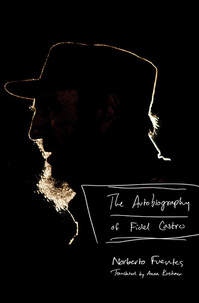
AutobiographyOfFidelCastroBK.jpg

Source of book image:
http://farm3.static.flickr.com/2575/4095461227_09463c5680.jpg

(p. C1) The plethora of dictators, despots and revolutionaries-turned-authoritarians south of the border has spawned a genre of literature that might be called the Latin American Strongman Novel — a genre that includes harrowing novels based on real historical figures, like Mario Vargas Llosa’s dazzling “Feast of the Goat” (which depicted Rafael Trujillo’s devastating rule over the Dominican Republic) and more mythic creations, like Gabriel García Márquez’s “Autumn of the Patriarch,” that have employed the sorcery of magical realism to conjure larger-than-life fictional tyrants in a panoply of ruthlessness, audacity and corruption.

The latest in this tradition of books is Norberto Fuentes’s fascinating new novel, “The Autobiography of Fidel Castro,” which purports to tell the longtime Cuban leader’s story in his own words. The “self-portrait” that emerges from these pages is that of a Machiavellian survivor: an egomaniac who identifies himself with the revolution but who is loyal not to a cause, not to an ideology, not to his compatriots, but only to his own ambition.
This Fidel is narcissistically longwinded, like his real-life counterpart. He is also a self-mythologizing change agent who succeeds in making himself “the neurological center of an entire nation” — a wily Nietzschean operator who believes in the force of his own will, while sensing that “the chameleon is going to last longer under his rock than the lion, despite its roaring and lean muscles.” He is a cynical master of manipulation and strategic maneuvering, a skilled practitioner of the black arts of propaganda and gamesmanship who always wants “to keep people guessing.”
A journalist and Hemingway (p. C7) scholar, Mr. Fuentes was once a cheerleader of the revolution and part of Mr. Castro’s inner circle himself. He grew disillusioned with the Cuban leader, however, after two army officers were executed in 1989 on what many believe were trumped-up charges. Mr. Fuentes fell out of favor, came under government surveillance and was detained after a failed attempt to flee Cuba by boat. After a hunger strike and the intervention of Mr. García Márquez, he was allowed to leave the country in 1994, and has since denounced Mr. Castro for his “absolute personal dictatorship” and willingness “to do anything necessary to stay in power.”

For the full story, see:
MICHIKO KAKUTANI. “Books of The Times; Fiction Trying for Truth in Novel’s View of Dictator.” The New York Times (Tues., December 15, 2009): C1 & C7.
(Note: the online version of the article is dated Mon., December 14, 2009.)

FuentesNorberto2009-12-19.jpg

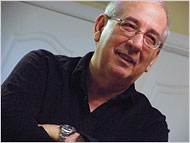
“Norberto Fuentes” Source of caption and photo: online version of the NYT article quoted and cited above.

Global Warming Climatologist Leaves Post Due to His “Efforts to Keep the Work of Skeptical Scientists Out of Major Journals”

(p. A6) The head of the British research unit at the center of a controversy over the disclosure of thousands of e-mail messages among climate-change scientists has stepped down pending the outcome of an investigation.

Phil Jones, the director of the Climatic Research Unit at the University of East Anglia in England, said that he would leave his post while the university conducted a review of the release of the e-mail messages. The university has called the release and publication of the messages a “criminal breach” of the school’s computer systems.
The e-mail exchanges among several prominent American and British climate-change scientists appear to reveal efforts to keep the work of skeptical scientists out of major journals and the possible hoarding and manipulation of data to overstate the case for human-caused climate change.
In a related announcement, Pennsylvania State University said it would review the work of a faculty member who is cited prominently in the e-mail messages, Michael Mann, to assure that it meets proper academic standards.

For the full story, see:

JOHN M. BRODER. “Climatologist Leaves Post in Inquiry Over Leaks.” The Wall Street Journal (Weds., December 2, 2009): A6.

(Note: the online version of the article is dated December 1, 2009 and has the slightly different title “Climatologist Leaves Post in Inquiry Over E-Mail Leaks.”)

“When the Sons of the Communists Themselves Wanted to Become Capitalists and Entrepreneurs”

JanicekJosefPlasticPeople2009-12-19.jpg“Josef Janicek, 61, was on the keyboard for a concert in Prague last week by the band Plastic People of the Universe.” Source of caption and photo: online version of the NYT article quoted and cited below.

(p. A10) PRAGUE — It has been called the Velvet Revolution, a revolution so velvety that not a single bullet was fired.

But the largely peaceful overthrow of four decades of Communism in Czechoslovakia that kicked off on Nov. 17, 1989, can also be linked decades earlier to a Velvet Underground-inspired rock band called the Plastic People of the Universe. Band members donned satin togas, painted their faces with lurid colors and wrote wild, sometimes angry, incendiary songs.
It was their refusal to cut their long, dank hair; their willingness to brave prison cells rather than alter their darkly subversive lyrics (“peace, peace, peace, just like toilet paper!”); and their talent for tapping into a generation’s collective despair that helped change the future direction of a nation.
“We were unwilling heroes who just wanted to play rock ‘n’ roll,” said Josef Janicek, 61, the band’s doughy-faced keyboard player, who bears a striking resemblance to John Lennon and still sports the grungy look that once helped get him arrested. “The Bolsheviks understood that culture and music has a strong influence on people, and our refusal to compromise drove them insane.”
. . .
In 1970, the Communist government revoked the license for the Plastics to perform in public, forcing the band to go underground. In February 1976, the Plastic People organized a music festival in the small town of Bojanovice — dubbed “Magor’s Wedding” — featuring 13 other bands. One month later, the police set out to silence the musical rebels, arresting dozens. Mr. Janicek was jailed for six months; Mr. Jirous and other band members got longer sentences.
Mr. Havel, already a leading dissident, was irate. The trial of the Plastic People that soon followed became a cause célèbre.
Looking back on the Velvet Revolution they helped inspire, however indirectly, Mr. Janicek recalled that on Nov. 17, 1989, the day of mass demonstrations, he was in a pub nursing a beer. He argued that the revolution had been an evolution, fomented by the loosening of Communism’s grip under Mikhail Gorbachev and the overwhelming frustration of ordinary people with their grim, everyday lives. “The Bolsheviks knew the game was up,” he said, “when the sons of the Communists themselves wanted to become capitalists and entrepreneurs.”

For the full story, see:
DAN BILEFSKY. “Czechs’ Velvet Revolution Paved by Plastic People.” The New York Times (Mon., November 16, 2009): A10.
(Note: the online version of the article is dated November 15, 2009.)
(Note: ellipsis added.)

Intel’s Computer-on-a-Chip “Was Achieved Largely by Immigrants from Hungary, Italy, Israel, and Japan”

(p. 111) By launching the computer-on-a-chip, Intel gave America an enduring advantage in this key product in information technology–an edge no less significant because it was achieved largely by immigrants from Hungary, Italy, Israel, and Japan. Intel’s three innovations of 1971–plus the silicon gate process that made them the smallest, fastest, and best-selling devices in the industry–nearly twenty years later remain in newer versions the most powerful force in electronics.

Source:

Gilder, George. Microcosm: The Quantum Revolution in Economics and Technology. Paperback ed. New York: Touchstone, 1990.

Doctorow’s “Makers” Novel Paints Unrealistically Bleak View of Life with Creative Destruction

MakersBK.jpg

Source of book image: http://www.globalnerdy.com/wordpress/wp-content/uploads/2009/11/makers.jpg

Awhile back I mentioned a science fiction book that made use of the process of creative destruction. Here’s a discussion of another one—called Makers, it apparently adopts the unlikely premise that a world of creative destruction would have a 20% unemployment rate. (I say “unlikely” because the evidence is that in a world of creative destruction, as many new jobs are created as old ones are destroyed.)

(p. A19) Consider the world of “Makers,” the latest by best-selling writer Cory Doctorow. This novel is set in a not-too distant future, when the creative destruction of technological change has created an economy so efficient, with profit margins so thin, that traditional companies can hardly stay in business.

The inventor-heroes of “Makers” take technology to its conclusion: They figure out a way to use three-dimensional printers to produce copies of machines and most anything else at close to no cost. This sparks “New Work,” with geeky investment bankers scouring the country to fund promising artisans who use the technology to build things cheaply. The heroes also run a series of entertainment rides across the country in abandoned Wal-Marts, until Disney unleashes its lawyers on them.
Mr. Doctorow, a Canadian living in London, has a keen eye for the pressures on contemporary business. In the novel, an M.B.A. brought in to work with the inventors explains, “The system makes it hard to sell anything above the marginal cost of goods, unless you have a really innovative idea, which can’t stay innovative for long, so you need continuous invention and reinvention, too.”
. . .
In the world of “Makers,” and perhaps in our own world, “we’re approaching a kind of pure and perfect state now, with competition and invention getting easier and easier–it’s producing a kind of superabundance.”
Mr. Doctorow paints a bleak picture of the process of getting there, even if many of us take a more benign view of increasingly efficient capitalism. “Makers” features widespread unemployment, with 20% of workers relocating to look for jobs. Even with scientific advances–obesity is solved, for example–life is brutal. There are squatter neighborhoods alongside abandoned strip malls.

For the full story, see:

L. GORDON CROVITZ. “Technology Is Stranger Than Fiction; Best-selling writer Cory Doctorow on change and its discontents.” The Wall Street Journal (Mon., NOVEMBER 23, 2009): A19.

(Note: ellipsis added.)

Emails Vindicate Skeptics Who Questioned Scientific Basis of Global Warming

(p. A1) Just two years ago, a United Nations panel that synthesizes the work of hundreds of climatologists around the world called the evidence for global warming “unequivocal.”

But as representatives of about 200 nations converge in Copenhagen on Monday to begin talks on a new international climate accord, they do so against a background of renewed attacks on the basic science of climate change.
The debate, set off by the circulation of several thousand files and e-mail messages stolen from one of the world’s foremost climate research institutes, has led some who oppose limits on greenhouse gas emissions, and at least one influential country, Saudi Arabia, to question the scientific basis for the Copenhagen talks.
The uproar has threatened to complicate a multiyear diplomatic effort already ensnared in difficult political, technical and financial disputes that have caused leaders to abandon hopes of hammering out a binding international climate treaty this year.
. . .
(p. A8) On dozens of Web sites and blogs, skeptics and foes of greenhouse gas restrictions take daily aim at the scientific arguments for human-driven climate change. The stolen material was quickly seized upon for the questions it raised about the accessibility of raw data to outsiders and whether some data had been manipulated.
An investigation into the stolen files is being conducted by the University of East Anglia, in England, where the computer breach occurred. Rajendra K. Pachauri, chairman of the United Nations Intergovernmental Panel on Climate Change, has also said he will look into the matter. At the same time, polls in the United States and Britain suggest that the number of people who doubt that global warming is dangerous or caused by humans has grown in recent years.
. . .
Science is about probability, not certainty. And the persisting uncertainties in climate science leave room for argument. What is a realistic estimate of how much temperatures will rise? How severe will the effects be? Are there tipping points beyond which the changes are uncontrollable?
Even climate scientists disagree on many of these questions. But skeptics have been critical of the data assembled to show that warming is occurring and the analytic methods that climate scientists use, including mathematical models used to demonstrate a human cause for warming and project future trends.
Both sides also have at times been criticized for overstatement in characterizing the scientific evidence. The contents of the stolen e-mail messages and documents have given fresh ammunition to the skeptics’ camp.
The Climatic Research Unit’s role as a central aggregator of temperature and other climate data has also made it a target. One widely discussed file extracted from the unit’s computers, presumed to be the log of a researcher named Ian Harris, recorded his years of frustration in trying to make sense of disparate data and described procedures — or “fudge factors,” as he called them — used by scientists to eliminate known sources of error.

For the full story, see:
ANDREW C. REVKIN and JOHN M. BRODER. “Facing Skeptics, Climate Experts Sure of Peril.” The New York Times (Mon., December 7, 2009): A1 & A8.
(Note: the online version of the article is dated Sun., December 6, 2009 and has the title “In Face of Skeptics, Experts Affirm Climate Peril.”)
(Note: ellipses added.)

Note: the online version of the article includes the following, very interesting, correction of the print version:
Correction: December 15, 2009
Because of an editing error, an article on Dec. 7 about the scientific evidence supporting global warming overstated the level of certainty expressed in a 2007 report by the Intergovernmental Panel on Climate Change, a network of scientists, that human-caused warming was under way and, if unabated, would pose rising risks. The panel said that most warming since 1950 was “very likely” caused by humans, not that there was “no doubt.” The article also misidentified the temperature data cited by a scientist at the University of East Anglia’s Climatic Research Unit who had expressed frustration in a log about trying to make sense of disparate data. The data was direct measurements of temperature, not indirect indicators like the study of tree rings.

(Note: italics and bold in original.)

Emails Reveal Global Warming Scientists Exclude Contrary Views

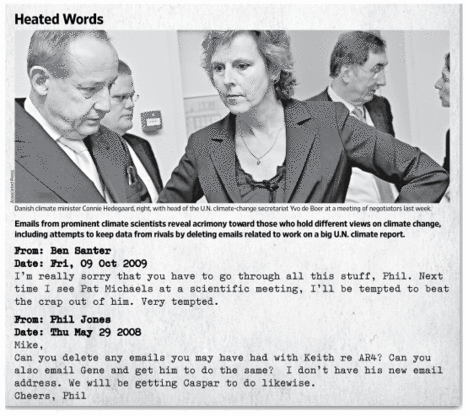
ClimateGateEmails.gifSource of photo and email images: online version of the WSJ article quoted and cited below.
One can imagine Michael Crichton looking down on us with a sad smile:

(p. A3) The scientific community is buzzing over thousands of emails and documents — posted on the Internet last week after being hacked from a prominent climate-change research center — that some say raise ethical questions about a group of scientists who contend humans are responsible for global warming.

The correspondence between dozens of climate-change researchers, including many in the U.S., illustrates bitter feelings among those who believe human activities cause global warming toward rivals who argue that the link between humans and climate change remains uncertain.
Some emails also refer to efforts by scientists who believe man is causing global warming to exclude contrary views from important scientific publications.
“This is horrible,” said Pat Michaels, a climate scientist at the Cato Institute in Washington who is mentioned negatively in the emails. “This is what everyone feared. Over the years, it has become increasingly difficult for anyone who does not view global warming as an end-of-the-world issue to publish papers. This isn’t questionable practice, this is unethical.”
John Christy, a scientist at the University of Alabama at Huntsville attacked in the emails for asking that an IPCC report include dissenting viewpoints, said, “It’s disconcerting to realize that legislative actions this nation is preparing to take, and which will cost trillions of dollars, are based upon a view of climate that has not been completely scientifically tested–but rather orchestrated.”
In all, more than 1,000 emails and more than 2,000 other documents were stolen Thursday from the Climate Research Unit at East Anglia University in the U.K. The identity of the hackers isn’t certain, but the files were posted on a Russian file-sharing server late Thursday, and university officials confirmed over the weekend that their computer had been attacked and said the documents appeared to be genuine.
. . .
In one email, Benjamin Santer from the Lawrence Livermore National Laboratory in Livermore, Calif., wrote to the director of the climate-study center that he was “tempted to beat” up Mr. Michaels. Mr. Santer couldn’t be reached for comment Sunday.
In another, Phil Jones, the director of the East Anglia climate center, suggested to climate scientist Michael Mann of Penn State University that skeptics’ research was unwelcome: We “will keep them out somehow — even if we have to redefine what the peer-review literature is!” Neither man could be reached for comment Sunday.

For the full story, see:
KEITH JOHNSON. “Climate Strife Comes to Light; Emails Illustrate Anger of Scientists Who Believe Humans Are Root of Global Warming.” The Wall Street Journal (Mon., NOVEMBER 23, 2009): A3.
(Note: ellipsis added.)
(Note: the printed version of the article is mostly the same as the online version, but has some differences in order and content. The part quoted above is consistent with the printed version. The passages quoted are the same in both versions, except that the paragraph on the views of John Christy appears later in the online version, and the online version omits his phrase “but rather orchestrated.” [I skimmed for differences, but am not absolutely sure that I caught them all.])
(Note: the title of the online version of the article is: “Climate Emails Stoke Debate; Scientists’ Leaked Correspondence Illustrates Bitter Feud over Global Warming.”)