Drinking Water Not Harmed by Fracking

(p. A13) Fracking isn’t causing widespread damage to the nation’s drinking water, the Obama administration said in a long-awaited report released Thursday.
The U.S. Environmental Protection Agency–after a four-year study that is the U.S. government’s most comprehensive examination of the issue to date–concluded that hydraulic fracturing, as being carried out by industry and regulated by states, isn’t having “widespread, systemic impacts on drinking water.”

For the full story, see:
RUSSELL GOLD And AMY HARDER. “Fracking’s Harm to Water Not Widespread, EPA Says.” The Wall Street Journal (Fri., June 5, 2015): A5.
(Note: the date of the online version of the story is June 4, 2015, and has the title “Fracking Has Had No ‘Widespread’ Impact on Drinking Water, EPA Finds.”)

Environment Experts Admit Obama Policies Are Expensive, Ineffective and May Make Environment Worse

(p. B1) Is the American approach to combating climate change going off the rails?
Last year, President Obama set a goal of reducing carbon emissions by as much as 28 percent from 2005 levels by 2025, only 10 years from now.
Now, environmental experts are suggesting that some parts of the strategy are, at best, a waste of money and time. At worst, they are setting the United States in the wrong direction entirely.
That is the view of some of the world’s top environmental organizations, including Greenpeace, Friends of the Earth and the Sierra Club. On Tuesday, they argued in a letter to the White House that allowing the burning of biomass to help reduce consumption of fossil fuels in the nation’s power plants, as proposed by the Environmental Protection Agency, would violate the Clean Air Act.
It’s also the view of economists from the University of Chicago and the University of California, Berkeley, who on Tuesday released the disappointing results of a field test of the federal Weatherization Assistance Program, the government’s largest effort to improve residential energy efficiency.
It turns out that burning biomass — wood, mainly — for power produces 50 percent more CO2 than burning coal. And even if new forest growth were to eventually suck all of it out of the atmosphere, it would take decades — perhaps more than a century — to make up the difference and break even with coal.
One study commissioned by the state of Massachusetts concluded that the climate impacts of burning wood were worse than those for coal for 45 years, and (p. B8) worse than for natural gas for about 90 years. Humans do not have that kind of time.
The energy efficiency push has a different problem: It is much too expensive. The weatherization improvements cost more than twice as much as households’ energy savings. Even after including the broad social benefits from less pollution, it was still a bad deal. Indeed, the program spent $329 per ton of CO2 it kept out of the air, some eight times as much as the administration’s estimate of the social cost of damages caused by carbon.
These are not small setbacks. Most of the scenarios that keep the rise in global temperatures under a 2 degree Celsius ceiling, the point at which scientists fear the risk of climate upheaval rises significantly, rely heavily on bioenergy, including biomass for power generation and other biofuels, which face similar problems.

For the full commentary, see:
Eduardo Porter. “ECONOMIC SCENE; Climate Change Calls for Science, Not Hope.” The New York Times (Sun., JUNE 24, 2015): B1 & B8.
(Note: the date of the online version of the commentary is JUNE 23, 2015, and has the title “ECONOMIC SCENE; Climate Change Calls for Science, Not Hope.”)

The letter to the Obama administration from many environmental organizations, including Friends of the Earth, Greenpeace and the Sierra Club, is:
http://www.pfpi.net/wp-content/uploads/2015/06/Groups-bioenergy-letter-to-OMB-6-23-15.pdf

The research mentioned above by economists from Berkeley and the University of Chicago, is:
Fowlie, Meredith, Michael Greenstone, and Catherine Wolfram. “Do Energy Efficiency Investments Deliver? Evidence from the Weatherization Assistance Program.” Working Paper, The Becker-Friedman Institute for Research in Economics, The University of Chicago, June 2015.

The research mentioned above that was commissioned by the state of Massachusetts, is:
Walker, Thomas , Dr. Peter Cardellichio, Andrea Colnes, Dr. John Gunn, Brian Kittler, Bob Perschel, Christopher Recchia, and Dr. David Saah. “Biomass Sustainability and Carbon Policy Study, Executive Summary.” Manomet, MA: Manomet Center for Conservation Sciences, June 2010.

Mathematician Says Mathematical Models Failed

The author of the commentary quoted below is a professor of mathematics at the Baltimore County campus of the University of Maryland.

(p. 4) . . . , in a fishery, the maximum proportion of a population earmarked each year for harvest must be set so that the population remains sustainable.

The math behind these formulas may be elegant, but applying them is more complicated. This is especially true for the Chesapeake blue crabs, which have mostly been in the doldrums for the past two decades. Harvest restrictions, even when scientifically calculated, are often vociferously opposed by fishermen. Fecundity and survival rates — so innocuous as algebraic symbols — can be difficult to estimate. For instance, it was long believed that a blue crab’s maximum life expectancy was eight years. This estimate was used, indirectly, to calculate crab mortality from fishing. Derided by watermen, the life expectancy turned out to be much too high; this had resulted in too many crab deaths being attributed to harvesting, thereby supporting charges of overfishing.
In fact, no aspect of the model is sacrosanct — tweaking its parameters is an essential part of the process. Dr. Thomas Miller, director of the Chesapeake Biological Laboratory at the University of Maryland Center for Environmental Science, did just that. He found that the most important factor for raising sustainability was the survival rate of pre-reproductive-age females. This was one reason, in 2008, after years of failed measures to increase the crab population, regulatory agencies switched to imposing restrictions primarily on the harvest of females.    . . .
The results were encouraging: The estimated population rose to 396 million in 2009, from 293 million in 2008. By 2012, the population had jumped to 765 million, and the figure was announced at a popular crab house by Maryland’s former governor, Martin O’Malley, himself.
Unfortunately, the triumph was short-lived — the numbers plunged to 300 million the next year and then hit 297 million in 2014. Some blamed a fish called red drum for eating young crabs; others ascribed the crash to unusual weather patterns, or the loss of eel grass habitat. Although a definitive cause has yet to be identified, one thing is clear: Mathematical models failed to predict it.

For the full commentary, see:
Manil Suri. “Mathematicians and Blue Crabs.” The New York Times, SundayReview Section (Sun., MAY 3, 2015): 4.
(Note: ellipses added.)
(Note: the date of the online version of the commentary is MAY 2, 2015.)

Genius Physicist Dyson: Global Warming Is a Religion Where Belief Is Strong, Evidence Weak

(p. 8) On to controversial topics: What books would you recommend on climate science? On the relationship between science and religion?
On climate science, I recommend “Cool It: The Skeptical Environmentalist’s Guide to Global Warming,” by Bjorn Lomborg. On science and religion, “The Varieties of Religious Experience,” by William James. Lomborg is an economist, and James was a psychologist. Both books were written by skeptics, with understanding and respect for the beliefs that they were questioning. The reason why climate science is controversial is that it is both a science and a religion. Belief is strong, even when scientific evidence is weak.

For the full interview, see:
“Freeman Dyson: By the Book.” The New York Times Book Review (Sun., April 16, 2015): 8.
(Note: bold in original.)
(Note: the online version of the interview has the date April 19, 2015.)

The Lomborg book recommended by Dyson, is:
Lomborg, Bjørn. Cool It: The Skeptical Environmentalist’s Guide to Global Warming. New York: Alfred A. Knopf, 2007.

Obama’s Harvard Constitutional Law Professor Likens Obama’s Climate Change Policies to “Burning the Constitution”

(p. A1) WASHINGTON — Laurence H. Tribe, the highly regarded liberal scholar of constitutional law, still speaks of President Obama as a proud teacher would of a star student. “He was one of the most amazing research assistants I’ve ever had,” Mr. Tribe said in a recent interview. Mr. Obama worked for him at Harvard Law School, where Mr. Tribe has taught for four decades.
. . .
Next week Mr. Tribe is to deliver oral arguments for Peabody in the first federal court case about Mr. Obama’s climate change rules. Mr. Tribe argues in a brief for the case that in requiring states to cut carbon emissions, thus to change their energy supply from fossil fuels to renewable sources, the E.P.A. is asserting executive power far beyond its lawful authority under the Clean Air Act. At a House hearing last month, Mr. Tribe likened the climate change (p. A15) policies of Mr. Obama to “burning the Constitution.”
. . .
While Mr. Tribe is one of the nation’s foremost experts on constitutional law, and has argued some Supreme Court cases related to environmental law, he said he has never specialized in the Clean Air Act.
. . .
It is widely expected that the fight over the E.P.A. regulations will eventually go before the Supreme Court. If it does, Mr. Tribe said that he expects he “may well” play a role in that case — which would be argued before two other former students, Chief Justice John G. Roberts Jr. and Justice Elena Kagan.

For the full story, see:
CORAL DAVENPORT. “Laurence Tribe Fights Climate Case Against Star Pupil From Harvard, President Obama.” The New York Times (Tues., APRIL 7, 2015): A1 & A15.
(Note: ellipses added.)
(Note: the online version of the story has the date APRIL 6, 2015, and has the title “Laurence Tribe Fights Climate Case Against Star Pupil From Harvard, President Obama.”)

Penguin “Bellwether of Climate Change” Thriving in Antarctica

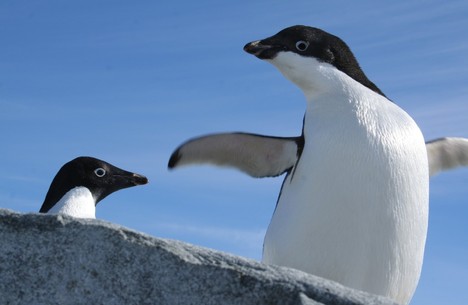
AdeilePenguinsThriving2015-03-16.jpg “Rather than declining as feared, the Adélie penguin population generally is on the rise, scientists say.” Source of caption and photo: online version of the WSJ article quoted and cited below.

(p. A3) For the first time, researchers have counted all the world’s Adélie penguins–a sprightly seabird considered a bellwether of climate change–and discovered that millions of them are thriving in and around Antarctica.
Rather than declining as feared due to warming temperatures that altered their habitats in some areas, the Adélie population generally is on the rise, the scientists said Thursday.
“What we found surprised everyone,” said ecologist Heather Lynch at Stony Brook University in Stony Brook, N.Y., who led the penguin census. “We found a 53% increase in abundance globally.”
Counting the birds by satellite, Dr. Lynch and imaging specialist Michelle LaRue at the University of Minnesota found that the Adélie penguin population now numbers 3.79 million breeding pairs–about 1.1 million more pairs than 20 years ago. In all, they identified 251 penguin colonies and surveyed 41 of them for the first time, including 17 apparently new colonies.

For the full story, see:
ROBERT LEE HOTZ. “Antarctic Penguins Thrive.” The Wall Street Journal (Fri., July 11, 2014): A3.
(Note: the online version of the story has the date July 10, 2014, and has the title “Adélie Penguin Census Shows Seabirds Are Thriving.”)

Climate Skeptic Vilified by Mainstream Establishment

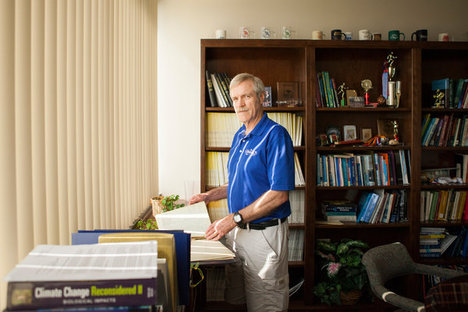
ChristyJohnClimateSkeptic2015-03-15.jpg“John Christy, a professor of atmospheric science at the University of Alabama, Huntsville, with the weather data he recorded daily while growing up in Fresno, Calif., in the 1960s.” Source of caption and photo: online version of the NYT article quoted and cited below.

(p. A14) “I detest words like ‘contrarian’ and ‘denier,’ ” he said. “I’m a data-driven climate scientist. Every time I hear that phrase, ‘The science is settled,’ I say I can easily demonstrate that that is false, because this is the climate — right here. The science is not settled.”

Dr. Christy was pointing to a chart comparing seven computer projections of global atmospheric temperatures based on measurements taken by satellites and weather balloons. The projections traced a sharp upward slope; the actual measurements, however, ticked up only slightly.
Such charts — there are others, sometimes less dramatic but more or less accepted by the large majority of climate scientists — are the essence of the divide between that group on one side and Dr. Christy and a handful of other respected scientists on the other.
“Almost anyone would say the temperature rise seen over the last 35 years is less than the latest round of models suggests should have happened,” said Carl Mears, the senior research scientist at Remote Sensing Systems, a California firm that analyzes satellite climate readings.
“Where the disagreement comes is that Dr. Christy says the climate models are worthless and that there must be something wrong with the basic model, whereas there are actually a lot of other possibilities,” Dr. Mears said. Among them, he said, are natural variations in the climate and rising trade winds that have helped funnel atmospheric heat into the ocean.
. . .
. . . , Dr. Christy argues that reining in carbon emissions is both futile and unnecessary, and that money is better spent adapting to what he says will be moderately higher temperatures.
. . .
. . . while his work has been widely published, he has often been vilified by his peers.
. . .
He says he worries that his climate stances are affecting his chances of publishing future research and winning grants. The largest of them, a four-year Department of Energy stipend to investigate discrepancies between climate models and real-world data, expires in September.
“There’s a climate establishment,” Dr. Christy said. “And I’m not in it.”

For the full story, see:
MICHAEL WINES. “Though Scorned by Colleagues, a Climate-Change Skeptic Is Unbowed.” The New York Times (Weds., JULY 16, 2014): A14.
(Note: ellipses added.)
(Note: the online version of the story has the date JULY 15, 2014.)

Fishing with Mosquito Nets, Where Food Is the Binding Constraint

(p. 1) BANGWEULU WETLANDS, Zambia — Out here on the endless swamps, a harsh truth has been passed down from generation to generation: There is no fear but the fear of hunger.
With that always weighing on his mind, Mwewa Ndefi gets up at dawn, just as the first orange rays of sun are beginning to spear through the papyrus reeds, and starts to unclump a mosquito net.
Nets like his are widely considered a magic bullet against malaria — one of the cheapest and most effective ways to stop a disease that kills at least half a million Africans each year. But Mr. Ndefi and countless others are not using their mosquito nets as global health experts have intended.
Nobody in his hut, including his seven children, sleeps under a net at night. Instead, Mr. Ndefi has taken his family’s supply of anti-malaria nets and sewn them together into a gigantic sieve that he uses to drag the bottom of the swamp ponds, sweeping up all sorts of life: baby catfish, banded tilapia, tiny mouthbrooders, orange fish eggs, water bugs and the occasional green frog.
“I know it’s not right,” Mr. Ndefi said, “but without these nets, we wouldn’t eat.”
Across Africa, from the mud flats of Nigeria to the coral reefs off Mozambique, mosquito-net fishing is a growing problem, an unintended consequence of one of the biggest and most celebrated public health campaigns in recent years.
The nets have helped save millions of lives, but scientists worry about the collateral damage: Africa’s fish.
. . .
“The nets go straight out of the bag into the sea,” said Isabel Marques da Silva, a marine biologist at Universidade Lúrio in Mozambique. “That’s why the inci-(p. 10)dence for malaria here is so high. The people don’t use the mosquito nets for mosquitoes. They use them to fish.”
But the unsparing mesh, with holes smaller than mosquitoes, traps much more life than traditional fishing nets do. Scientists say that could imperil already stressed fish populations, a critical food source for millions of the world’s poorest people.
. . .
In many places, fish are dried for hours in direct sunlight on treated mosquito nets. Direct sunlight can break down the insecticide coating. Anthony Hay, an associate professor of environmental toxicology at Cornell University, said fish could absorb some of the toxins, leaving people to ingest them when they eat the fish.
“It’s just another one of these ‘white man’s burdens,’ ” Mr. Hay said, referring to William Easterly’s well-known book critical of foreign aid by the West. “We think we have a solution to everybody’s problems, and here’s an example of where we’re creating a new problem.”
. . .
For Mr. Ndefi, it is a simple, if painful, matter of choice. He knows all too well the dangers of malaria. His own toddler son, Junior, died of the disease four years ago. Junior used to always be there, standing outside his hut, when Mr. Ndefi came home from fishing.
Mr. Ndefi hopes his family can survive future bouts of the disease. But he knows his loved ones will not last long without food.

For the full story, see:
JEFFREY GETTLEMAN. “Meant to Keep Mosquitos Out, Nets Are Used to Haul Fish In.” The New York Times, First Section (Sun., JAN. 25, 2015): 1 & 10.
(Note: ellipses are added.)
(Note: the online version of the story has the date JAN. 24, 2015, and has the title “Meant to Keep Malaria Out, Mosquito Nets Are Used to Haul Fish In.”)

The book referenced by Professor Hay, is:
Easterly, William. The White Man’s Burden: Why the West’s Efforts to Aid the Rest Have Done So Much Ill and So Little Good. New York: The Penguin Press, 2006.

“In Nebraska, You Don’t Have to Die to Go to Hell”

A 1939 entry from Don Hartwell’s diary:

(p. 300) July 10
The same clear, glaring sky & vicious blazing killing sun. Cane is about dead, corn is being damaged; it will soon be destroyed. Those who coined the phrase ‘There’s no place like Nebraska’ wrote better than they thought. In Nebraska, you don’t have to die to go to hell.

Source:
As quoted in: Egan, Timothy. The Worst Hard Time: The Untold Story of Those Who Survived the Great American Dust Bowl. Boston: Houghton Mifflin, 2006.
(Note: italics in original.)

Private Power Lights the Darkness

(p. A10) NUSEIRAT CAMP, Gaza Strip–It was just after sunset when the power went out in this Palestinian refugee camp. Within seconds, Ali al-Majdalawi flipped a switch on a blue generator in his backyard and the lights in 500 homes flickered back on again.
The 64-year-old patriarch runs what he calls the A. Majdalawi Electricity Co., a pop-up utility that consists of three generators and a spider’s web of power lines radiating from an empty lot he owns in the camp.
Mr. Majdalawi has no license to operate his company. But he does have an invoice pad at the ready and boasts a long list of customers including five mosques, a library and a police station.
. . .
Along with three partners, Mr. Majdalawi, a retired school official for the U.N., invested $80,000 of their savings to buy several diesel-powered generators two years ago and set about building their own power-delivery network.
The community of about 65,000 began in 1948, the year of Israel’s creation, when hundreds of families displaced by war between Jews and Arabs set up rows of temporary dwellings. Decades later, the refugees and their descendants still live here, tightly packed among schools run by the United Nations and a cemetery built into a sand dune at the center of town.
Because his company is private, Mr. Majdalawi couldn’t use municipal power polls to string up lines. He and his sons asked neighbors to let them use the walls of their homes for the wiring and allow crews to come in for periodic maintenance.
In most other respects, the business runs much like any other electricity company. Customers apply to join the grid and if approved, one of Mr. Majdalawi’s sons enters their names into a computer for monthly billing. Most clients request two amperes, enough to run lights, a television and a computer during blackouts. The price is 120 shekels a month, about $30.
“It is an alternate grid,” explained Mr. Majdalawi’s son, Rafet, the company’s chief accountant.
Deya Shaheen, a 25-year-old barber, said Mr. Majdalawi’s electricity has kept his year-old shop in business. The electric razors and the lights he uses to light the shop when customers drop in at night are powered on the three amperes he receives from the grid.On many nights, his shop is filled with young men looking for somewhere to watch soccer matches on television.
“Look, the power thing destroys your life,” he said. “People go to bed early not because they are sleepy, but because there is no power. There is nothing to do, no TV, no Internet. It is just dark.”

For the full story, see:
NICHOLAS CASEY. “Entrepreneur Fills in Gaza Electricity Gap; Palestinian Territory’s One Power Plant Meets Barely a Quarter of Demand, Posing an Obstacle in Reconstruction Efforts.” The Wall Street Journal (Weds., DEC. 24, 2014): A10.
(Note: ellipsis added.)
(Note: the online version of the story has the date DEC. 23, 2014, and has the title “Entrepreneur Fills in Gaps in Gaza Electricity Supplies; Palestinian Territory’s One Power Plant Meets Barely a Quarter of Demand.”)

The Federal Government’s “Arrogance on a Grand Scale” Encouraged the Dust Bowl

(p. 126) In the last years of the wheat boom, Bennett had become increasingly frustrated at how the government seemed to be encouraging an exploitive farming binge. He went directly after his old employer, the Department of Agriculture, for misleading people. Farmers on the Great Plains were working against nature, he thundered in speeches across the country; they were asking for trouble. Even in the late 1920s, before anyone else sounded an alarm, Bennett said people had sown the seeds of an epic disaster. The government continued to insist, through official bulletins , that soil was the one “resource that cannot be exhausted.” To Bennett, it was arrogance on a grand scale.
“I didn’t know so much costly misinformation could be put into a single brief sentence,” he said.

Source:
Egan, Timothy. The Worst Hard Time: The Untold Story of Those Who Survived the Great American Dust Bowl. Boston: Houghton Mifflin, 2006.