
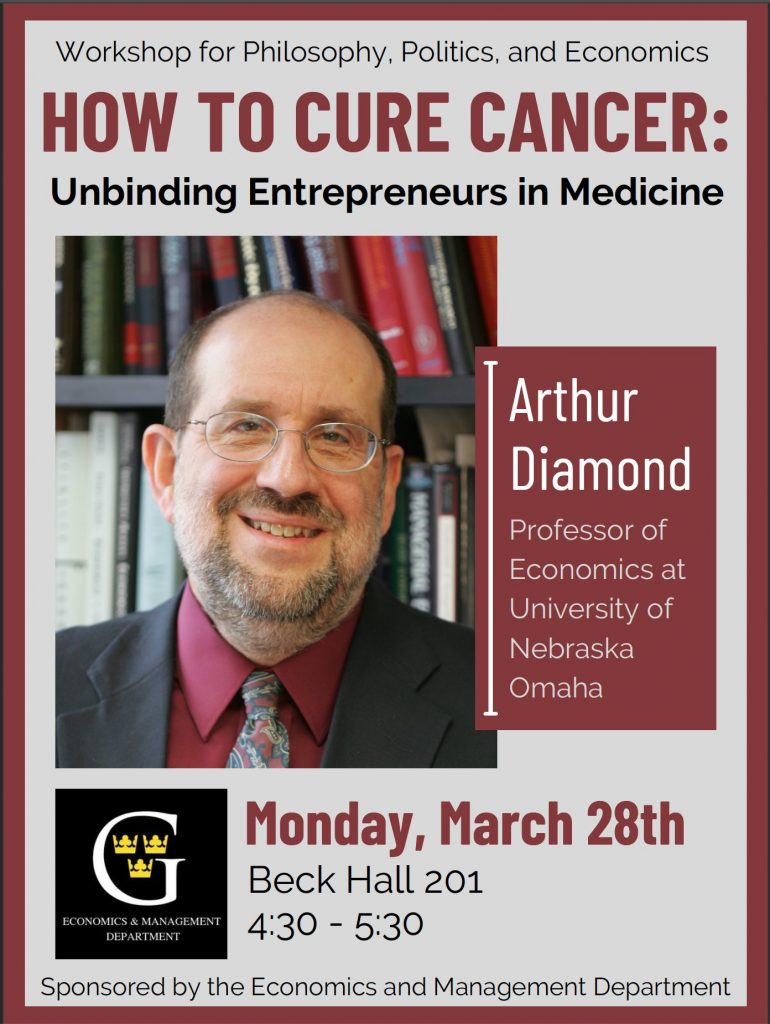
I appreciate Marta Podemska-Mikluch’s perseverance over the long pandemic in arranging my conversations with Gustavus Adolphus College students on some of my current research on medical entrepreneurship. I am looking forward to my visit!
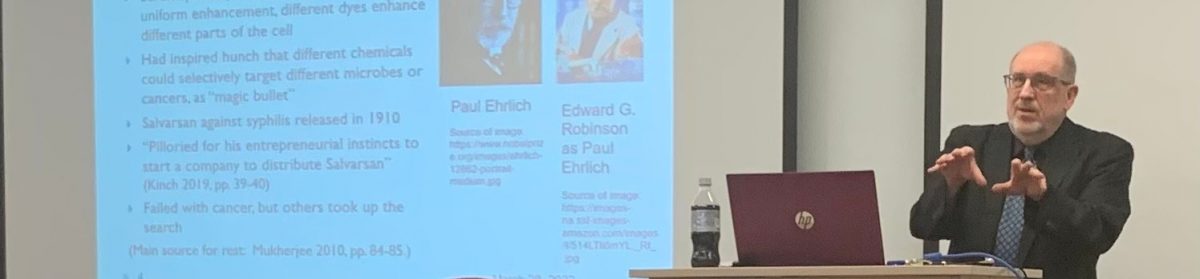
I appreciate Marta Podemska-Mikluch’s perseverance over the long pandemic in arranging my conversations with Gustavus Adolphus College students on some of my current research on medical entrepreneurship. I am looking forward to my visit!
(p. C3) Long-term economic growth is associated with both rising per capita energy consumption and slower population growth. For this reason, as the world continues to get richer, higher per capita energy consumption is likely to be offset by a lower population.
A richer world will also likely be more technologically advanced, which means that energy consumption should be less carbon-intensive than it would be in a poorer, less technologically advanced future. In fact, a number of the high-emissions scenarios produced by the United Nations Intergovernmental Panel on Climate Change involve futures in which the world is relatively poor and populous and less technologically advanced.
Affluent, developed societies are also much better equipped to respond to climate extremes and natural disasters. That’s why natural disasters kill and displace many more people in poor societies than in rich ones. It’s not just seawalls and flood channels that make us resilient; it’s air conditioning and refrigeration, modern transportation and communications networks, early warning systems, first responders and public health bureaucracies.
New research published in the journal Global Environmental Change finds that global economic growth over the last decade has reduced climate mortality by a factor of five, with the greatest benefits documented in the poorest nations. In low-lying Bangladesh, 300,000 people died in Cyclone Bhola in 1970, when 80% of the population lived in extreme poverty. In 2019, with less than 20% of the population living in extreme poverty, Cyclone Fani killed just five people.
Poor nations are most vulnerable to a changing climate. The fastest way to reduce that vulnerability is through economic development.
So while it is true that poor nations are most vulnerable to a changing climate, it is also true that the fastest way to reduce that vulnerability is through economic development, which requires infrastructure and industrialization. Those activities, in turn, require cement, steel, process heat and chemical inputs, all of which are impossible to produce today without fossil fuels.
For the full commentary, see:
(Note: the online version of the commentary has the date Jan. 23, 2020, and has the same title as the print version.)
Nordhaus’s commentary is related to the manifesto that he co-authored with many others:
(p. C7) Cultural history is frequently written as if circumscribed by national borders, with each country laying claim to a discrete social and intellectual way of life. Dismayed at this tendency, Orlando Figes, a noted historian of Russia, found himself wondering whether the forces of transnational integration weren’t at least as decisive as those that would drive cultures apart. In his new study “The Europeans” he aims “to approach Europe as a space of cultural transfers, translations and exchanges crossing national boundaries, out of which a ‘European culture’—an international synthesis of artistic forms, ideas and styles—would come into existence and distinguish Europe from the broader world.
. . .
His monumental work is the product of thorough and extensive research, largely in archival sources and in several languages. The author has a remarkable capacity to keep a huge quantity of factual material present in mind, and to bind it moreover into a coherent story. Woven through the biographical narrative is a detailed account of the transformations in technology, mores and law that created the new cosmopolitanism.
Chief among these was the rapid construction of railways, such that in France alone, for example, well more than 8,000 miles of track were laid down between 1850 and 1870. Railway travel gave people the time and comfort to read newspapers and fiction, which they could procure in the dozens of station bookstalls set up by merchants like W.H. Smith. “The train,” Mr. Figes notes, “was smoother than a horse-drawn carriage on a bumpy road, enabling passengers to read a book more easily.” Literacy had increased dramatically, and the rotary press, invented in 1843, facilitated the production of a vast quantity of printed matter, distribution of which deep into the provinces was in turn driven by the ramifying network of trains.
. . .
The spread of gas lighting, invented in the 1790s, made it possible for people to read comfortably in the evening. It also enabled them to play the piano at home, and of course piano technology had kept pace: The instruments became easier to play, and cheaper as well. In 1845, by the author’s estimation, 100,000 people in Paris were playing the piano, of which there were 60,000 in a city of about one million people.
For the full review, see:
(Note: ellipses added.)
(Note: the online version of the review has the date October 18, 2019, and has the title “‘The Europeans’ Review: Engines of Progress.”)
The book under review in the passages quoted above is:
Figes, Orlando. The Europeans: Three Lives and the Making of a Cosmopolitan Culture. New York: Metropolitan Books, 2019.
(p. A17) The first large randomized community-level study, published last month in Science, found that while generic surgical masks provided a modest (about 10%) reduction in the risk of infection from Delta, cloth masks didn’t significantly reduce risk. Masks may be even less protective against an extremely contagious variant like Omicron.
For the full commentary, see:
(Note: the online version of the commentary has the date Jan. 24, 2022, and has the same title as the print version.)
The article in Science mentioned above is:
(p. B1) America’s recent inflation spike has prompted renewed interest in an idea that many economists and policy experts thought they had long ago left behind for good: price controls.
The federal government last imposed broad-based limits on how much private companies could charge for their goods and services in the 1970s, when President Richard M. Nixon ushered in wage and price freezes over the course of a few years. That experiment was widely regarded as a failure, and ever since, the phrase “price controls” has, at least for many people, called to mind images of product shortages and bureaucratic overreach. In recent decades, few economists have bothered to study the idea at all.
. . .
(p. B2) Artificially holding down prices leads to shortages, inefficiencies or other unintended consequences, like an increase in black-market activity. And while some economists say price controls on specific products can make sense in specific situations — to prevent price-gouging after a natural disaster, for example — most argue that they are a poor tool for fighting inflation, which is a broad increase in prices.
In a recent survey of 41 academic economists conducted by the University of Chicago’s Booth School of Business, 61 percent said that price controls similar to those imposed in the 1970s would fail to “successfully reduce U.S. inflation over the next 12 months.” Others said the policy might bring down inflation in the short-term but would lead to shortages or other problems.
“Price controls can of course control prices — but they’re a terrible idea!” David Autor, an economist at the Massachusetts Institute of Technology, wrote in response to the survey.
. . .
“It sounds good: Your wages are going to be higher, and your prices are going to be the same,” said Lawrence H. Summers, a Harvard University economist. “Unless there is a mechanism for producing more stuff, it’s just going to result in longer queues.”
For the full story, see:
(Note: ellipses added.)
(Note: the online version of the story was updated Jan. 13, 2022, and has the title “Price Controls Set Off Heated Debate as History Gets a Second Look.”)
(p. A17) The annual BLS report on union membership released last week shows that unions lost nearly a quarter-million members in 2021, with private-sector membership dropping to a historic low of 6.1%. Even in retail and healthcare, which labor organizers targeted over pandemic-related safety concerns, union membership declined in 2021 from 2020.
. . .
. . . thinking well of unions and wanting to pay dues to be represented by one aren’t the same. I recently moderated focus groups of workers 18 to 29 in the Midwest and on the East and West coasts. While most said positive things about unions, only a handful wanted to join one.
. . .
The “historic” worker strife that has drawn media attention is more fiction than fact. Don’t take my word for it: The socialist magazine Jacobin reviewed the new BLS data on work stoppages and concluded that 2021 “was a quiet year, even by recent standards.”
For the full commentary, see:
(Note: ellipses added.)
(Note: the online version of the commentary has the date Jan. 23, 2022, and has the same title as the print version.)
(p. C10) Mr. Taylor, a novelist, critic and biographer, more ably balances the cultural footprint of “Nineteen Eighty-Four” with the story of its writing.
. . .
Orwell used his newspaper columns to flesh out the ideas that his novel—tentatively titled “The Last Man in Europe”—would explore. In one article, writes Mr. Taylor, Orwell suggested that “totalitarianism’s most terrifying quality is not only that it instigates atrocities, but that it seeks to control ‘the concept of objective truth’ and thereby manipulates both past and future.” This theme would take form in “Nineteen Eighty-Four” when Oceania periodically shifted from fighting one of its two enemies to fighting the other. Past alliances and rivalries instantly disappeared: “Oceania was at war with Eurasia: therefore Oceania had always been at war with Eurasia.”
. . .
George Orwell possessed three signal virtues, each of them rare and almost unheard of in concert. They are judgment, courage and clarity. As Christopher Hitchens pointed out in “Why Orwell Matters,” Orwell’s judgment was right on the great political questions of the 20th century: imperialism, fascism and communism. He had the courage to say so, even when it meant breaking with his countrymen (imperialism) and his comrades (communism). And Orwell had the talent to make his arguments in prose as clear as a windowpane, with his biases and flaws on display for all to judge.
For the full review, see:
(Note: ellipses added.)
(Note: the online version of the review has the date October 18, 2019, and has the title “‘The Ministry of Truth’ and ‘On Nineteen Eighty-Four’ Review: An Enduring Vision of Tyranny.”)
The book under review in the passages quoted above is:
Boucheron, Patrick. Machiavelli: The Art of Teaching People What to Fear. Translated by Willard Wood. New York: Other Press, 2020.
(p. A15) Fission is in fashion as drawbacks of intermittent wind and solar power emerge.
. . .
Regulatory limits on annual exposure around nuclear plants are less than a year’s background radiation from rocks and cosmic rays. Radiation scientists now know that people can safely absorb that much radiation every day because DNA is repaired and cells are replaced constantly in living beings. Yet regulators’ mandated limits, at a thousandth of what’s really harmful, create fright of all radiation. No one needed to be evacuated at Fukushima or around Chernobyl, places where thousands died from unwarranted fear and relocation stress.
For the full commentary, see:
(Note: ellipsis added.)
(Note: the online version of the commentary has the date Jan. 26, 2022, and has the same title as the print version.)
(p. B11) It is a neurotoxin 100 times more deadly than cyanide and the cause of the food-borne illness known as botulism. During World War II and for some years after, the Department of Defense hoped to develop it as a chemical weapon. But it wasn’t until the 1970s that Alan Scott, an ophthalmologist, turned the botulinum toxin into a pharmaceutical, when he began to investigate it as a medical treatment for serious eye impairments.
. . .
When, in 1978, Dr. Scott first injected the powerful paralytic into the eye muscles of a patient who had undergone retinal detachment surgery that had left his eye pulled to one side, he didn’t know who was more nervous, himself or the patient, he told Scientific American magazine in 2016.
But the procedure succeeded, and Dr. Scott would go on to refine one of the world’s deadliest poisons into a life-altering treatment — he called it Oculinum — for those who suffered from conditions like strabismus, a misalignment of the eyes.
Doctors also began using it to treat migraines and jaw-clenching, among other ailments, and as they did so many of their delighted patients noticed a curious byproduct: The toxin’s ability to paralyze targeted facial muscles smoothed the lines around them, though its effects wore off after a few months.
For the full obituary, see:
(Note: ellipsis added.)
(Note: the online version of the obituary was updated Jan. 20, 2022, and has the title “Alan Scott, Doctor Behind the Medical Use of Botox, Dies at 89.”)
(p. A5) The Republican governor, unlike many of his Democratic counterparts, didn’t use the term “climate change” or endorse specific policies aimed at combating factors that most climate scientists say are driving warming, such as greenhouse-gas emissions. He focused on responding to the effects of a warming climate.
“What I’ve found is people, when they start talking about things like global warming, they typically use that as a pretext to do a bunch of left-wing things,” said Mr. DeSantis at the event. “We’re not doing any left-wing stuff.”
Governors and lawmakers in several Republican-led states, including Idaho, South Carolina and Texas, are taking a similar approach as concern about climate change increases. After natural disasters that research suggests are becoming more frequent and intense, they are taking measures such as infrastructure upgrades to mitigate flooding, wildfires and severe storms. Such moves are vital to their states’ economic livelihood, they say.
. . .
At the Oldsmar event, Mr. DeSantis outlined a proposal to dedicate more than $270 million to 76 projects aimed at bolstering defenses against rising sea levels and flooding. “We’re a low-lying state, we’re a storm-prone state, and we’re a flood-prone state,” he said.
For the full story, see:
(Note: ellipsis added.)
(Note: the online version of the story has the date Jan. 23, 2022, and has the title “Millions Have Lost a Step Into the Middle Class, Researchers Say.”)
(p. C12) But anyone who observes politics, business or even the loftiest social institutions will know that the world is rife with backstabbers, hypocrites and ethical ne’er-do-wells all thriving at the highest levels—beyond the reach of law or hashtag.
. . .
Machiavelli’s gift, Mr. Boucheron argues, was “naming with precision that which was happening.” He explains the behavior of tyrants not to excuse them, but to show the rest of us what to look out for, in the clearest terms possible. Machiavelli’s “lucidity,” says Mr. Boucheron, was the “weapon of the despairing.”
Other political thinkers have read Machiavelli this way. Jean-Jacques Rousseau wrote in “The Social Contract” that Machiavelli was not advising tyrants but “instructing the people on what they have to fear.” John Adams credited Machiavelli for helping him think through the likely threats to a young American republic.
For the full review, see:
(Note: ellipsis added.)
(Note: the online version of the review has the date January 24, 2020, and has the title “‘Machiavelli’ Review: A Poetics for Tyrants.”)
The book under review is:
Boucheron, Patrick. Machiavelli: The Art of Teaching People What to Fear. Translated by Willard Wood. New York: Other Press, 2020.