
Uber to Politicians: “Catch-Me-If-You-Can”

(p. B1) Last week, the home-sharing service Airbnb had more than 40,000 listings in Paris, making the French capital the company’s most popular destination for travelers looking to rent a room or an entire apartment. Paris officials applaud it for bringing innovation to the city’s hotel industry.
The ride-hailing company Uber had a much more difficult week.
Thousands of Parisian taxi drivers took to the streets to protest UberPop, the company’s low-cost service that’s similar to UberX in the United States. French politicians denounced the company for defying the country’s transport laws. And two of Uber’s top executives in France were detained by the police and accused of operating an illegal taxi business. By Friday [July 3, 2015], the company had suspended UberPop across the country.
Uber and Airbnb are similar in many ways. Both born in San Francisco, the companies are now two of the largest entrants in the so-called on-demand economy, in which services are available at the touch of a smartphone button. They are both flush with investor money — with valuations in the tens of billions of dollars — and are using the cash to expand rapidly around the world.
But the starkly different paths in France for these companies lay bare contrasting strategies as they encounter the world of global regulators. Since it began in 2009, Uber has entered city after city, in Europe and elsewhere, with a largely catch-me-if-you-can attitude. Airbnb, which offers more rooms than traditional hotel groups like Hilton and InterContinental, has instead tilted toward courting local politicians in many of its most popular markets.
So far, Uber’s approach has not significantly slowed it down. The company operates in more than 300 cities in almost 60 countries and is valued by investors at more than $40 billion.

For the full story, see:
MARK SCOTT. “The Bumps in Uber’s Fast Lane.” The New York Times (Weds., JULY 8, 2015): B1-B2.
(Note: bracketed date added.)
(Note: the online version of the story has the date JULY 7, 2015, and has the title “What Uber Can Learn From Airbnb’s Global Expansion.”)
Government Elephant Ivory Bans Endanger Rare Helmeted Hornbills

Another unintended consequence of well-intentioned government policy.

(p. A3) BEIJING — Even as China, the world’s leading market for illegal ivory, promises to help safeguard elephants in Africa, a rare bird in Southeast Asia is in danger because its skull is being sold in China as an ivory alternative, conservationists say.
. . .
More than 2,000 helmeted hornbill skulls, or casques, were seized by the authorities in Indonesia and China in the past five years, according to a new report by the Environmental Investigation Agency, a nongovernmental organization based in London. In some cases, Chinese citizens were caught trying to leave Indonesia with casques in their luggage.
. . .
China has joined the world in taking a stand against the trade in elephant and rhinoceros products. In September, during his state visit to the United States, President Xi Jinping pledged to “enact nearly complete bans on ivory import and export.”
But some conservationists worry that less celebrated but also threatened animals, including the helmeted hornbill, are being overlooked, becoming easy picks to meet the demand.
“Shifting to hornbill ivory is like grabbing a low-hanging fruit,” Yokyok Hadiprakarsa, the director of the Indonesian Hornbill Conservation Society, wrote in an email.

For the full story, see:
SHAOJIE HUANG. “Chinese Demand for Ivory Alternative Threatens Rare Hornbill Bird.” The New York Times (Weds., MARCH 23, 2016): A3.
(Note: ellipses added.)
(Note: the online version of the story has the date MARCH 22, 2016, and has the title “Chinese Demand for Ivory Alternative Threatens Rare Bird.”)

Regulations and Bureaucratic Inefficiency May Kill Restaurant

(p. A22) To begin with, although the B&H Dairy Restaurant on Second Avenue in Manhattan now hangs by a thread, no one was hurt there on March 26 [, 2015], the day that three buildings on the same block were leveled by a gas explosion.
. . .
“On the third day after the explosion, people from the building department and Con Edison came together,” Mr. Abdelwahed said. “They inspected the place, upstairs, downstairs, the pipes, the basement. They told me, ‘You are O.K., you should be fine, no problem.’ ”
That changed, he said, in the charged days that followed, as it emerged that apparently illegal alterations to the gas lines had been made in one of the buildings down the street.
The original inspector returned, he said, and told him that another inspection was going to happen in a couple of days. “He said, ‘You’re not going to pass that inspection. Because of what happened next door, I don’t want to be responsible for the future,’ ” Mr. Abdelwahed said.
All of the gas piping in the building has to be replaced, a job the landlord has taken on, though it is not clear what deficiencies it had. The Buildings Department file for 127 Second Avenue shows that there were no open violations on the premises in March, and none now.
After questions were put four times to the city on Thursday about the nature of the problems with B&H’s operation, a spokesman for the mayor said the administration was trying to help small businesses affected by the explosion, including the restaurant.
In B&H, Mr. Abdelwahed said, the inspector noted that his stove had five burners, but the plans on file showed only four. “He required me to correct it on the plan,” Mr. Abdelwahed said. “Originally it was four. I don’t know how it came to be five. It’s not an issue. Where was an inspector before all this? You’re trying to show you’re working?”
. . .
“He told me, ‘You have to change the fire system,’ ” Mr. Abdelwahed said of the inspector. “Of course, I had a fire suppression system all the time, inspected. I told him, ‘I am going to go out of business.’ He said: ‘I’m sorry, I can’t help you.’ They don’t want to be responsible for anything.”
Because the fire suppression system was going to jut into the backyard, Mr. Abdelwahed had to apply for permission from the city’s Landmarks Commission as the block is part of a historic landmark district. Only after that approval was granted could his contractor apply for a building permit.
“What’s killing them is the lag time,” said Mr. Reynolds, who is organizing crowdfunding support for the restaurant. Bernadette Nation, an official with the city’s Department of Small Business Services, has cut red tape in getting permits issued, and their story has been covered on New York 1 and by many blogs.

For the full story, see:
JIM DWYER. “About New York; Unharmed by a Gas Explosion, but Choked by the Red Tape That Followed.” The New York Times (Fri., JULY 10, 2015): A22.
(Note: ellipses, and bracketed year, added. The quote from Mr. Reynolds in the last passage above, appears in the print version of the article, but not in the online version of the article.)
(Note: the online version of the story has the date JULY 9, 2015.)

Suburbs Solved City Over-Crowding and Allowed Child Rearing

(p. C7) . . . , Adna Ferrin Weber, writing in 1899, had it right. “The ‘rise of the suburbs’ it is,” he wrote, “which furnishes the solid basis of a hope that the evils of city life, so far as they result from overcrowding, may be in large part removed.”
. . .
Joel Kotkin, in “The Human City: Urbanism for the Rest of Us,” presents the most cogent, evidence-based and clear-headed exposition of the pro-suburban argument. In Mr. Kotkin’s view, there is a war against suburbia, an unjust war launched by intellectuals, environmentalists and central-city enthusiasts. In pithy, readable sections, each addressing a single issue, he debunks one attack on the suburbs after another. But he does more than that. He weaves an impressive array of original observations about cities into his arguments, enriching our understanding of what cities are about and what they can and must become, with sections reflecting on such topics as “housing inflation,” “the rise of the home-based economy,” “the organic expansion of cities” and “forces undermining the middle class in global cities.”
The essence of Mr. Kotkin’s defense of suburban expansion in the United States–with which he is most familiar and where the opposition to his views is better organized and much more formidable than elsewhere–is that suburbs now contain the great majority of residences as well as jobs. Suburban neighborhoods, he suggests, are as conducive to community living and as “green” as central-city ones. But his critique of conventional urban-planning wisdom goes further. He argues that central-city living is largely unaffordable by the middle class, let alone the poor; that central cities are becoming the abodes of the global rich, encouraging glamorous consumption rather than providing middle-class jobs; and that dense urban living in small, expensive quarters discourages child rearing, a critical concern for policy makers in many industrialized countries today.

For the full review, see:
SHLOMO ANGEL. “In Praise of Urban Sprawl; Dense urban living discourages child rearing. It is no surprise that there are 80,000 more dogs than children in San Francisco.” The Wall Street Journal (Sat., May 21, 2016): C5-C6.
(Note: the online version of the review has the date May 20, 2016.)

The book under review, is:
Kotkin, Joel. The Human City: Urbanism for the Rest of Us. Chicago: Agate B2 Books, 2016.

Cloud Profits Give “Amazon Cover to Plunge into New Projects”

Jeff Bezos is what I call a “project entrepreneur”: he uses profits from earlier projects to fund new projects.

(p. B12) When it comes to investment, Amazon.com no longer has to stop to take a breath. And that is making it an even more formidable rival to bricks-and-mortar retailers.

The e-commerce giant has reported minimal profits in its 19-year history as a public company as it has pursued a pattern of near-endless investment. Amazon has plowed money into expanding its warehouse and delivery infrastructure and branching into new markets such as grocery, music, online video and, most recently, apparel.
In the past, Amazon has occasionally chosen to take a quarter here and there to press pause on that investment. That had the effect of reassuring the market that it could immediately be profitable if it ever chose to stop.
. . .
The protective shield of the cloud seems to be giving Amazon cover to plunge into new projects at an even more rapid clip than it has in the past.

For the full story, see:
MIRIAM GOTTFRIED. “Amazon Cloud Profit Sparks Retail Storm.” The Wall Street Journal (Sat., May 21, 2016): B12.
(Note: ellipsis added.)
(Note: the online version of the story has the date May 20, 2016, and has the title “Amazon’s Cloud Cover Makes It a Bigger Threat.”)

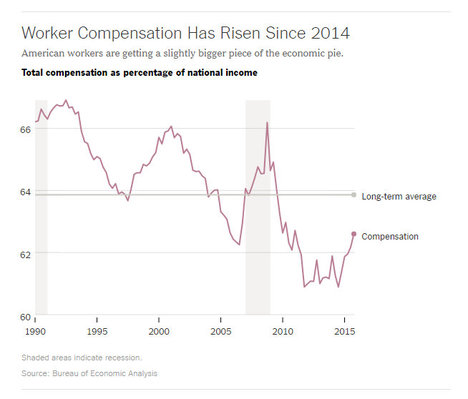
Workers Gain Slightly Larger Percent of GDP

WorkerCompensationGraph2016-05-27.jpgSource of graph: online version of the NYT article quoted and cited below.

(p. B1) American workers are reaping fewer of the gains of a growing economy in the form of pay and benefits. Shareholders are reaping more in the form of corporate profits. That shift has been one of the most important economic stories of the last several decades, and it is the key to understanding stagnant wages for middle-class workers and a soaring stock market in the last quarter-century.

Here is what is less widely understood: That trend appears to be reversing itself.
It is early and the reversal may not last. And it certainly hasn’t fully undone the shift underway since the 1980s. But the numbers are quite clear that in the last couple of years workers have claimed a bigger piece of the economic pie and shareholders a smaller one.
The evidence available so far in 2016 — steady growth in wages and weak earnings for publicly traded companies — suggests that the reversal is continuing this year.

For the full story, see:
Neil Irwin. “The Upshot; Workers Are Getting a Bit More of the Economic Pie.” The New York Times (Fri., MAY 6, 2016): B1 & B9.
(Note: the online version of the story has the date MAY 3, 2016, and has the title “The Upshot; Workers Are Getting a Bit More of the Economic Pie (and Shareholders Less).”)

“Students Are Hungry to Make an Impact”

(p. B2) “Today’s students are hungry to make an impact, and we have to be responsive,” said Gordon Jones, the dean of a new College of Innovation and Design at Boise State University in Idaho and the former director of Harvard’s Innovation Lab.
Yet campus entrepreneurship fever is encountering skepticism among some academics, who say that start-up programs can lack rigor and a moral backbone.
Even a few entrepreneurship educators say that some colleges and universities are simply parroting an “innovate and disrupt” Silicon Valley mind-set and promoting narrow skill sets — like how to interview potential customers or pitch to possible investors — without encouraging students to tackle more complex problems.
“A lot of these universities want to get in the game and serve this up because it’s hot,” Mr. Jones said. “The ones that are doing it right are investing in resources that are of high caliber and equipping students to tackle problems of importance.”
. . .
. . . the quick start-up workshops offered on some campuses can seem at odds with the traditional premise of liberal arts schools to educate deliberative, critical thinkers.
“Real innovation is rooted in knowledge and durable concern and interest, not just ‘I thought of something that nobody ever thought of before,'” said Jonathan Jacobs, who writes frequently about liberal education and is the chairman of the philosophy department at John Jay College of Criminal Justice of The City University of New York. “That’s not educating people, frankly.”
And at least a few professors of entrepreneurship say that some universities are not ensuring that students learn the fundamentals of starting, running and sustaining a business.

For the full story, see:
NATASHA SINGER. “Colleges Rush to Embolden Entrepreneurs.” The New York Times (Tues., DEC. 29, 2015): A1 & B2 (sic).
(Note: ellipses added.)
(Note: the online version of the story has the date DEC. 28, 2015, and has the title “Universities Race to Nurture Start-Up Founders of the Future.”)

Imperial Passivity of the Holy Roman Empire Allowed Liberty and Diversity

(p. C7) On Aug. 6, 1806, an imperial herald decked out in full court regalia galloped purposefully through the streets of Vienna to a magnificent medieval church at the center of the city. Once there, he ascended to the balcony, blew his silver trumpet and declared that the Holy Roman Empire, an institution that had lasted for more than 1,000 years, was no more.
. . .
But because the empire never evolved into a viable nation-state, many scholars and politicians regarded it as a failure. The Germans in particular (including the great 19th-century historian Leopold von Ranke) blamed the empire for the fact that Germany remained a “delayed nation” that was only unified (through Prussian machinations) in 1871.
Yet it was precisely this lack of political centralization, Mr. Wilson argues, that provided the empire with its greatest strength. Imperial passivity meant that individual rulers and states were largely left alone to govern as they wished. And all subjects had the right to appeal to the emperor if they believed their rights had been trammeled upon. Jews, for example, were given imperial protection as early as 1090; and though forced to live as second-class citizens during much of the empire’s history, many viewed its dissolution as a catastrophe.
Political fragmentation also had cultural benefits. Unlike France and England, with their single capital and monarch, the Holy Roman Empire had numerous kings, courts and centers of patronage. The result was a remarkably wide distribution of educational and cultural institutions, one that is still observable in the former imperial lands. It was probably also no coincidence that both the printing press and Europe’s first mail service were launched within the fragmented empire or that the imperial territories experienced higher levels of economic growth than regions of Europe with more centralized control.
. . .
Though far from perfect, the empire lasted for as long as it did because it strove to provide the two things most hoped for in a state: liberty and security.

For the full review, see:
MARK MOLESKY. “The Strength of a Weak State; In the Holy Roman Empire, individual rulers and states were largely left to govern as they wished.” The Wall Street Journal (Sat., May 21, 2016): C7.
(Note: the online version of the review has the date May 20, 2016.)

The book under review, is:
Wilson, Peter H. Heart of Europe: A History of the Holy Roman Empire. Cambridge, MA: Belknap Press, 2016.

Feds Spend Over $500 Million to Aid Barges Shipping Coal

(p. B1) CHARLEROI, Pa.–A few years ago, coal barges lined up 20 or 30 deep, waiting their turn for a towboat to shuttle them through the locks near this town along the Monongahela River.
These days it is the towboats that often sit idle. Cheap natural gas, stricter power-plant-emissions rules and a weak steel market have gutted coal demand, and with it traffic on the rivers that have served as the industry’s commercial arteries for over a century.
Nevertheless, river infrastructure is about to be flooded with federal cash. In December, Congress authorized $405 million to improve river locks and dams over the next fiscal year, the most since 2008.
The money follows a multimillion-dollar lobbying effort spearheaded by the Waterways Council Inc., which represents an array of companies including coal producer Murray Energy Corp., utility FirstEnergy Corp., agricultural-commodities trader Cargill Inc. and Marathon Petroleum Corp.
. . .
“It’s kind of ironic–we’re spending even more to update and modernize this system when the value and volume of the commodities is diminishing, and coal is something that we as a country are moving away from,” said Steve Ellis, vice president of Taxpayers for Common Sense, a conservative-leaning advocacy group that analyzes infrastructure spending.

For the full story, see:
ROBBIE WHELAN. “Barges Get a Boost, Even as Demand Sinks.” The Wall Street Journal (Thurs., Feb. 4, 2016): B1 & B7.
(Note: ellipsis added.)
(Note: the online version of the story has the date Feb. 2, 2016, and has the title “U.S. Opens Spigot for Lock-and-Dam Fixes, Even as Coal Traffic Dwindles.”)

A Rooftop Farm Is “a Foolish Endeavor” Due to High Costs and Government Regulations

(p. B1) BrightFarms Inc. last year pulled the plug on a planned greenhouse in Washington, D.C., 10 months into the process of getting permits, and earlier exited an effort to develop a rooftop farm in Brooklyn, New York. FarmedHere LLC, which operates a farm in a former box factory outside Chicago, shut down for six months last August to revamp its strategy.
Building farms on city rooftops is “a foolish endeavor” because of the higher costs and the additional time for permitting, said Paul Lightfoot, chief executive of BrightFarms.

For the full story, see:
Ruth Simon. “Farming Startups Have Tough Row to Hoe.” The Wall Street Journal (Thurs., April 14, 2016): B1 & B6.
(Note: ellipses added.)
(Note: the online version of the story has the date April 13, 2016, and has the title “Farming Gets High Tech in Bid to Offer Locally Grown Produce.”)

Steady-State Stagnation Is Not an Option

Some environmentalists advocate an end to economic growth. Inside economics, and in the broader world, a heated debate has considered whether an economy can long stagnate in a steady-state. The idea that it can, is captured in the circular flow diagram that has been a fixture of many introductory economics textbooks for many decades. I argue that without the dynamism that is achieved by innovative entrepreneurs, long-term stagnation is not an option. Exogenous events, such as earthquakes, will always come along to disturb the steady-state. And when they do, only entrepreneurs can restore the steady-state. If there are no entrepreneurs, there will be decline. If there are entrepreneurs, they will not stop at the steady-state; they will seek progress. The choice is forward or backward. Long-term steady-state stagnation is not an option.

(p. 10) SANKHU, Nepal — As the anniversary of Nepal’s devastating earthquake came and went last week, Tilakmananda Bajracharya peered up at the mountainside temple his family has tended for 13 generations, wondering how long it would remain upright.

. . .
Many people here pin their hopes on promises of foreign aid: After the disaster, images of collapsed temples and stoic villagers in a sea of rubble were beamed around the world, and donors came forward with pledges of $4.1 billion in foreign grants and soft loans.
But those promises, so far, have not done much to speed the progress of Nepal’s reconstruction effort. Outside Kathmandu, the capital, many towns and villages remain choked with rubble, as if the earthquake had happened yesterday. The government, hampered by red tape and political turmoil, has only begun to approve projects. Nearly all of the pledged funds remain in the hands of the donors, unused.
The delay is misery for the 770,000 households awaiting a promised subsidy to rebuild their homes. Because a yearly stretch of bad weather begins in June, large-scale rebuilding is unlikely to begin before early 2017, consigning families to a second monsoon season and a second winter in leaky shelters made of zinc sheeting.
. . .
. . . , some visitors who came here to assess the reconstruction expressed shock at how little had been done.
. . .
“It has been a horrible year,” said Anju Shrestha, 36, whose shed stands on a site that once held a three-story brick house.
A neighbor, Kanchhi Shrestha, guessed her age at about 75, based on a major earthquake that occurred two years before she was born. She pulled her skirt up to show feet splotchy with raw sores.
“I will die in this shelter if they do not give me money,” she said. “I have nothing to eat.”
However, she added, it would be inappropriate for a person like her to demand assistance from Nepal’s government.
“We cannot scold the government,” she said. “If the government provides, we will fold our hands and tell them, ‘You are God.’ “

For the full story, see:
ELLEN BARRY. “A Year Later, Nepal Is Trapped in the Shambles of a Devastating Quake.” The New York Times, First Section (Sun., May 1, 2016): 10.
(Note: ellipses added.)
(Note: the online version of the story has the date APRIL 30, 2016, and has the title “A Year After Earthquake, Nepal’s Recovery Is Just Beginning.”)