Regulatory Restrictions on Business Have Doubled Since 1975

GrowingRegulatoryRestrictionsGraph2016-10-31.jpgSource of graph: online version of the WSJ article quoted and cited below.

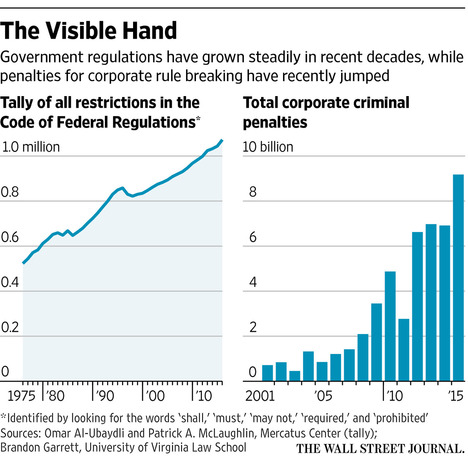
(p. A2) Measuring the regulatory state is no easy task. The Code of Federal Regulations contains more than a million restrictions, as signified by the use of the words “shall,” “must,” “may not,” “required,” and “prohibited,” according to two scholars from the Mercatus Center, a free-market think tank. The total has doubled since 1975, pausing only during Ronald Reagan’s first term and Bill Clinton’s second.

Rule enforcement is also getting more serious. Responding to accusations of lax oversight in the past, federal authorities have imposed criminal penalties, in particular on financial companies, averaging $7 billion a year in the past four years, up fourfold from the prior 11, according to Brandon Garrett, a law professor at the University of Virginia.
. . .
Brent Skorup, a scholar at the Mercatus Center, says regulators like the FCC increasingly extract behavioral conditions from companies via transaction approvals rather than rule-making. For example, Comcast Corp. acquired NBC Universal in 2011 after agreeing to a long list of conditions, from not charging for faster network access (aka abiding by “net neutrality”) to expanding local, public-interest and children’s programming.

For the full commentary, see:
GREG IP. “CAPITAL ACCOUNT; AT&T Feels Growing Reach of Presidency.” The Wall Street Journal (Thurs., Oct. 27, 2016): A2.
(Note: ellipsis added.)
(Note: the online version of the commentary has the date Oct. 26, 2016 title “CAPITAL ACCOUNT; Reaction to AT&T-Time Warner Deal Shows Presidency’s Growing Reach.”)

The data presented in the left panel of the graph above is described in the following article:
Al-Ubaydli, Omar, and Patrick A. McLaughlin. “Regdata: A Numerical Database on Industry-Specific Regulations for All United States Industries and Federal Regulations, 1997-2012.” Regulation and Governance (2015), doi: 10.1111/rego.12107.

The data can be downloaded at:
http://regdata.org/data/

The Garrett results mentioned above, are reported in his article:
Garrett, Brandon L. “The Rise of Bank Prosecutions.” The Yale Law Journal Forum (May 23, 2016): 33-56.

After Global Warming Hits Vietnam: “We Live Better Now”

(p. A9) On a chilly January day recently, Do Van Duy slugged back another shot of rice liquor. It had been a good year for raising fish in the Red River delta of northern Vietnam. He and other villagers in Nam Dien had gathered to toast their success as the Lunar New Year approached–and question whether climate change is such a bad thing after all.
“We live better now,” said Mr. Duy, 31 years old, who now farms grouper, shrimp and crab in the brackish waters of the delta after giving up rice a few years ago. “If you can make the switch there’s a lot more money to be made.”
Nearly three-quarters of households in Nam Dien have abandoned rice farming, said Bui Van Cuong, a fisheries official with the People’s Commune in Nam Dien, as salt water flows farther into the delta’s farmland. “The changes are very apparent over the past 10 years,” Mr. Cuong said.
The shift is focusing attention on a difficult question: Is it better to invest resources in fighting the effects of climate change, or in helping people adapt?
. . .
“Their competitive advantage is changing,” said Le Anh Tuan, a director at the Institute for Climate Change Studies at Can Tho University. “The delta might not always be the best place to grow rice, but people can raise shrimp instead.”

For the full story, see:
JAMES HOOKWAY. “Vietnam’s New Tack in Climate Fight.” The Wall Street Journal (Thurs., Feb. 25, 2016): A9.
(Note: ellipsis added.)
(Note: the online version of the story has title “Vietnam Tries New Tack in Climate-Change Battle: Teach a Man to Fish.”)

Land Use Regulations Increase Income Inequality

IncomeAndPopulationInRichAndPoorStatesGraph2016-11-14.jpgSource of graph: online version of the WSJ article quoted and cited below.

(p. A3) In this year’s election, candidates have focused blame for rising income inequality on broad economic forces, from globalization to the decline of the American manufacturing base. But a growing body of research suggests a more ordinary factor: the price of the average single-family home for sale, from Fairfield, Conn., to Portland, Ore.

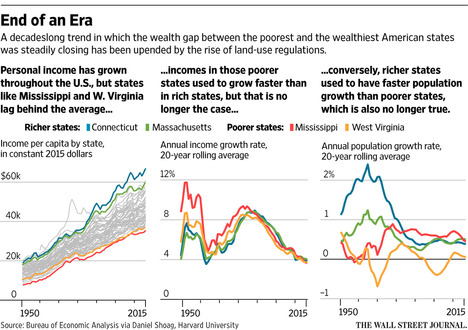
According to research by Daniel Shoag, an associate professor of public policy at Harvard University, and Peter Ganong, a postdoctoral fellow at the National Bureau of Economic Research, a decadeslong trend in which the income gap between the poorest and richest states steadily closed has been upended by growth in land-use regulations.
Moving to a wealthier area in search of job opportunities has historically been a way to promote economic equality, allowing workers to pursue higher-paying jobs elsewhere. But those wage gains lose their appeal if they are eaten up by higher housing costs. The result: More people stay put and lose out on potential higher incomes.
. . .
Messrs. Shoag and Ganong looked at mentions of “land-use” in appeals-court cases and found the number of references began rising sharply around 1970, with some states seeing a much larger increase than others. For example, the share of cases mentioning land use for New York rose 265% between 1950 and 2010 and 644% in California during the same period. By contrast, it increased by only 80% in Alabama.

For the full story, see:
LAURA KUSISTO. “Land Use Rules Under Fire.” The Wall Street Journal (Weds., Oct. 19, 2016): A3.
(Note: ellipsis added.)
(Note: the online version of the story has the date Oct. 18, 2016, and has the title “As Land-Use Rules Rise, Economic Mobility Slows, Research Says.” A few extra words appear in the online version quoted above, that were left out of the print version.)

The research by Ganong and Shoag, mentioned above, is:

Ganong, Peter, and Daniel Shoag. “Why Has Regional Income Convergence in the U.S. Declined?” Harvard University, John F. Kennedy School of Government, Working Paper Series, Jan. 2015.

Let Individual Indians Own Land on Reservations

Mortgaging homes is a common way for entrepreneurs to provide initial funds for their startups. So our keeping individual Indians from owning land on reservations, cuts off their access to funds for entrepreneurship.
The commentary quoted below is related to a book edited by Anderson and contributed to by Regan.

(p. A13) . . . , Native Americans showed a remarkable ability to adapt to new goods and technology. Italian trade beads became an integral part of American Indian decoration and art. The Spanish horse transformed Plains Indian hunting and warfare.

Over centuries, however, these adaptations and innovations have been replaced by subjugation by the U.S. government. In 1831, Chief Justice John Marshall declared the Cherokees to be a “domestic dependent nation” and characterized the relationship of tribes to the U.S. as resembling “that of a ward to his guardian.” Marshall’s words were entrenched when Congress became trustee of all Indian lands and resources under the Dawes Act of 1887.
In recent decades, the government has paid lip service to “tribal sovereignty,” but in practice Native Americans have little autonomy. Tribes and individual Indians still cannot own their land on reservations. This means Native Americans cannot mortgage their assets for loans like other Americans, thus allowing them little or no access to credit. This makes it incredibly difficult to start a business in Indian Country. Even when tribes try to engage in economic activity, the feds impose mountains of regulations, all in the name of looking after Indian affairs.

For the full commentary, see:
TERRY L. ANDERSON and SHAWN REGAN. “It’s Time for the Feds to Get Out of Indian Country; A permit to develop energy resources requires 49 steps on tribal lands and just four steps off reservations.” The Wall Street Journal (Sat., Oct. 8, 2016): A13.
(Note: ellipsis added.)
(Note: the online version of the commentary has the date Oct. 7, 2016.)

The book mentioned at the top of this entry, is:
Anderson, Terry L., ed. Unlocking the Wealth of Indian Nations. Lanham, Maryland: Lexington Books, 2016.

Medal-Winning Official Steals Concrete from Public Road and Sells to Cronies

(p. A4) MOSCOW — Corruption in Russia sometimes amounts to highway robbery, literally.
A senior prison official has been accused of stealing the pavement from a 30-mile stretch of public highway in the Komi Republic, a thinly populated, heavily forested region in northern Russia, the daily newspaper Kommersant reported on its website on Wednesday [January 13, 2016].
. . .
While he was in Komi, Mr. Protopopov won a medal for fostering “spiritual unity,” the Kommersant report said, without specifying whether the unity was with the crews doing the illicit road work.

For the full story, see:
NEIL MacFARQUHAR. “Don’t Blame Snow for Missing Road in Russia’s North.” The New York Times (Thurs., JAN. 14, 2016): A4.
(Note: ellipsis, and bracketed date, added.)
(Note: online version of the story has the date JAN. 13, 2016, and has the title “Missing a Road in Russia? This May Be Why.”)

Department of Motor Vehicles Staffed by Sloths

The video clip above is an authorized “embed” from YouTube.

(p. D3) . . . “since the trailers have been playing everywhere, I can tell you a bit about one of the best things in “Zootopia”–an extended sequence set in a Department of Motor Vehicles office where all the clerks are sloths. That’s a funny notion, to be sure, and the main sloth, a clerk named Flash (Raymond S. Persi) has a deliciously distinctive demeanor. But the sequence’s great distinction is how confidently it is developed. In an era of quick cuts and speedy action, Flash is remarkably…outlandishly….hilariously….and memorably s-l-o-w. Kids will be imitating him for a month of Saturdays.

For the full review, see:
Morgenstern, Joe. “‘Zootopia’: Beauty and the Beasts.” The Wall Street Journal (Fri., March 4, 2016): D3.
(Note: the ellipsis at the start is added; the internal ellipses are in the original.)
(Note: the online version of the review has the date March 3, 2016, and has the title “‘Zootopia’ Review: Beauty and the Beasts.”)

Chelsea on Clinton Foundation in Haiti: “The Incompetence Is Mind Numbing”

(p. B1) Chelsea Clinton was alarmed.
. . .
As Ms. Clinton asserted herself at the Clinton Foundation, eager to embrace her role as a board member and de facto heir, she became concerned about what seemed to her to be a lack of professionalism, as well as a blurring of the lines between the foundation’s philanthropic activities and some of its leaders’ business interests.
. . .
Even when emailing with her parents, Ms. Clinton was not shy about delivering blistering criticism, as when she wrote to them after a trip to Haiti, which the foundation was trying to help rebuild after the devastating 2010 earthquake. “To say I was profoundly disturbed by what I saw — and didn’t see — would be an understatement,” Ms. Clinton wrote to her mother. “The incompetence is mind numbing.”

For the full story, see:
AMY CHOZICK. “CAMPAIGN MEMO; Hacked Emails Reveal Image of Chelsea Clinton.” The New York Times (Fri., OCT. 28, 2016): A17.
(Note: the online version of the story has the date OCT. 27, 2016, and has the title “CAMPAIGN MEMO; Chelsea Clinton’s Frustrations and Devotion Shown in Hacked Emails.”)

After Infrastructure Stimulus “Japan Is Less, Not More, Dynamic”

(p. A15) To help fight . . . economic sluggishness, Japan has invested enormously in infrastructure, building scores of bridges, tunnels, highways, and trains, as well as new airports–some barely used. The New York Times reported that, between 1991 and late 2008, the country spent $6.3 trillion on “construction-related public investment”–a staggering sum. This vast outlay has undoubtedly produced engineering marvels: in 1998, for instance, Japan completed the Akashi Kaikyō Bridge, the longest suspension bridge in the world; just this year, the country began providing bullet-train service between Tokyo and the northern island of Hokkaido. The World Competitiveness Report ranks Japan’s infrastructure as seventh-best in the world and its train infrastructure as the best. But while these trillions in spending may have kept some people working, no one can look at the Japanese numbers and conclude that the money has ramped up the growth rate. Moreover, the largesse is part of the reason that the nation now labors under a crushing public debt, worth 230 percent of GDP. Japan is less, not more, dynamic after its infrastructure bonanza.

For the full commentary, see:
Edward L. Glaeser. “Notable & Quotable: Infrastructure Isn’t Always Stimulating.” The Wall Street Journal (Weds., Sept. 14, 2016): A15.
(Note: ellipsis above added; ellipsis in article title below, in original.)
(Note: the online version of the commentary has the date Sept. 13, 2016.)

The above commentary by Glaeser was quoted from the Glaeser article:
Glaeser, Edward L. “If You Build It . . . : Myths and Realities About America’s Infrastructure Spending.” City Journal 26, no. 3 (Summer 2016): 25-33.

Murders Up More than 10% in U.S. in 2015

(p. A1) Murders in the U.S. jumped 10.8% in 2015, according to figures released Monday by the Federal Bureau of Investigation–a sharp increase that could fuel concerns that the nation’s two-decade trend of falling crime may be ending.
The figures had been expected to rise, after preliminary data released earlier this year indicated violent crime and murders were climbing. But the double-digit increase in murders dwarfed any of the past 20 years, in which the biggest one-year jump was 3.7% in 2005.

For the full story, see:
DEVLIN BARRETT. “Increase in Murders Sharpest in Decades.” The Wall Street Journal (Tues., Sept. 27, 2016): A1-A2.
(Note: the online version of the story has the date Sept. 26, 2016, and has the title “U.S. Murders Increased 10.8% in 2015.”)

“My Fate Lies with Me, Not with Heaven”

(p. A7) . . . Dr. Unschuld, who is as blunt as he is outspoken, stands at the center of a long and contentious debate in the West over Chinese medicine. For many, it is the ur-alternative to what they see as the industrialized and chemicalized medicine that dominates in the West. For others, it is little more than charlatanism, with its successes attributed to the placebo effect and the odd folk remedy.
Dr. Unschuld is a challenge to both ways of thinking. He has just finished a 28-year English translation of the three principal parts of the foundational work of Chinese medicine: the Huangdi Neijing, or Yellow Emperor’s Inner Classic, published by the University of California Press. But unlike many of the textbooks used in Chinese medicine schools in the West, Dr. Unschuld’s works are monuments to the art of serious translation; he avoids New Age jargon like “energy” or familiar Western medical terms like “pathogens,” seeing both as unfair to the ancient writers and their worldviews.
But this reflects a deep respect for the ancient authors the detractors of Chinese medicine sometimes lack. Dr. Unschuld hunts down obscure terms and devises consistent terminologies that are sometimes not easy to read, but are faithful to the original text. Almost universally, his translations are regarded as trailblazing — making available, for the first time in a Western language, the complete foundational works of Chinese medicine from up to 2,000 years ago.
. . .
. . . then there is the issue of efficacy. With his extremely dry humor, Dr. Unschuld likens Chinese medicine to the herbal formulas of the medieval Christian mystic Hildegard von Bingen. If people want to try it, they should be free to do so, he said, but not at taxpayer expense. As for himself, Dr. Unschuld says he has never tried Chinese medicine.
. . .
His purely academic approach, . . . , makes him a difficult figure for China to embrace. While widely respected for his knowledge and translations, he has done little to advance the government’s agenda of promoting Chinese medicine as soft power. Echoing other critics, he describes China’s translations of the classics as “complete swindles,” saying they are done with little care and only a political goal in mind.
For Dr. Unschuld, Chinese medicine is far more interesting as an allegory for China’s mental state. His most famous book is a history of Chinese medical ideas, in which he sees classic figures, such as the Yellow Emperor, as a reflection of the Chinese people’s deep-seated pragmatism. At a time when demons and ghosts were blamed for illness, these Chinese works from 2,000 years ago ascribed it to behavior or disease that could be corrected or cured.
“It is a metaphor for enlightenment,” he says.
Especially striking, Dr. Unschuld says, is that the Chinese approach puts responsibility on the individual, as reflected in the statement “wo ming zai wo, bu zai tian” — “my fate lies with me, not with heaven.” This mentality was reflected on a national level in the 19th and 20th centuries, when China was being attacked by outsiders. The Chinese largely blamed themselves and sought concrete answers by studying foreign ideas, industrializing and building a modern economy.

For the full story, see:
IAN JOHNSON. “The Saturday Profile; An Expert on Chinese Medicine, but No New Age Healer.” The New York Times (Sat., SEPT. 24, 2016): A7.
(Note: ellipsis added.)
(Note: the online version of the story has the date SEPT. 23, 2016, and has the title “Gandhi the Imperialist – Book Review.”)

The recently finished book mentioned above, is:
Unschuld, Paul U. Huang Di Nei Jing Ling Shu: The Ancient Classic on Needle Therapy. Oakland, CA: University of California Press, 2016.

Without Property Rights “No One Is Safe”

(p. 1) BINDURA, Zimbabwe — Dozens of angry young men jumped off a truck in front of Agrippah Mutambara’s gate, shouting obscenities and threatening to seize his 530-acre farm in the name of Zimbabwe’s president. They tried to scale the fence, scattering only when he raised and cocked his gun.
Zimbabwe made international headlines when it started seizing white-owned farms in 2000. But Mr. Mutambara is not a white farmer. Far from it, he is a hero of this country’s war of liberation who served as Zimbabwe’s ambassador to three nations over two decades.
But when he defected from President Robert Mugabe’s party to join the opposition a few months ago, he immediately put his farm at risk.
“When it was happening to the whites, we thought we were redressing colonial wrongs,” said Mr. Mutambara, 64, who got his farm after it had been seized from a white farmer. “But now we realize it’s also coming back to us. It’s also haunting us.”
. . .
(p. 10) “No one is safe,” said Temba Mliswa, 44, who was the chairman of the party’s chapter in Mashonaland West Province before his expulsion from the party in 2014.
Mr. Mliswa got a 2,000-acre farm belonging to a white Zimbabwean in 2005. When he took possession, Mr. Mliswa said, police officers beat the white farmer and his workers.
But last year, Mr. Mliswa said, hundreds of youths sent by the party invaded the farm again, destroying property and beating his workers. They eventually left, but one of Mr. Mugabe’s ministers recently held a rally in which he threatened to take Mr. Mliswa’s farm unless he stopped criticizing the president’s party.
“They use the land to control you,” Mr. Mliswa said.
. . .
Mr. Mliswa said he had received his farm when his uncle headed the lands ministry. Once considered Mr. Mugabe’s right-hand man, the uncle was also expelled from the governing party in 2014 and now risks losing his farm, too, Mr. Mliswa said.
“There was blood spilt on my farm, there was violence, which I really, really, really, really regret,” he said of the seizure of his farm from its white owner in 2005. “I apologize profusely, but it was because of the system I was involved in. I belonged to a party whose culture is violence.”

For the full story, see:
NORIMITSU ONISHI. “‘No One Is Safe’: Zimbabwe Threatens to Seize Farms of Party Defectors.” The New York Times, First Section (Sun., AUG. 28, 2016): 1 & 12.
(Note: ellipses added.)
(Note: the online version of the story has the date AUG. 24, [sic] 2016, and has the title “‘No One Is Safe’: Zimbabwe Threatens to Seize Farms of Party Defectors.”)