Harry Reid Hires GE Employee to Be His Chief Tax Policy Advisor

The “Capture Theory” associated with scholars George Stigler and Gabriel Kolko says that government regulatory bodies tend to be captured by the companies that they are intended to regulate. Stigler and Kolko would not be surprised by the passage quoted below.

(p. B5) . . . on Jan. 25, Mr. Reid’s office announced that he had appointed Cathy Koch as chief adviser to the majority leader for tax and economic policy. The news release lists Ms. Koch’s admirable and formidable experience in the public sector. “Prior to joining Senator Reid’s office,” the release says, “Koch served as tax chief at the Senate Finance Committee.”

It’s funny, though. The notice left something out. Because immediately before joining Mr. Reid’s office, Ms. Koch wasn’t in government. She was working for a large corporation.
Not just any corporation, but quite possibly the most influential company in America, and one that arguably stands to lose the most if there were any serious tax reform that closed corporate loopholes. Ms. Koch arrives at the senator’s office by way of General Electric.
Yes, General Electric, the company that paid almost no taxes in 2010. Just as the tax reform debate is heating up, Mr. Reid has put in place a person who is extraordinarily positioned to torpedo any tax reform that might draw a dollar out of G.E. — and, by extension, any big corporation.
Omitting her last job from the announcement must have merely been an oversight. By the way, no rules prevent Ms. Koch from meeting with G.E. or working on issues that would affect the company.

For the full story, see:
JESSE EISINGER, ProPublica. “A Revolving Door in Washington With Spin, but Less Visibility.” The New York Times (Thurs., February 21, 2013): B5.
(Note: ellipsis added.)
(Note: the online version of the story has the date February 20, 2013.)

Governments Stop Errol Joseph from Repairing His House

JosephErrolNewOrleansHouseFixer2013-05-04.jpg “Errol Joseph and his wife, Esther, at their Forstall Street property in New Orleans. Mr. Joseph, 62, had spent his life fixing houses.” Source of caption and photo: online version of the NYT article quoted and cited below.

(p. A1) NEW ORLEANS — Errol Joseph has the doorknobs. He has the doors, too, as well as a bathtub and a couple of sinks, stacks of drywall, a hot water heater, pipes, an air-conditioner compressor, and big pink rolls of insulation. They are sitting in a shed.

A few blocks up the street sits the gaunt frame of a house, the skeleton in which all these insides are supposed to fit. They have sat apart for years. The gap between: permits, procedures, policies, rules and the capricious demands of bureaucracy.
As people in the Northeast set off on the road back from Hurricane Sandy, there are those here, like Mr. Joseph, who are keen to offer warnings that recovery can be far more difficult than they imagine. Mr. Joseph sees his own story as a cautionary tale, though he admits he is unsure what he would have, or should have, done differently.
“Do the right thing and fall further behind,” said Mr. Joseph, a big man with a soft voice.
. . .
(p. A4) But Mr. Joseph, who had spent his life repairing houses, figured he could do it himself, and would be back at home by that summer. He spent most of his rebuilding grant buying materials, including windows, shingles and everything else in the shed. In the spring of 2009, he elevated the frame of the house, leaving it propped on wooden cribbing.
Before he took any further steps, he contacted the state for an inspection, as he had been instructed.
Then the inspectors showed up.
” ‘Do not do anything to this house until you get a letter of continuance,’ ” he recalled one inspector saying. “He said that three times. He said you would lose your money.”
So Mr. Joseph did not do anything to the house. Months went by. No letter arrived. The inspector disappeared. Officials denied that anyone had ever said anything about a letter, said Mr. Joseph, who in his regular visits to state offices would then ask for written permission to move forward anyway.
In 2010, told that he would not be allowed to do the work himself, he drew up a contract with an elevation specialist. But permission from the state to move forward was still elusive. “Your paperwork is in the system,” Mr. Joseph was told.
Though Mr. Joseph did not know it, his paperwork was blocked for months in the federal clearance process, but for reasons that remain a mystery.
The drywall rotted in the shed. The frame sat in the elements. The city, unaware of Mr. Joseph’s travails, warned of demolition.

For the full story, see:
CAMPBELL ROBERTSON. “Katrina Rebuilder Can’t Rise Above Red Tape.” The New York Times (Thurs., February 21, 2012): A1 & A4.
(Note: ellipses added.)
(Note: the online version of the story has the date February 20, 2012, and has the title “Routed by Katrina, Stuck in Quagmire of Rules.”)
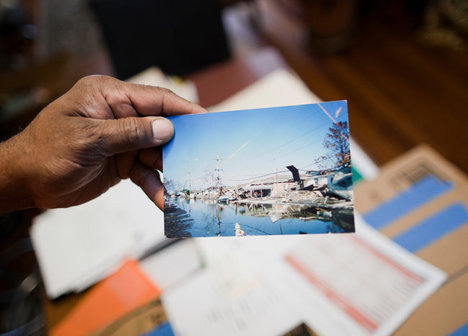
JosephErroBlockAfterKatrina2013-05-04.jpg “A photograph of Mr. Joseph’s block taken shortly after Hurricane Katrina. It took years to prove his house was salvageable.” Source of caption and photo: online version of the NYT article quoted and cited above.

Berkshire Buys Big into DaVita, Firm Accused of Medicare Fraud

Warren Buffett’s Berkshire Hathaway apparently has a large stake in DaVita Healthcare Partners. An earlier entry on this blog discussed accusations that DaVita Healthcare Partners has committed substantial healthcare fraud by charging the taxpayer millions of dollars for medicine that is needlessly thrown away. Apparently the DaVita investment is due to Ted Weschler, one of two deputies to whom Buffett has delegated the investment of some of Berkshire’s funds.

(p. 3D) Weschler is believed to be behind Berkshire’s aggressive move into DaVita Healthcare Partners — a stock he owned when he ran his own hedge fund. Berkshire bought 10.9 million shares last year, becoming Da-Vita’s largest stakeholder with 15.7 percent of the company. DaVita provides kidney dialy­sis services and is seen as a consistent cash-flow genera­tor. In November, the company closed its $4.7 billion purchase of Healthcare Partners, one of the country’s largest operators of medical groups and physi­cian networks. DaVita shares rose more than 35 percent in the past 12 months.

For the full story, see:

MarketWatch . “Buffett was avid hunter of 6 stocks last year; Wells Fargo, GM and DirecTV top Berkshire’s list.” Omaha World-Herald (Tues., March 12, 2013): 1D & 3D.

David Kay Johnston Defends Entrepreneurial Capitalism Against Crony Capitalism

FinePrintBK2013-04-28.jpg

Source of book image: http://media.npr.org/assets/bakertaylor/covers/manually-added/fineprint_custom-c26eb6a3f6c4d9bc09220769911f3cbeaa900b7f-s6-c10.jpg

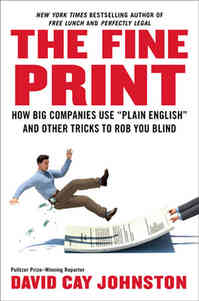
I saw an informative C-SPAN interview with David Cay Johnston a while back. I had known from Johnston’s previous books and reporting, that he was devoted to exposing the outrages of crony capitalism. What the interview revealed to me was that Johnston was not opposed to capitalism in general, and in fact viewed himself as friendly to entrepreneurial capitalism.

I believe that big companies are not bad when they got and stay big by honestly earning big profits from willing and delighted consumers. But big companies are bad when, as often happens, they use their size to get the government to suppress start-up competitors or to take money from taxpayers to subsidize their activities.
I have not yet read Johnston’s latest book on the big and bad, but I expect it to present sad, but useful, examples.

Book discussed:
Johnston, David Cay. The Fine Print: How Big Companies Use “Plain English” to Rob You Blind. New York: Portfolio, 2012.

The Costs of Green Jobs Policies

Regulating_to_disasterBK2013-04-24.jpg

Source of book image: http://javelindc.com/home/wp-content/uploads/2012/11/regulating_to_disaster.jpg

I caught part of a C-SPAN presentation on the Regulating to Disaster book. It sounded plausible and intriguing—consistent with other evidence I have seen that “green” jobs have been over-hyped and under-delivered.
Perhaps more important, there are the high opportunity costs of the tax dollars devoted to the “green” jobs, in terms of the non-green jobs that would have been created by entrepreneurs if less of their income had been taxed away.
I hope to look at the book in the near future.

Book discussed:
Furchtgott-Roth, Diana. Regulating to Disaster: How Green Jobs Policies Are Damaging America’s Economy. New York: Encounter Books, 2012.

Today Is 13th Anniversary of Democrats’ Infamous Betrayal of Elián González

GonzalezElianSeizedOn2000-04-22.jpg“In this April 22, 2000 file photo, Elian Gonzalez is held in a closet by Donato Dalrymple, one of the two men who rescued the boy from the ocean, right, as government officials search the home of Lazaro Gonzalez, early Saturday morning, April 22, 2000, in Miami. Armed federal agents seized Elian Gonzalez from the home of his Miami relatives before dawn Saturday, firing tear gas into an angry crowd as they left the scene with the weeping 6-year-old boy.” Source of caption and photo: online version of JENNIFER KAY and MATT SEDENSKY. “10 years later, few stirred by Elian Gonzalez saga.” Omaha World-Herald (Thurs., April 22, 2010): 7A. (Note: the online version of the article is dated April 21, 2010 and has the title “10 years after Elian, US players mum or moving on.”)

Today (April 22, 2013) is the 13th anniversary of one of the darkest days in American history—when the Democratic Clinton Administration seized a six year old child in order to force him back into the slavery that his mother had died trying to escape.

Tax Rates Have Big Effect on Labor Supply and Rate of Entrepreneurial Start-Ups

(p. A23) Higher taxes will produce long-term changes in social norms, behavior and growth. Edward Prescott, a winner of the Nobel Memorial Prize in economics, found that, in the 1950s when their taxes were low, Europeans worked more hours per capita than Americans. Then their taxes went up, reducing the incentives to work and increasing the incentives to relax. Over the next decades, Europe saw a nearly 30 percent decline in work hours.
The rich tend to be more sensitive to tax-rate changes because they’ve got advisers who are paid to be. Martin Feldstein, an economics professor at Harvard, looked into tax changes in the 1980s and concluded that raising rates causes people to shift compensations to untaxed fringe benefits and otherwise suppresses their economic activity. A study last year by the economists Michael Keane and Richard Rogerson found that tax rates can have a surprisingly large influence on how much people invest in education, how likely they are to create businesses and which professions they go into.

For the full commentary, see:
DAVID BROOKS. “The Progressive Shift.” The New York Times (Tues., March 19, 2013): A23.
(Note: the online version of the commentary has the date March 18, 2013.)

The Keane and Rogerson paper summarized by Brooks is:
Keane, Michael, and Richard Rogerson. “Micro and Macro Labor Supply Elasticities: A Reassessment of Conventional Wisdom.” Journal of Economic Literature 50, no. 2 (June 2012): 464-76.

Non-Paying Nations Send Heavy-Drinking Delegates to United Nations

(p. A20) UNITED NATIONS — When the United Nations began renovating its Manhattan headquarters in 2009, one of the first casualties of the construction was the storied Delegate’s Lounge, where for decades the delicate work of diplomacy was aided by a good stiff drink.
The loss of the bar led to protest from diplomats and their staffs, and a temporary outpost was soon established.
That bar is also now gone, but the thirst for liquor at the United Nations is apparently still strong.
This week, an American diplomat offered what he called a “modest proposal” that he hoped would speed along the United Nations’ notoriously protracted budgetary proceedings. He asked delegates to put a cork in it.
“The negotiation rooms should in future be an inebriation-free zone,” the diplomat, Joseph M. Torsella, said.
. . .
The United States’ plea for sobriety was reported on the Web site of Foreign Policy magazine. The article cited anonymous diplomats saying that the most recent budget negotiations, which concluded in December, featured at least one delegate who became sick from too much alcohol.
. . .
The United States, Japan and western European countries provide the majority of the United Nations’ budget. And many of the dozens of countries that make up the committee that sets the budget have little financial stake in the negotiations, so partaking of alcohol may seem a good way to endure marathon sessions that can last well into the night.

For the full story, see:
MARC SANTORA. “Diplomat Calls for End to Drunkenness During Negotiations at United Nations.” The New York Times (Fri., March 8, 2013): A20.
(Note: the online version of the review has the date March 7, 2013 and has the title “Diplomat Calls for End to Drunkenness During U.N. Negotiations.”)
(Note: ellipses added.)

New York Resisted Roosevelt’s Enforcing “Stupid” Vice Laws

IslandOfViceBK2013-03-09.jpg

Source of book image: http://media.npr.org/assets/bakertaylor/covers/i/island-of-vice/9780385519724_custom-e38a25fc66f104a049d4d24aa39dbe92d42fbd57-s6-c10.jpg

(p. C9) . . . as Richard Zacks’s excellent “Island of Vice: Theodore Roosevelt’s Doomed Quest to Clean Up Sin-Loving New York” ably shows, while we might like to believe that the stretch from 1970 to 1995 represents the city’s nadir, it was just about business as usual in New York over the centuries.

From its time as a Dutch colonial outpost, the city has always been pretty bad. You’d almost think New Yorkers prefer it that way. Of course, we don’t like fraud, robbery, assault, arson, rape or murder any more than anyone else does. But the deliberate injury of one’s fellow citizen isn’t the only way to break the law. There are also those crimes that fall under the broad category of “vice”: things such as gambling, prostitution, indecent exposure and selling alcohol at a convenient time. Historically, the average New Yorker has not greeted these acts with the same immediate urge to suppress that many of his or her fellow Americans have had. You don’t get a nickname like “The City That Never Sleeps” without having a certain amount of things worth staying up for.
. . .
In the end, Mr. Zacks’s exhaustively researched yet lively story is a classic battle between an irresistible force, Roosevelt’s ego, and an immovable object, the people of New York’s unwillingness to follow laws they thought were stupid. In this case, the object won, and handily. Mr. Zacks’s account of the way the city’s saloonkeepers instantly turned their establishments into hotels to take advantage of a loophole in the law is particularly amusing. Eventually, the police department, not unsympathetic to the Sunday tippler, began finding ways to wriggle out from under the commissioner’s thumb, and beer-friendly Tammany Hall, with the people solidly behind it, began peeling away his allies.

For the full review, see:
DAVID WONDRICH. “BOOKSHELF; Teddy’s Rough Ride.” The Wall Street Journal (Sat., March 17, 2012): C9.
(Note: ellipses added.)
(Note: the online version of the review has the date November 30, 2012.)

Book under review:
Zacks, Richard. Island of Vice: Theodore Roosevelt’s Doomed Quest to Clean up Sin-Loving New York. New York: Doubleday, 2012.

Chicago Gun Ban Laws Do Not Stop Chicago Gun Deaths

(p. A1) CHICAGO — Not a single gun shop can be found in this city because they are outlawed. Handguns were banned in Chicago for decades, too, until 2010, when the United States Supreme Court ruled that was going too far, leading city leaders to settle for restrictions some describe as the closest they could get legally to a ban without a ban. Despite a continuing legal fight, Illinois remains the only state in the nation with no provision to let private citizens carry guns in public.
And yet Chicago, a city with no civilian gun ranges and bans on both assault weapons and high-capacity magazines, finds itself laboring to stem a flood of gun violence that contributed to more than 500 homicides last year and at least 40 killings already in 2013, including a fatal shooting of a 15-year-old girl on Tuesday.
To gun rights advocates, the city provides stark evidence that even some of the toughest restrictions fail to make places safer. “The gun laws in Chicago only restrict the law-abiding citizens and they’ve essentially made the citizens prey,” said Richard A. Pearson, executive director of the Illinois State Rifle Association.

For the full story, see:
MONICA DAVEY. “Strict Gun Laws in Chicago Can’t Stem Fatal Shots.” The New York Times (Weds., January 30, 2013): A1 & A18.
(Note: the online version of the story has the date January 29, 2013, and has the slightly different title “Strict Gun Laws in Chicago Can’t Stem Fatal Shots.”)

Most in NYC Oppose Bloomberg’s Nanny State Soda Ban

OgunbiyiRocheDrinksLargeSodaTimesSquare2013-02-23.jpg “Theodore Ogunbiyi-Roche, 10, who is visiting from London, drank a large soda in Times Square . . . ” Source of caption and photo: online version of the NYT article quoted and cited below.

(p. A18) . . . , New Yorkers are cool to Mayor Michael R. Bloomberg’s plan to prohibit sales of large sugary drinks in city restaurants, stadiums and movie theaters, according to a . . . poll by The New York Times.

Six in 10 residents said the mayor’s soda plan was a bad idea, compared with 36 percent who called it a good idea. A majority in every borough was opposed; Bronx and Queens residents were more likely than Manhattanites to say the plan was a bad idea.
. . .
. . . those opposed overwhelmingly cited a sense that Mr. Bloomberg was overreaching with the plan and that consumers should have the freedom to make a personal choice . . .
“The ban is at the point where it is an infringement of civil liberties,” Liz Hare, 43, a scientific researcher in Queens, said in a follow-up interview. “There are many other things that people do that aren’t healthy, so I think it’s a big overreach.”
Bob Barocas, 64, of Queens, put it more bluntly: “This is like the nanny state going off the wall.”

For the full story, see:
MICHAEL M. GRYNBAUM and MARJORIE CONNELLY. “60% in City Oppose Soda Ban, Calling It an Overreach by Bloomberg, Poll Finds.” The New York Times (Thurs., August 23, 2012): A18.
(Note: ellipses in caption and article added.)
(Note: the online version of the story has the date August 22, 2012, and the title “60% in City Oppose Bloomberg’s Soda Ban, Poll Finds.”)