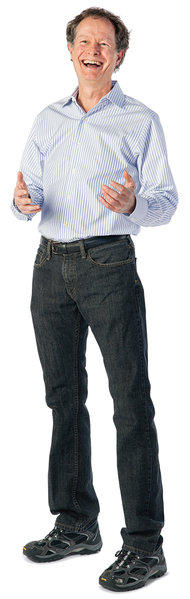
Entrepreneur Mackey Says Whole Foods Drops Prices as Larger Size Creates Economies of Scale

MackeyJohnWholeFoodsCEO2013-02-23.jpg

“John Mackey.” Source of caption and photo: online version of the NYT article quoted and cited below.

(p. 16) In your new book, “Conscious Capitalism,” you write that Whole Foods sees its customers as its “most important stakeholders” and that the company is obsessed with their happiness. The biggest complaint I hear about Whole Foods is how expensive it is. Why not drop prices to make your customers happier?
People always complain about prices being too high. Whole Foods prices have dropped every year as we get to be larger and we have economies of scale. Also, people are not historically well informed about food prices. We’re only spending about 7 percent of our disposable personal income on food. Fifty years ago, it was nearly 16 percent.
. . .
In 2009, some Whole Foods customers organized boycotts after you wrote an op-ed in The Wall Street Journal expressing opposition to Obama’s health care proposals. Do you wish you hadn’t written it?
No, I don’t. I regret that a lot of people didn’t actually read it and it got taken out of context. President Obama asked for ideas about health care reform, and I put my ideas out there. Whole Foods has a good health care plan. It’s not a solution to America’s health care problems, but it’s part of the solution.
So did you vote for Romney?
I did.
I imagine a certain percentage of Whole Foods customers will also boycott because of this.
I don’t know what to say except that I’m a capitalist, first. There are many things I don’t like about Romney, but more things I don’t like about Obama. This is America, and people disagree on things.

For the full interview, see:
Andrew Goldman, Interviewer. “TALK; The Kale King.” The New York Times Magazine (Sun., January 20, 2013): 16.
(Note: ellipsis added; bold in original, indicating interviewer questions.)
(Note: the online version of the interview has the date January 18, 2013, and has the title “TALK; John Mackey, the Kale King.”)

Mackey’s book is:
Mackey, John, and Rajendra Sisodia. Conscious Capitalism: Liberating the Heroic Spirit of Business. Boston, MA: Harvard Business Review Press, 2013.

Admiring Jobs’ New Products, Gates Wistfully Wondered If “Maybe I Should Have Stayed in That Game”

(p. 553) Bill Gates had never lost his fascination with Jobs. In the spring of 2011 I was at a dinner with him in Washington, where he had come to discuss his foundation’s global health endeavors. He expressed amazement at the success of the iPad and how Jobs, even while sick, was focusing on ways to improve it. “Here I am, merely saving the world from malaria and that sort of thing, and Steve is still coming up with amazing new products,” he said wistfully. “Maybe I should have stayed in that game.” He smiled to make sure that I knew he was joking, or at least half joking.

Source:
Isaacson, Walter. Steve Jobs. New York: Simon & Schuster, 2011.

Darwin Shared His Thought Processes Without Condescension

DarwinCharlesIn1881.jpg

“SAGE OF AGES; Portrait of Charles Darwin in 1881, by Julia Margaret Cameron.” Source of caption and photo: online version of the WSJ article quoted and cited below.

(p. C14) . . . Mr. Johnson observes:

No scientific innovator has ever taken more trouble to smooth the way for lay readers without descending into vulgarity. What is almost miraculous about the book is Darwin’s generosity in sharing his thought processes, his lack of condescension. There is no talking down, but no hauteur, either. It is a gentlemanly book.

In both style and substance, this passage is classic Paul Johnson.
. . .
What makes Darwin good, in the biographer’s estimation, is the scientist’s democratic dissemination of knowledge. Darwin triumphed with “The Origin of Species,” Mr. Johnson contends, not only because of his ability to portray the theory of evolution as the inescapable outcome of his decades of study and the work of fellow scientists, whom he was careful to praise, but because he was acutely aware that he had to present his notions of natural selection and survival of the fittest so as not to stir up public controversy. To an extraordinary degree, Darwin deflected attacks by couching his discoveries in terms of the plants he liked to examine and cultivate. He had relatively little to say about human evolution.

For the full review, see:
CARL ROLLYSON. “Studies of the Moral Animal.” The Wall Street Journal (Sat., December 15, 2012): C14.
(Note: ellipses added.)
(Note: the online version of the review essay has the date December 14, 2012.)

The book under review is:
Johnson, Paul M. Darwin: Portrait of a Genius. New York: Viking Adult, 2012.

Fossil Fuels Are Making the Planet Greener

(p. C4) The latest and most detailed satellite data, which is yet to be published but was summarized in an online lecture last July by Ranga Myneni of Boston University, confirms that the greening of the Earth has now been going on for 30 years. Between 1982 and 2011, 20.5% of the world’s vegetated area got greener, while just 3% grew browner; the rest showed no change.

What explains this trend? Man-made nitrogen fertilizer causes crops to grow faster, but it is having little effect on forests. There are essentially two possibilities: climate and carbon dioxide itself. Warmer, wetter weather should cause more vegetation to grow. But even without warming, an increase in carbon dioxide should itself accelerate growth rates of plants. CO2 is a scarce resource that plants have trouble scavenging from the air, and plants grow faster with higher levels of CO2 to inhale.
Dr. Myneni reckons that it is now possible to distinguish between these two effects in the satellite data, and he concludes that 50% is due to “relaxation of climate constraints,” i.e., warming or rainfall, and roughly 50% is due to carbon dioxide fertilization itself. In practice, the two interact. A series of experiments has found that plants tolerate heat better when CO2 levels are higher.
The inescapable if unfashionable conclusion is that the human use of fossil fuels has been causing the greening of the planet in three separate ways: first, by displacing firewood as a fuel; second, by warming the climate; and third, by raising carbon dioxide levels, which raise plant growth rates.

For the full commentary, see:
MATT RIDLEY. “MIND & MATTER; “How Fossil Fuels Have Greened the Planet.” The Wall Street Journal (Sat., January 5, 2013): C4.
(Note: the online version of the commentary has the date January 4, 2013.)

Entrepreneur Kurzweil Says If He Gets Cancer, He Will Invent a Cure

KurzweilRay2013-02-03.jpg

“Ray Kurzweil.” Source of caption and photo: online version of the NYT article quoted and cited below.

(p. 12) As a futurist, you are famous for making predictions of when technological innovations will actually occur. Are you willing to predict the year you will die?
My plan is to stick around. We’ll get to a point about 15 years from now where we’re adding more than a year every year to your life expectancy.

To clarify, you’re predicting your immortality.
The problem is I can’t get on the phone with you in the future and say, “Well, I’ve done it, I have lived forever,” because it’s never forever.
. . .
You’ve said that if you woke up one day with a terminal disease, you’d be forced to invent a cure. Were you being serious?
I absolutely would try. I’m working now on a cancer project with some scientists at M.I.T., and if I develop cancer, I do have some ideas of what I would do.
I imagine a lot of people would hear that and say, Ray, if you think you’re capable of curing yourself, why don’t you go ahead and start curing others?
Well, I mean, I do have to pick my priorities. Nobody can do everything. What we spend our time on is probably the most important decision we make. I don’t know if you’re aware, but I’m joining Google as director of engineering.

For the full interview, see:
Andrew Goldman, Interviewer. “TALK; The Life Robotic; The Futurist Ray Kurzweil Says We’re Going to Live Forever. Really.” The New York Times Magazine (Sun., January 27, 2013): 12.
(Note: ellipsis added; bold in original, indicating interviewer questions.)
(Note: the online version of the interview has the date January 25, 2013, and has the title “TALK; Ray Kurzweil Says We’re Going to Live Forever.”)

Steve Jobs Advised Obama to Reduce Regulations of Business and Union Power in Education

(p. 544) The meeting . . . lasted forty-five minutes, and Jobs did not hold back. “You’re headed for a one-term presidency,” Jobs told Obama at the outset. To prevent that, he said, the administration needed to be a lot more business-friendly. He described how easy it was to build a factory in China, and said that it was almost impossible to do so these days in America, largely because of regulations and unnecessary costs.
Jobs also attacked America’s education system, saying that it was hopelessly antiquated and crippled by union work rules. Until the teachers’ unions were broken, there was almost no hope for education reform. Teachers should be treated as professionals, he said, not as industrial assembly-line workers. Principals should be able to hire and fire them based on how good they were. Schools should be staying open until at least 6 p.m. and be in session eleven months of the year. It was absurd, he added, that American classrooms were still based on teachers standing at a board and using textbooks. All books, learning materials, and assessments should be digital and interactive, tailored to each student and providing feedback in real time.

Source:
Isaacson, Walter. Steve Jobs. New York: Simon & Schuster, 2011.
(Note: ellipsis added.)

Entrepreneur Peter Thiel Says We Should Fight for Longer Lives

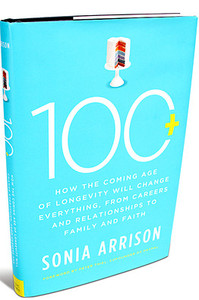
100PlusBK2013-01-12.jpg

Source of book image: http://si.wsj.net/public/resources/images/OB-PJ926_bkrv10_DV_20110829191924.jpg

(p. C13) Sonia Arrison’s “100 Plus” was first published in 2011, but its message is evergreen: how scientists are directly attacking the problem of aging and death and why we should fight for life instead of accepting decay as inevitable. The goal of longer life doesn’t just mean more years at the margin; it means a healthier old age. There is nothing to fear but our own complacency.

For the full review essay, see:
Peter Thiel (author of passage quoted above, one of 50 contributors to whole article). “Twelve Months of Reading; We asked 50 of our friends to tell us what books they enjoyed in 2012–from Judd Apatow’s big plans to Bruce Wagner’s addictions. See pages C10 and C11 for the Journal’s own Top Ten lists.” The Wall Street Journal (Sat., December 15, 2012): passim (Thiel’s contribution is on p. C13).
(Note: the online version of the review essay has the date December 14, 2012.)

The book Thiel endorses is:
Arrison, Sonia. 100 Plus: How the Coming Age of Longevity Will Change Everything, from Careers and Relationships to Family and Faith. New York: Basic Books, 2011.

Higher Taxes Would Slow Creation of Entrepreneur Bronfein’s Time-Saving Medical Robotic Systems

(p. A11) . . . in Baltimore, . . . a local entrepreneur, following the logic of need, invested seven years and $30 million developing a robotic system for packaging prescription drugs for long-term patients in nursing homes and hospitals.
In a conversation last year, inventor Michael Bronfein told me if he’d known what it would cost him in time and money, he might never have started. How many entrepreneurs say the same? Probably all of them. But Mr. Bronfein saw a need and the power of technology to meet it, and the result was the Paxit automated medication dispensing system.
He saw workers spending hours under the old system sticking pills in monthly blister packs known as “bingo cards,” a process expensive and error-prone. He saw nurses on the receiving end then spending time to pluck the pills out of blister packs and into paper cups, to create the proper daily drug regimen for each patient.
. . .
He followed the economic logic that indicated that all the people involved in the old system were becoming too valuable to have their time wasted by the old system. Backed by his company, Remedi SeniorCare, Paxit–in which a robot packages, labels and dispatches a daily round of medicines for each patient–is spreading across the mid-Atlantic and Midwest and winning plaudits from medical-care providers.
. . .
We need to preserve the incentive for investors to bring us the robots that will make the future bearable, rather than burying entrepreneurs in taxes in a vain attempt to seize the returns of investments before those investments are made.

For the full commentary, see:
Jenkins, HOLMAN W., JR. “BUSINESS WORLD; Robots to the Rescue? The flip side of an entitlements crisis is a labor shortage.” The Wall Street Journal (Weds., January 9, 2013): A11.
(Note: ellipses added.)
(Note: the online version of the review has the date January 8, 2013.)

IKEA Says Government Bureaucracy Slows Job Creation

OhlssonMikaelCEOofIKEA2013-02-03.jpg “The economy ‘will remain challenging for a long time,’ says IKEA Chief Executive Mikael Ohlsson.” Source of caption and photo: online version of the WSJ article quoted and cited below.

(p. B3) MALMO, Sweden–IKEA is poised to embark on a global spending spree, but its departing chief executive says red tape is slowing how fast the home-furnishings retailer can open its pocket book.

With the company set to report record sales on Wednesday, CEO Mikael Ohlsson said the amount of time it takes to open a store has roughly doubled in recent years.
“What some years ago took two to three years, now takes four to six years. And we also see that there’s a lot of hidden obstacles in different markets and also within the [European Union] that’s holding us back,” he said in an interview recently at an IKEA store on Sweden’s western coast.
. . .
IKEA plans to invest €2 billion in stores, factories and renewable energy this year. But the company fell €1 billion short of its goal of investing €3 billion in new projects last year, largely because of bureaucratic obstacles, he said. For 10 years IKEA has tried unsuccessfully to relocate a store in France, for example. The company also is challenging German policy dictating what can be sold and where, saying the rules are out of sync with EU legislation.
“It’s a pity, because it can help create jobs and investments at a time when unemployment is high in many countries,” Mr. Ohlsson said. A new IKEA store creates construction and store jobs for about 1,000 workers, he said.
. . .
The company’s highest-profile headaches have come in India, an untapped market where IKEA wants to open a first store in at least five years and roll out an additional three soon thereafter.

For the full story, see:
ANNA MOLIN. “IKEA Chief Takes Aim at Red Tape.” The Wall Street Journal (Weds., January 23, 2013): B3.
(Note: ellipses added.)
(Note: the online version of the story has the date January 22, 2013.)

Steve Jobs Framing a Decision in Terms of Christensen’s “The Innovator’s Dilemma”

The following passage is Steve Jobs speaking, as quoted by Walter Isaacson.

(p. 532) It’s important that we make this transformation, because of what Clayton Christensen calls “the innovator’s dilemma,” where people who invent something are usually the last ones to see past it, and we certainly don’t want to be left behind. I’m going to take MobileMe and make it free, and we’re going to make syncing content simple. We are building a server farm in North Carolina. We can provide all the syncing you need, and that way we can lock in the customer.

Source:
Isaacson, Walter. Steve Jobs. New York: Simon & Schuster, 2011.

Arne Duncan Endorses Christensen’s Disruption of All Levels of Education

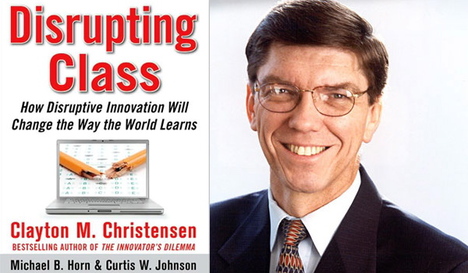
DisruptingClassAndChristensen2013-01-11.jpg

Source of book image and photo of Christensen: http://images.businessweek.com/ss/08/12/1215_best_design_books/image/disruptingclass.jpg

(p. C6) Clayton Christensen is a provocative thinker, and I have been greatly influenced by his work on disruptive innovation and how it can transform education.

For the full review essay, see:
Arne Duncan (author of passage quoted above, one of 50 contributors to whole article). “Twelve Months of Reading; We asked 50 of our friends to tell us what books they enjoyed in 2012–from Judd Apatow’s big plans to Bruce Wagner’s addictions. See pages C10 and C11 for the Journal’s own Top Ten lists.” The Wall Street Journal (Sat., December 15, 2012): passim (Duncan’s contribution is on p. C6).
(Note: the online version of the review essay has the date December 14, 2012.)

Christensen’s books suggesting disruptive innovations for education are:
Christensen, Clayton M., Curtis W. Johnson, and Michael B. Horn. Disrupting Class: How Disruptive Innovation Will Change the Way the World Learns. updated ed. New York: NY: McGraw-Hill, 2011.
Christensen, Clayton M., and Henry J. Eyring. The Innovative University: Changing the DNA of Higher Education from the inside Out. San Francisco, CA: Jossey-Bass, 2011.