Behavioral Economists and Psychologists Pledged to Keep Silent on Their Advice to Re-Elect Obama

(p. D1) Late last year Matthew Barzun, an official with the Obama campaign, called Craig Fox, a psychologist in Los Angeles, and invited him to a political planning meeting in Chicago, according to two people who attended the session.
“He said, ‘Bring the whole group; let’s hear what you have to say,’ ” recalled Dr. Fox, a behavioral economist at the University of California, Los Angeles.
So began an effort by a team of social scientists to help their favored candidate in the 2012 presidential election. Some members of the team had consulted with the Obama campaign in the 2008 cycle, but the meeting in January signaled a different direction.
“The culture of the campaign had changed,” Dr. Fox said. “Before then I felt like we had to sell ourselves; this time there was a real hunger for our ideas.”
. . .
(p. D6) When asked about the outside psychologists, the Obama campaign would neither confirm nor deny a relationship with them.
. . .
For their part, consortium members said they did nothing more than pass on research-based ideas, in e-mails and conference calls. They said they could talk only in general terms about the research, because they had signed nondisclosure agreements with the campaign.
In addition to Dr. Fox, the consortium included Susan T. Fiske of Princeton University; Samuel L. Popkin of the University of California, San Diego; Robert Cialdini, a professor emeritus at Arizona State University; Richard H. Thaler, a professor of behavioral science and economics at the University of Chicago’s business school; and Michael Morris, a psychologist at Columbia.
“A kind of dream team, in my opinion,” Dr. Fox said.

For the full story, see:
BENEDICT CAREY. “Academic ‘Dream Team’ Helped Obama’s Effort.” The New York Times (Tues., November 13, 2012): D1 & D6.
(Note: ellipses added.)
(Note: the online version of the story has the date November 12, 2012.)
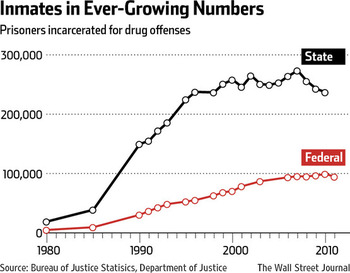
The War on Drugs Likely “Increased the Rate of Addiction”

DrugPrisonerGraph2013-02-03.jpg

Source of graph: online version of the WSJ commentary quoted and cited below.

(p. C1) President Richard Nixon declared a “war on drugs” in 1971. The expectation then was that drug trafficking in the United States could be greatly reduced in a short time through federal policing–and yet the war on drugs continues to this day. The cost has been large in terms of lives, money and the well-being of many Americans, especially the poor and less educated. By most accounts, the gains from the war have been modest at best.

The direct monetary cost to American taxpayers of the war on drugs includes spending on police, the court personnel used to try drug users and traffickers, and the guards and other resources spent on imprisoning and punishing those convicted of drug offenses. Total current spending is estimated at over $40 billion a year.
These costs don’t include many other harmful effects of the war on drugs that are difficult to quantify. For example, over the past 40 years the fraction of students who have dropped out of American high schools has remained large, at about 25%. Dropout rates are not high for middle-class white children, but they are very high for black and Hispanic children living in poor neighborhoods. Many factors explain the high dropout rates, especially bad schools and weak family support. But another important factor in inner-city neighborhoods is the temptation to drop out of school in order to profit from the drug trade.
The total number of persons incarcerated in state and federal prisons in the U.S. has grown from 330,000 in 1980 to about 1.6 million today. Much of the increase in this population is directly due to the war on drugs and the severe punishment for persons convicted of drug trafficking. About 50% of the inmates in federal prisons and 20% of those in state prisons have been convicted of either selling or using drugs. The many minor drug traffickers and drug users who spend time in jail find fewer opportunities for legal employment after they get out of prison, and they develop better skills at criminal activities.
. . .
(p. C2) It is generally harder to break an addiction to illegal goods, like drugs. Drug addicts may be leery of going to clinics or to nonprofit “drugs anonymous” groups for help. They fear they will be reported for consuming illegal substances. Since the consumption of illegal drugs must be hidden to avoid arrest and conviction, many drug consumers must alter their lives in order to avoid detection.
Usually overlooked in discussions of the effects of the war on drugs is that the illegality of drugs stunts the development of ways to help drug addicts, such as the drug equivalent of nicotine patches. Thus, though the war on drugs may well have induced lower drug use through higher prices, it has likely also increased the rate of addiction. The illegality of drugs makes it harder for addicts to get help in breaking their addictions. It leads them to associate more with other addicts and less with people who might help them quit.
. . .
The decriminalization of both drug use and the drug market won’t be attained easily, as there is powerful opposition to each of them. The disastrous effects of the American war on drugs are becoming more apparent, however, not only in the U.S. but beyond its borders. Former Mexican President Felipe Calderon has suggested “market solutions” as one alternative to the problem. Perhaps the combined efforts of leaders in different countries can succeed in making a big enough push toward finally ending this long, enormously destructive policy experiment.

For the full commentary, see:
GARY S. BECKER and KEVIN M. MURPHY. “Have We Lost the War on Drugs? After more than four decades of a failed experiment, the human cost has become too high. It is time to consider the decriminalization of drug use and the drug market.” The Wall Street Journal (Sat., January 5, 2013): C1 & C2.
(Note: the online version of the commentary has the date January 4, 2013.)

Apple’s Corporate Culture Under Jobs: “Accountability Is Strictly Enforced”

(p. 531) In theory, you could go to your iPhone or any computer and access all aspects of your digital life. There was, however, a big problem: The service, to use Jobs’s terminology, sucked. It was complex, devices didn’t sync well, and email and other data got lost randomly in the ether. “Apple’s MobileMe Is Far Too Flawed to Be Reliable,” was the headline on Walt Mossberg’s review in the Wall Street Journal.
Jobs was furious. He gathered the MobileMe team in the auditorium on the Apple campus, stood onstage, and asked, “Can anyone tell me what MobileMe is supposed to do?” After the team members offered their answers, Jobs shot back: “So why the fuck doesn’t it do that?” Over the next half hour he continued to berate them. “You’ve tarnished Apple’s reputation,” he said. You should hate each other for having let each other down. Mossberg, our friend, is no longer writing good things about us.” In front of the whole audience, he got rid of the leader of the MobileMe team and replaced him with Eddy Cue, who oversaw all Internet content at Apple. As Fortune’s Adam Lashinsky reported in a dissection of the Apple corporate culture, “Accountability is strictly enforced.”

Source:
Isaacson, Walter. Steve Jobs. New York: Simon & Schuster, 2011.

Is America Moving Toward a Less Upwardly Mobile Future?

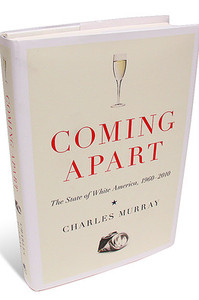
Coming-ApartBK2013-01-11.jpg

Source of book image: http://catholicexchange.com/wp-content/uploads/2012/07/Coming-Apart.jpg

(p. C6) The future as described by Charles Murray in “Coming Apart” is bleak enough to have been imagined by George Orwell. Unfortunately, “Coming Apart” is nonfiction, meticulously documented and depressingly real. Mr. Murray examines America as it moves away from an upwardly mobile, socially mobile country with shared purpose and shared identities to a country dividing into two isolated and disparate camps.

For the full review essay, see:
Jeb Bush (author of passage quoted above, one of 50 contributors to whole article). “Twelve Months of Reading; We asked 50 of our friends to tell us what books they enjoyed in 2012–from Judd Apatow’s big plans to Bruce Wagner’s addictions. See pages C10 and C11 for the Journal’s own Top Ten lists.” The Wall Street Journal (Sat., December 15, 2012): passim (Bush’s contribution is on p. C6).
(Note: the online version of the review essay has the date December 14, 2012.)

The book under review, is:
Murray, Charles. Coming Apart: The State of White America, 1960-2010. New York: Crown Forum, 2012.

Ending College Affirmative Action Would Only Cause Minor Lowering in Black Admissions

(p. 113) This research examines the determinants of the match between high school seniors and postsecondary institutions in the United States. I model college application decisions as a nonsequential search problem and specify a unified structural model of college application, admission, and matriculation decisions that are all functions of unobservable individual heterogeneity. The results indicate that black and Hispanic representation at all 4-year colleges is predicted to decline modestly–by 2%–if race-neutral college admissions policies are mandated nationwide. However, race-neutral admissions are predicted to decrease minority representation at the most selective 4-year institutions by 10%.

Source of abstract:
Howell, Jessica S. “Assessing the Impact of Eliminating Affirmative Action in Higher Education.” Journal of Labor Economics 28, no. 1 (January 2010): 113-66.

Lichen Fungi May Never Age

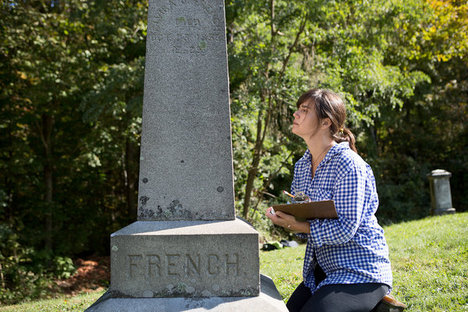
PringleAnneLichenResearch2013-01-12.jpg “ANNUAL VISITOR; For the last eight years, Anne Pringle of Harvard has been collecting data about the lichens on the gravestones at a cemetary in Petersham, Mass.” Source of caption and photo: online version of the NYT article quoted and cited below.

(p. D3) PETERSHAM, Mass. — On a sparkling New England afternoon, as hawks coasted overhead and yellow leaves drifted to the ground, Anne Pringle stood before a large granite obelisk that marked the graves of a family called French.
. . .
For eight years, Dr. Pringle, 42, has been returning to this cemetery each fall, to measure, sketch and scrutinize the lichens, which belong to the genus Xanthoparmelia. She wants to know whether they deteriorate with the passage of time, leaving them more susceptible to death.
. . .
Lichens are not individuals but tiny ecosystems, composed of one main fungus, a group of algae and an assortment of smaller fungi and bacteria.
. . .
While lichens are communities, Dr. Pringle is largely interested in the fungi. Mycologists, the scientists who study fungi — not the most glamorous corridor of biology — have long assumed that many of these organisms don’t age.
. . .
“What you know is based on the organisms you study,” she said. “What would you say about the evolution of senescence if instead of working with insects, you worked with modular organisms, which is what lichen are?”
Daniel Doak, a University of Colorado ecologist, agrees that the question is worth asking. Research like Dr. Pringle’s — along with other studies of species including the bristlecone pine tree and the wandering albatross, a bird, both of which may avoid senescence — suggests another possible path.
“It’s saying something fundamental,” Dr. Doak said, “that senescence is not an inevitable part of life. Which means there might be ways to prevent it.” That idea could eventually have implications for human medicine.
. . .
Dr. Pringle’s preliminary results show that as a lichen grows older and larger, it is less likely to die. “If you made me answer the question now,” she said, “I’d say there can be senescence of parts of an individual. But I don’t think an individual ever senesces.”

For the full story, see:
HILLARY ROSNER. “In a Place for the Dead, Studying a Seemingly Immortal Species.” The New York Times (Tues., January 1, 2013): D3.
(note: ellipses added.)
(Note: the online version of the story has the date December 31, 2012.)

LichenCommunity2013-01-12.jpg“THRIVING; Dr. Pringle’s initial results show that as a lichen grows older and larger, it is less likely to die.” Source of caption and photo: online version of the NYT article quoted and cited above.

The Universality of Values: Every Kid Wants a Cell Phone

(p. 528) When they got to Istanbul, . . . [Jobs] hired a history professor to give his family a tour. At the end they went to a Turkish bath, where the professor’s lecture gave Jobs an insight about the globalization of youth:

I had a real revelation. We were all in robes, and they made some Turkish coffee for us. The professor explained how the coffee was made very different from anywhere else, and I realized, “So fucking what?” Which kids even in Turkey give a shit about Turkish coffee? All day I had looked at young people in Istanbul. They were all drinking what every other kid in the world drinks, and they were wearing clothes that look like they were bought at the Gap, and they are all using cell phones. They were like kids everywhere else. It hit me that, for young people, this whole world is the same now. When we’re making products, there is no such thing as a Turkish phone, or a music player that young people in Turkey would want that’s different from one young people elsewhere would want. We’re just one world now.

Source:
Isaacson, Walter. Steve Jobs. New York: Simon & Schuster, 2011.
(Note: ellipsis and bracketed “Jobs” added; indented Jobs block quote was indented in the original.)

What Reagan Meant When He Said Trees Cause Pollution

ReagansPathToVictoryBK2011-03-11.jpg

Source of the book image: http://thecommentary.ca/images/books/Reagan2.jpg

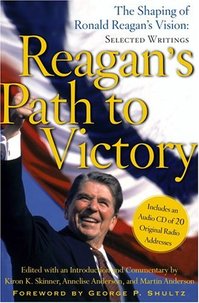
(p. 10) For better or worse, Reagan’s ability to spin yarns out of everything that ever went into his mind is on display in ”Reagan’s Path to Victory,” the fourth volume in a series of collected speeches, letters and scripts published over the past four years. This one, edited like the others by Kiron K. Skinner, Annelise Anderson and Martin Anderson, is a chronological compilation of the syndicated radio talks Reagan delivered from 1975 to 1979.
. . .
In 1980, as a reporter freshly hired by Time magazine, I was assigned to Reagan’s campaign plane. My first week on the road, while listening to him give a speech in which he talked about how trees cause pollution and other quirky notions, an aide turned to me and said, ”Where did he get those facts?” I wrote a story, parsing the misleading little factoids that studded his stump speeches; the headline was that quote. The afternoon the article appeared, I was invited to sit next to Reagan on his campaign plane. I was braced for a rough lecture, but none came. I realized that he was either smart enough not to have read the article, or smart enough to pretend he hadn’t — or merely smart enough to know it wouldn’t matter. I also learned, when I started to play the old journalistic gotcha game by questioning him on issues ranging from Taiwan to his affection for the gold standard, that he was able to flea-flick the subjects away by launching into some amusing but irrelevant anecdote. At first I thought he was a bit oblivious. Eventually, I realized I was the oblivious one. He knew exactly what he was doing.
Now, having read the collection of his radio addresses, I even know what he was thinking when he proclaimed that most pollution is caused by trees. In a rather convoluted talk, in which he identifies the main pollution problem as oxides of nitrogen, he grandly declares: ”Nature it seems also produces oxides of nitrogen. As a matter of fact, nature produces 97 percent of them. If we could successfully eliminate 100 percent of all the man-produced polluting oxides of nitrogen, we’d still have 97 percent of what we presently have.”
So we’re a little closer to knowing where Ronald Reagan got his facts, and even a bit closer to knowing where he got his beliefs. And that’s not a bad step toward understanding the deeper questions and mysteries about him.

For the full review, see:
Walter Isaacson. “The Reagan Evolution.” The New York Times Book Review (Sun., October 31, 2004): 9-10.
(Note: ellipsis added.)
(Note: the online version of the review has the title “‘The Tycoons’: Benefactors of Great Wealth.”)

Book discussed in passage quoted above:
Skinner, Kiron K., Annelise Anderson, and Martin Anderson, eds. Reagan’s Path to Victory; the Shaping of Ronald Reagan’s Vision; Selected Writings. New York: Free Press, 2004.

“Rome’s Rise Is a Story of Economic Growth, Not Divine Intervention or Native Virtue”

(p. C7) In chronicling the decline and fall of the Roman Empire, Edward Gibbon declared that “if a man were called to fix the period in the history of the world during which the human race was most happy and prosperous, he would, without hesitation, name that which elapsed from the death of Domitian to the accession of Commodus.” Gibbon himself elegantly narrated how happiness and prosperity withered after this flowering between 96 and 180 A.D. But what about the near-millennium of Roman history that came before? “What was it,” as Anthony Everitt asks in “The Rise of Rome,” “that enabled a small Italian market town by a ford on the river Tiber to conquer the known world” and thereby made Gibbon’s golden years possible?
. . .
Most of that economic activity, whether it developed autonomously as a result of lower costs or was driven by the coercive rule of the state, was catalyzed by the Mediterranean, with which even the sophisticated Roman road network could not compete. Yet in the period from the middle of the third century B.C. to the middle of the first, Mr. Everitt, following his literary sources, directs our attention to Hamilcar, the Carthaginian general; and to Hannibal, his hot-tempered son, leading elephants first across the Pyrenees and then the Alps. Both are important, and, had they not been defeated, Rome would have had a very short “rise” indeed. But the real action was on the Mediterranean. As the number of shipwrecks datable to these years attests, it was being crossed by trading vessels with a frequency never yet seen and never again matched–including the halcyon years hymned by Gibbon.
Sometimes the data can preserve an astonishingly precise record of a trade route. For example, storage containers–probably for wine–salvaged from the spectacular wrecks at Grand Congloué, off Marseilles, bear the stamp “SES.” Archaeologists have confidently linked this mark with a certain Sestius, who must have manufactured the wares at the villa we know he owned in southwestern Tuscany, no mean distance away.
When the shipwreck data, which suggest increased economic activity, are considered alongside the population contraction that Rome suffered in its bloody military campaigns, a tentative but rich answer to Mr. Everitt’s question begins to emerge: Rome’s rise is a story of economic growth, not divine intervention or native virtue. And although even this account, like all our conclusions about the distant past, must be provisional, it is at least anchored in an empirical model of how income gains from trade and lowered transaction costs were not swallowed up by an ever-expanding population.

For the full review, see:
BRENDAN BOYLE. “BOOKSHELF; The Economy of Empire; The rise of the world’s greatest empire is as much a story of shipping and markets as of divine providence and individual virtue.” The Wall Street Journal (Sat., September 22, 2012): C7.
(Note: ellipsis added.)
(Note: the online version of the article was dated September 21, 2012.)

Social Scientists Prefer Articles that Contain Bogus Math

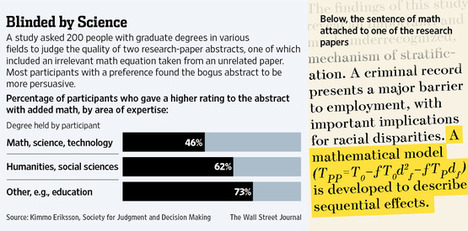
MathBiasGraphic2013-01-12.jpgSource of graphic: online version of the WSJ article quoted and cited below.

(p. A2) . . . research has shown that even those who should be especially clear-sighted about numbers–scientific researchers, for example, and those who review their work for publication–are often uncomfortable with, and credulous about, mathematical material. As a result, some research that finds its way into respected journals–and ends up being reported in the popular press–is flawed.

In the latest study, Kimmo Eriksson, a mathematician and researcher of social psychology at Sweden’s Mälardalen University, chose two abstracts from papers published in research journals, one in evolutionary anthropology and one in sociology. He gave them to 200 people to rate for quality–with one twist. At random, one of the two abstracts received an additional sentence, the one above with the math equation, which he pulled from an unrelated paper in psychology. The study’s 200 participants all had master’s or doctoral degrees. Those with degrees in math, science or technology rated the abstract with the tacked-on sentence as slightly lower-quality than the other. But participants with degrees in humanities, social science or other fields preferred the one with the bogus math, with some rating it much more highly on a scale of 0 to 100.
“Math makes a research paper look solid, but the real science lies not in math but in trying one’s utmost to understand the real workings of the world,” Prof. Eriksson said.

For the full story, see:
CARL BIALIK. “THE NUMBERS GUY; Don’t Let Math Pull the Wool Over Your Eyes.” The Wall Street Journal (Sat., January 5, 2013): A2.
(Note: ellipsis added.)
(Note: the online version of the story has the date January 4, 2013,)

A pdf of Eriksson’s published article can be downloaded from:
Eriksson, Kimmo. “The Nonsense Math Effect.” Judgment and Decision Making 7, no. 6 (November 2012): 746-49.

Steve Jobs Viewed Patents as Protecting Property Rights in Ideas

(p. 512) . . . Apple filed suit against HTC (and, by extension, Android), alleging infringement of twenty of its patents. Among them were patents covering various multi-touch gestures, swipe to open, double-tap to zoom, pinch and expand, and the sensors that determined how a device was being held. As he sat in his house in Palo Alto the week the lawsuit was filed, he became angrier than I had ever seen him:

Our lawsuit is saying, “Google, you fucking ripped off the iPhone, wholesale ripped us off.” Grand theft. I will spend my last dying breath if I need to, and I will spend every penny of Apple’s $40 billion in the bank, to right this wrong. I’m going to destroy Android, because it’s a stolen product. I’m willing to go to thermonuclear war on this. They are scared to death, because they know they are guilty. Outside of Search, Google’s products–Android, Google Docs–are shit.

A few days after this rant, Jobs got a call from Schmidt, who had resigned from the Apple board the previous summer. He suggested they get together for coffee, and they met at a café in a Palo Alto shopping center. “We spent half the time talking about personal matters, then half the time on his perception that Google had stolen Apple’s user interface designs,” recalled Schmidt. When it came to the latter subject, Jobs did most of the talking. Google had ripped him off, (p. 513) he said in colorful language. “We’ve got you red-handed,” he told Schmidt. “I’m not interested in settling. I don’t want your money. If you offer me $5 billion, I won’t want it. I’ve got plenty of money. I want you to stop using our ideas in Android, that’s all I want.” They resolved nothing.

Source:
Isaacson, Walter. Steve Jobs. New York: Simon & Schuster, 2011.
(Note: ellipsis added.)