Obama Industrial Policy Risks Funding Dead Ends

(p. B1) President Obama has cast himself as a reluctant interventionist in two of the nation’s major industries, Wall Street and Detroit. The federal aid, he says, is a financial bridge to a postcrisis future and the hand-holding will be temporary.

Even so, the scale of the government investment and control — especially by the auto task force now vetting plans at Chrysler and General Motors — points to an approach that has been shunned by the United States more than other developed nations.
“By any coherent definition, this is industrial policy,” said Marcus Noland, a senior fellow at the Peterson Institute for International Economics.
. . .
(p. B7) . . . a more comprehensive, industrial-policylike approach to Detroit carries its own perils, economists say. In trying to manage the industrial shrinkage, they say, there is a fine line between easing the social impact and protecting jobs in ways that inhibit economic change and renewal. In pursuit of new growth, governments risk encouraging overinvestment in areas that prove to be technological dead ends.
In the Japanese experience, economists see evidence of both dangers. Problems, they say, are typically byproducts of what economists call “political capture.” That is, an industrial sector earmarked for special government attention builds up its own political constituency, lobbyists and government bureaucrats to serve that industry. They slow the pace of change, and an economy becomes less nimble and efficient as a result.
Economists say the phenomenon is scarcely confined to nations with explicit industrial policies and cite the history of agricultural subsidies in America or military procurement practices.
But going down the path of industrial policy certainly holds that risk. “You have to bear in mind the opportunity costs of these kinds of government interventions, and remember that life is not an economic textbook and that politics can easily override economic rationality,” said Mr. Noland, an author, with Howard Pack, of “Industrial Policy in an Era of Globalization: Lessons From Asia.”

For the full story, see:
STEVE LOHR. “Highway to the Unknown; Forays in Industrial Policy Bring Risks.” The New York Times (Weds., May 19, 2009): B1 & B7.
(Note: the online title is “In U.S., Steps Toward Industrial Policy in Autos.”)
(Note: ellipses added.)
The full reference to Noland and Pack’s book is:
Noland, Marcus, and Howard Pack. Industrial Policy in an Era of Globalization: Lessons from Asia, Policy Analyses in International Economics. Washington, D.C.: Peterson Institute, 2003.
Electric Mitsubishis and Nissans May Leapfrog Hybrid Toyotas

(p. B6) Both Nissan and Mitsubishi have their own reasons for rushing out an all-electric car. Having invested little in hybrids, they hope to leapfrog straight to the next technology.
. . .
“You don’t see many competing technologies survive in a key market for very long,” said Mr. Shimizu, the Keio University professor.
And more often than not in the history of innovation, a change in the dominant technology means a change in the market leader.
“Electric cars are a disruptive technology, and Toyota knows that,” Mr. Shimizu said. “I wouldn’t say Toyota is killing the electric vehicle. Perhaps Toyota is scared.”

For the full story, see:
HIROKO TABUCHI. “The Electric Slide.” The New York Times (Thursday, August 20, 2009): B1 & B6.
(Note: The online version of the article had the title: “Toyota, Hybrid Innovator, Holds Back in Race to Go Electric.”)
(Note: ellipsis added.)

Four Month Wait for Blood Test in Brits’ Government Health Care

(p. 6) Founded in 1948 during the grim postwar era, the National Health Service is essential to Britain’s identity. But Britons grouse about it, almost as a national sport. Among their complaints: it rations treatment; it forces people to wait for care; it favors the young over the old; its dental service is rudimentary at best; its hospitals are crawling with drug-resistant superbugs.

All these things are true, sometimes, up to a point.
. . .
Told my husband needed a sophisticated blood test from a particular doctor, I telephoned her office, only to be told there was a four-month wait.
“But I’m a private patient,” I said.
“Then we can see you tomorrow,” the secretary said.
And so it went. When it came time for my husband to undergo physical rehabilitation, I went to look at the facility offered by the N.H.S. The treatment was first rate, I was told, but the building was dismal: grim, dusty, hot, understaffed, housing 8 to 10 elderly men per ward. The food was inedible. The place reeked of desperation and despair.
Then I toured the other option, a private rehabilitation hospital with air-conditioned rooms, private bathrooms and cable televisions, a state-of-the-art gym, passably tasty food and cheery nurses who made a cup of cocoa for my husband every night before bed.

For the full commentary, see:
SARAH LYALL. “An Expat Goes for a Checkup.” The New York Times, Week in Review Section (Sun., August 8, 2009): 1 & 6.
(Note: the online title is “Health Care in Britain: Expat Goes for a Checkup.”)
(Note: ellipsis added.)

Global Warming Allows Humans to “Skip” Next Ice Age

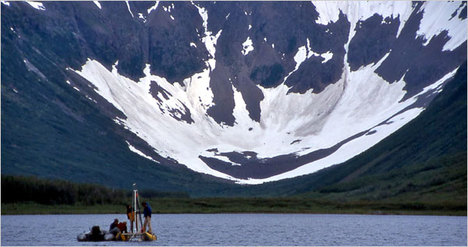
SundayLakeAlaska2009-09-06.jpg “Researchers use a floating platform to take sediment cores from Sunday Lake in southwestern Alaska.” Source of photo and caption: online version of the NYT article quoted and cited below.

(p. A17) The human-driven buildup of heat-trapping greenhouse gases in the atmosphere appears to have ended a slide, many millenniums in the making, toward cooler summer temperatures in the Arctic, the authors of a new study report.

Scientists familiar with the work, to be published Friday in the journal Science, said it provided fresh evidence that human activity is not only warming the globe, particularly the Arctic, but could also even fend off what had been presumed to be an inevitable descent into a new ice age over the next few dozen millenniums.
. . .
In the very long term, the ability to artificially warm the climate, particularly the Arctic, could be seen as a boon as the planet’s shifting orientation to the Sun enters a phase that could initiate the next ice age.
As a result of such periodic shifts, 17 ice ages are thought to have come and gone in two million years. The last ice age ended 11,000 years ago and the next one, according to recent research, could be 20,000 or 30,000 years off discounting any influence by humans. The last ice age buried much of the Northern Hemisphere under a mile or more of ice.
With humans’ clear and growing ability to alter the climate, Dr. Overpeck said, “we could easily skip the next opportunity altogether.”

For the full story, see:

ANDREW C. REVKIN. “Global Warming Is Delaying Ice Age, Study Finds.” The New York Times (Fri., September 4, 2009): A17.

(Note: the online version of the article has the title “Global Warming Could Forestall Ice Age.”)
(Note: ellipsis added.)

The reference to the full scientific presentation of the research is:
Kaufman, Darrell S., David P. Schneider, Nicholas P. McKay, Caspar M. Ammann, Raymond S. Bradley, Keith R. Briffa, Gifford H. Miller, Bette L. Otto-Bliesner, Jonathan T. Overpeck, Bo M. Vinther, and Members Arctic Lakes 2k Project. “Recent Warming Reverses Long-Term Arctic Cooling.” Science 325, no. 5945 (2009): 1236-39.

Clunker-Like Subsidies May Mainly Affect Timing of Purchases

(p. A6) The next program to test the effect of government funds comes this fall. Consumers who buy high-efficiency appliances such as refrigerators, washing machines and dishwasher can receive rebates of up to $200 on certain products; no trade-ins would be required. The $300 million program was included in the $787 billion stimulus law.

As with the clunkers program, it’s unclear whether the rebate program will offer anything more than a short-term economic boost.
“The people who will most like likely respond to this are the people who need appliances, and they were probably going to buy appliances anyway,” said Erik Hurst, an economist at the University of Chicago’s Booth School of Business. “If all you’ve done is move that from tomorrow to today, then the economy is going to lag even more tomorrow.”

For the full story, see:
SUDEEP REDDY. “Dealers Get More Time to File for Clunker Rebates.” The Wall Street Journal (Weds., AUGUST 25, 2009): A6.

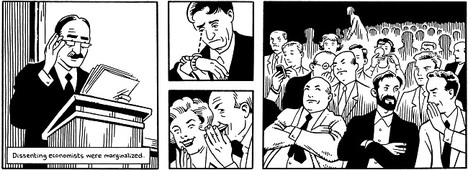
Economists “Mistook Beauty, Clad in Impressive-Looking Mathematics, for Truth”

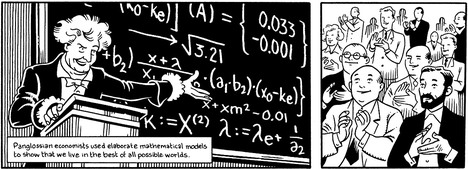
PlanglossianEconomistsCartoon2009-09-06.jpg Source of caricatures: online version of the NYT article quoted and cited below.

Nobel Prize winner Paul Krugman is no friend of the free market, and more importantly, his manner of dealing with opponents is a long way from gracious civility.
But he is not always completely wrong:

(p. 36) Few economists saw our current crisis coming, . . .
. . .
(p. 37) As I see it, the economics profession went astray because economists, as a group, mistook beauty, clad in impressive-looking mathematics, for truth.

For the full commentary, see:
PAUL KRUGMAN. “How Did Economists Get It So Wrong?.” The New York Times, Magazine Section (Sun., September 2, 2009): 36-43.
(Note: ellipses added.)

DissentingEconomistsCartoon2009-09-06.jpgThe economist on the left is probably intended to resemble Keynes, but he also bears some resemblance to Hayek. Source of caricatures: online version of the NYT article quoted and cited above.

“Axel Springer Has Dared to Compete with Itself”

The European newspaper publisher Axel Springer, discussed in the story quoted below, appears to be following the advice of Christensen and Raynor in their book The Innovator’s Solution. In that book, they suggest that incumbent firms need to be willing to set up units that compete with their older business models, if they hope to survive the introduction of disruptive innovations.

(p. B4) PARIS — As the death toll in the American newspaper industry mounted this month, the German publisher Axel Springer, which owns Bild, the biggest newspaper in Europe, reported the highest profit in its 62-year history.
. . .
Axel Springer generates 14 percent of its revenue online, more than most American newspapers, even though the markets in which it operates — primarily Germany and Eastern Europe — are less digitally developed than the United States.
One reason, Mr. Döpfner said, is that Axel Springer has dared to compete with itself. Instead of trying to protect existing publications, it acquired or created new ones, some of which distribute the same content to different audiences.
At one newsroom in Berlin, for example, journalists produce content for six publications: the national newspaper Die Welt, its Sunday edition and a tabloid version aimed at younger readers; a local paper called Berliner Morgenpost, and two Web sites.

For the full story, see:
ERIC PFANNER. “European Newspapers Find Creative Ways to Thrive in the Internet Age.” The New York Times (Mon., March 29, 2009): B4.
(Note: ellipsis added.)

The Christensen and Raynor book mentioned above, is:
Christensen, Clayton M., and Michael E. Raynor. The Innovator’s Solution: Creating and Sustaining Successful Growth. Boston, MA: Harvard Business School Press, 2003.

Aid Dependency “Kills Entrepreneurship”

MoyoDambisa2009-09-03.jpg

Dambisa Moyo. Source of photo: online version of the NYT article quoted and cited below.

(p.11) You argue in your book that Western aid to Africa has not only perpetuated poverty but also worsened it, and you are perhaps the first African to request in book form that all development aid be halted within five years.

Think about it this way — China has 1.3 billion people, only 300 million of whom live like us, if you will, with Western living standards. There are a billion Chinese who are living in substandard conditions. Do you know anybody who feels sorry for China? Nobody.

Maybe that’s because they have so much money that we here in the U.S. are begging the Chinese for loans.

Forty years ago, China was poorer than many African countries. Yes, they have money today, but where did that money come from? They built that, they worked very hard to create a situation where they are not dependent on aid.

What do you think has held back Africans?

I believe it’s largely aid. You get the corruption — historically, leaders have stolen the money without penalty — and you get the dependency, which kills entrepreneurship. You also disenfranchise African citizens, because the government is beholden to foreign donors and not accountable to its people.

If people want to help out, what do you think they should do with their money if not make donations?

Microfinance. Give people jobs.

For the full interview, see:
DEBORAH SOLOMON, interviewer. “Questions for Dambisa Moyo; The Anti-Bono.” The New York Times, Magazine (Sun., Feb. 22, 2009): 11.

DeadAidBK.jpg

Source of book image: http://media.us.macmillan.com/jackets/500H/9780374139568.jpg

Let Venture Capitalists Invest Their Own Money in Entrepreneurs

(p. A17) Venture-capital funds deal solely with privately purchased equity securities in start-up companies, which are not traded in public markets. They have as their limited partners only people who meet the S.E.C.’s definition of a “qualified client” (meaning they possess a substantial amount of money to invest). These investors, who typically allocate a small percentage of their portfolios to venture capital, are familiar with risk, but it is long-term risk, stretching out 7 to 10 years. They put their faith not in publicly traded securities but in entrepreneurs, emerging technologies and new markets.

Because their business is contained within the ecosystem of limited partners, venture-capital funds and the companies in which they invest absorb all the risk: there can be no domino effect in the world financial system.
. . .
It would be a shame to impose any new limits now, when venture capital is the asset class that can best help build and nurture the companies that bring about growth and job creation. The figures are compelling. In 2008, venture-backed companies that went public in previous years accounted for 12.1 million jobs and $2.9 trillion in revenues for the United States Treasury.
The names of companies financed by venture capital are legendary: Cisco, Google, Facebook, Apple, Federal Express, Staples, Yahoo, Amazon, Genentech and on and on. The privately purchased equity securities that helped start these companies supported new technological and scientific ideas, all of which led to new jobs.

For the full commentary, see:
ALAN PATRICOF and ERIC DINALLO. “Stopping Start-Ups.” The New York Times (Mon., August 31, 2009): A17.
(Note: ellipsis added.)

Congress Takes Exotic, Costly Global Warming Trip

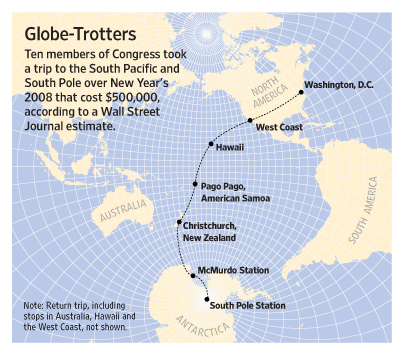
GlobalWarmingGlobeTrottersMap.gifSource of map: online version of the WSJ article quoted and cited below.

(p. A1) WASHINGTON — When 10 members of Congress wanted to study climate change, they did more than just dip their toes into the subject: They went diving and snorkeling at the Great Barrier Reef. They also rode a cable car through the Australian rain forest, visited a penguin rookery and flew to the South Pole.

The 11-day trip — with six spouses traveling along as well — took place over New Year’s 2008. Details are only now coming to light as part of a Wall Street Journal analysis piecing together the specifics of the excursion.
It’s tough to calculate the travel bills racked up by members of Congress, but one thing’s for sure: They use a lot of airplanes. In recent days, House of Representatives members allocated $550 million to upgrade the fleet of luxury Air Force jets used for trips like these — even though the Defense Department says it doesn’t need all the planes. . . .
The South Pole trip, led by Rep. Brian Baird (D., Wash.), ranks among the priciest. The lawmakers reported a cost to taxpayers of $103,000.
That figure, however, doesn’t include the actual flying, because the trip used the Air Force planes, not commercial carriers. Flight costs would lift the total tab to more than $500,000, based on Defense Department figures for aircraft per-hour operating costs.

For the full story, see:
BRODY MULLINS and T.W. FARNAM. “Lawmakers’ Global-Warming Trip Hit Tourist Hot Spots; Penguins, a Rocket-Propelled Airplane (and Tax Dollars) Also Involved.” The Wall Street Journal (Weds., June 10, 2009): A1 & A4.
(Note: ellipsis added.)

RocketAssistedSiEquippedPlane.jpg “The type of rocket-assisted, ski-equipped plane that took the lawmakers to the South Pole.” Source of photo and caption: online version of the WSJ article quoted and cited above.

Government Regulations Stifle Creative Venture Capital

(p. A9) This is a good time to recall that the venture-capital industry was born as a reaction to New Deal regulations that stifled capital and prolonged the Depression. The country’s first venture-capital firm (other than family-run funds) was American Research and Development, planned in the 1930s and launched after World War II in Boston.

Its leader was longtime Harvard Business School professor Georges Doriot, who is the subject of a fascinating recent biography, “Creative Capital,” by Spencer Ante. Mr. Ante, a BusinessWeek editor, tells me that as he researched the topic “one of the most surprising things I learned was how concerned financiers and industrialists had become about the riskless economy in direct response to the New Deal. Even in the 1930s, people understood that small business was the lifeblood of the economy.”
American Research and Development backed early-stage companies deemed too risky by banks and investment trusts at the time. The firm was an early investor in Digital Equipment Corp., the Boston-area company that revolutionized computing.
Despite financial success, the history of the firm is a reminder that our regulatory system, by its nature focused on avoiding risk, has a hard time dealing with investment firms whose mission is to take risks. Doriot was a well-known name in commerce and academia from the 1940s through the 1970s. He was the first French graduate of Harvard Business School, a founder of the INSEAD business school and a leading adviser to the U.S. military.
But even as a pillar of Boston’s commercial and academic worlds, Doriot had many run-ins with federal regulators. Over the years, regulators dictated compensation for the American Research and Development staff, tried to force disclosure of the performance of its early-stage companies, and second-guessed how it tracked the valuations of its investments.
The Securities and Exchange Commission hounded the company so often that Doriot once wrote a three-page memo saying, “ARD has more knowledge of what is right and wrong than the average person at the SEC.” He was prudent enough not to send it. He did mail another memo to the SEC enforcement office in Boston, in 1965: “I rather resent, after 20 years of experience, to have two men come here, spend two days, and tell us that we do not know what we are doing.”
. . .
No venture capital firm has asked to be bailed out, and none are too big to fail. As hard as it is for regulators to understand, the nature of venture capital is such that it should not even aspire to be a low-risk enterprise

.

For the full commentary, see:

L. GORDON CROVITZ. “No Such Thing as Riskless Venture Capital; New regulations could retard the innovation our economy needs.” The Wall Street Journal (Weds., AUGUST 9, 2009): A19.

(Note: ellipsis added.)