The Case for Patent System Reform

(p. A13) The Patent Office now gets some 500 million applications a year, leading to litigation costs of over $10 billion a year to define who has what rights. As Judge Richard Posner has written, patents for ideas create the risk of “enormous monopoly power (imagine if the first person to think up the auction had been able to patent it).” Studies indicate that aside from the chemical and pharmaceutical industries, the cost of litigation now exceeds the profits companies generate from licensing patents.

For the full commentary, see:

L. GORDON CROVITZ. “OPINION: INFORMATION AGE; Why Technologists Want Fewer Patents.” The Wall Street Journal (Mon., JUNE 15, 2009): A13.
Justice Department is Creating Barriers to Companies Trying to Create New Technologies

BarrettCraigIntel2009-06-20.jpg

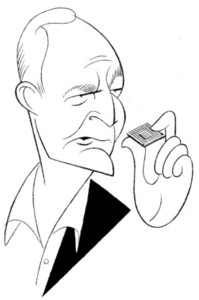
Intel CEO Craig Barrett. Source of caricature: online version of the WSJ article quoted and cited below.

(p. A9) Craig Barrett is spending the last days of his tenure as Intel chairman the same way he spent his previous 35 years at the corporation: moving at a superhuman pace that leaves exhausted subordinates in his wake.

Mr. Barrett has maintained this lifestyle since he replaced Andrew Grove as CEO of Intel in 1998. “Was it hard to follow a legend?” he asks himself in his typical blunt way, adding, “What do you think?” Mr. Barrett barely broke pace when he became chairman in 2005, and shows no sign of slowing even now, at age 69, as he faces retirement.
. . .
The latest thing that has him animated is the record $1.45 billion antitrust fine levied against Intel by the European Union this week. Mr. Barrett shakes his head and says, “The antitrust rules and regulations seem designed for a different era. When you look at high-tech companies, with the high R&D budgets, specialization and market creation they need to hold their big market shares, it’s so very different from the old world of oil companies and auto makers that the antitrust regulations were designed for. They are out of sync with reality.
“And how do you reconcile European regulators, who don’t believe that any company should have more than 50% market share — even a market that company created — with the way we operate here? Of course, now it seems as if our Justice Department is preparing to march in lock-step behind Europe. In the end, all they are going to do is create barriers to companies growing, entering into new markets, and bringing new technologies into those markets. And when we stop being the land of opportunity, all of those smart immigrant kids getting their Ph.D.s here are going to start heading home after they graduate. Then watch what happens to our competitiveness.”

For the full story, see:
MICHAEL S. MALONE. “OPINION: THE WEEKEND INTERVIEW with Craig Barrett; From Moore’s Law to Barrett’s Rules; Intel’s chairman on antitrust silliness and the secrets of high-tech success.” Wall Street Journal (Sat., MARCH 16, 2009): A9.
(Note: ellipsis added.)

Small Companies Created 80% of Net New Jobs in 1970s

(p. 298) David L. Birch and his associates at MIT gained a glimpse of this topsy-turvy domain during the late 1970s when they themselves entered the statistical skunkworks of the economy by conducting the most comprehensive and detailed analysis ever performed on the facts of American small business. Using records from a Dun & Bradstreet sample of 5.6 million firms, the Birch team reached the highly publicized conclusion that companies with fewer than 100 employees created 80 percent of the net new jobs in the U.S. economy during the 1970s. Data from the early 1980s confirmed these findings. In launching jobs, the last were manifestly first in U.S. capitalism.

Source:
Gilder, George. Recapturing the Spirit of Enterprise: Updated for the 1990s. updated ed. New York: ICS Press, 1992.

Drug Innovation Funding Slashed in Economic Crisis

BiotechIPOgraph.gif

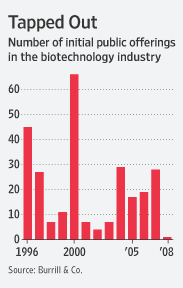
Source of graphic: online version of the WSJ article quoted and cited below.

(p. B1) Big pharmaceutical companies have spent billions of dollars to buy other drug giants lately, leaving behind small biotech companies that can no longer find investors.

The biotech industry had thrived as a new-drug incubator for big pharma companies, which poured money into acquisitions and partnerships to build up their biotech-drug product line. Some of that is still happening, but most sources of investment funding have dried up in recent months.
Since November, 10 biotechs have declared bankruptcy, says Ellen Dadisman, a spokeswoman for the Biotechnology Industry Organization. Meanwhile, 120 of the 360 publicly traded biotechs have less than six months of cash left, compared with just 12 companies in that position a year ago, according to Burrill & Co., a venture-capital concern in San Francisco that follows the industry.

For the full story, see:

KEITH J. WINSTEIN. “Cash Dries Up for Biotech Drug Firms.” Wall Street Journal (Mon., MARCH 16, 2009): B1.

Lomborg Warns of “Climate-Industrial Complex”

(p. A19) Some business leaders are cozying up with politicians and scientists to demand swift, drastic action on global warming. This is a new twist on a very old practice: companies using public policy to line their own pockets.

The tight relationship between the groups echoes the relationship among weapons makers, researchers and the U.S. military during the Cold War. President Dwight Eisenhower famously warned about the might of the “military-industrial complex,” cautioning that “the potential for the disastrous rise of misplaced power exists and will persist.” He worried that “there is a recurring temptation to feel that some spectacular and costly action could become the miraculous solution to all current difficulties.”
This is certainly true of climate change. We are told that very expensive carbon regulations are the only way to respond to global warming, despite ample evidence that this approach does not pass a basic cost-benefit test. We must ask whether a “climate-industrial complex” is emerging, pressing taxpayers to fork over money to please those who stand to gain.

For the full commentary, see:
BJORN LOMBORG. “OPINION: The Climate-Industrial Complex; Some businesses see nothing but profits in the green movement.” Wall Street Journal (Thurs., MAY 22, 2009): A19.

Government Regulators Again Suppress Entrepreneurial Innovation

FeetNibblingFish2009-06-20.jpgSource of photo: http://images.quickblogcast.com/82086-71861/pedicurex_large.jpg

(p. A1) Until Mr. Ho brought his skin-eating fish here from China last year, no salon in the U.S. had been publicly known to employ a live animal in the exfoliation of feet. The novelty factor was such that Mr. Ho became a minor celebrity. On “Good Morning America” in July, Diane Sawyer placed her feet in a tank supplied by Mr. Ho and compared the fish nibbles to “tiny little delicate kisses.”

Since then, cosmetology regulators have taken a less flattering view, insisting fish pedicures are unsanitary. At least 14 states, including Texas and Florida, have outlawed them. Virginia doesn’t see a problem. Ohio permitted fish pedicures after a review, and other states haven’t yet made up their minds. The world of foot care, meanwhile, has been plunged into a piscine uproar. Salon owners who (p. A12) bought fish and tanks before the bans were imposed in their states are fuming.
The issue: cosmetology regulations generally mandate that tools need to be discarded or sanitized after each use. But epidermis-eating fish are too expensive to throw away. “And there’s no way to sanitize them unless you bake them for 20 minutes at 350 degrees,” says Lynda Elliott, an official with the New Hampshire Board of Barbering, Cosmetology and Esthetics. The board outlawed fish pedicures in November.
In Ohio, ophthalmologist Marilyn Huheey, who sits on the Ohio State Board of Cosmetology, decided to try it out for herself in a Columbus salon last fall. After watching the fish lazily munch on her skin, she recommended approval to the board. “It seemed to me it was very sanitary, not sterile of course,” Dr. Huheey says. “Sanitation is what we’ve got to live with in this world, not sterility.”
. . .
State bans have disrupted Mr. Ho’s plans to build a nationwide franchise network. Currently, he has four active franchises, in Virginia, Delaware, Maryland and Missouri. But others have terminated franchise agreements. In Calhoun, Ga., Tran Lam, owner of Sky Nails, says she paid Mr. Ho $17,500 in exchange for fish and custom-made pedicure tanks. A few weeks later, in October, the Georgia Board of Cosmetology deemed fish pedicures illegal. “I’m very mad,” says Ms. Lam. “I lost a lot of money and the economy is so bad.”

For the full story, see:
JOHN SCHWARTZ. “Ban on Feet-Nibbling Fish Leaves Nail Salons on the Hook; Mr. Ho’s Import From China Caught On, But Some State Pedicure Inspectors Object.” Wall Street Journal (Mon., MARCH 23, 2009): A1 & A12.
(Note: ellipsis added.)

“Entrepreneurship is the Creation of Surprises”

(p. 297) Because he started in rebellion against established firms, he bears a natural skepticism toward settled expertise. Because he had to make scores of decisions before all the information was in, he recognizes that enterprise always consists of action in uncertainty. The entrepreneur prevails not by understanding an existing situation in all its complex particulars, but by creating a new situation which others must try to comprehend. The enterprise is an aggressive action, not a reaction. When it is successfully launched, all the rest of society–government, labor, other businesses–will have to react. In a sense, entrepreneurship is the creation of surprises. It entails breaking the looking glass of established ideas–even the gleaming mirrors of executive suites–and stepping into the often greasy and fetid bins of creation.
In the entrepreneur’s contrarian domains, he needs most of all a willingness to accept failure, learn from it, and act boldly in the shadows of doubt. He inhabits a realm where the last become (p. 298) first, where supply creates demand, where belief precedes knowledge. It is a world where expertise may be a form of ignorance and the best possibilities spring from a consensus of impossibility.

Source:
Gilder, George. Recapturing the Spirit of Enterprise: Updated for the 1990s. updated ed. New York: ICS Press, 1992.

Medoff Swimming Naked

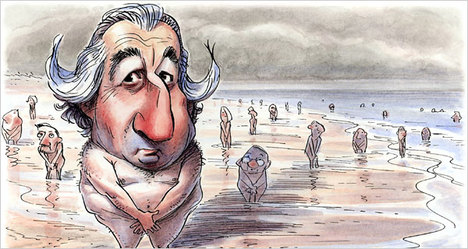
BedoffBernieSwimmingWithoutSuit.jpgBernie Medoff, and friends, swimming naked. Source of caricature: online version of the NYT article quoted and cited below.

The article quoted and cited below, is most notable for the wonderful illustration of the famous Warren Buffett quote on how hard times reveal who has been prudent and who has not been prudent.

(p. 19) Though we may be caring less, we’re hearing a lot more about Ponzi schemes lately, perhaps because the scams tend to fall apart when markets drop. As Warren Buffett so memorably put it, “You only find out who is swimming naked when the tide goes out.”

For the full commentary, see:
JOHN SCHWARTZ. “Lost in Bernie Madoff’s Shadow.” The New York Times, SundayBusiness Section (Sun., April 11, 2009): 19 & 24.

Our “Patently Absurd” Patent System

(p. A15) The Founders might have used quill pens, but they would roll their eyes at how, in this supposedly technology-minded era, we’re undermining their intention to encourage innovation. The U.S. is stumbling in the transition from their Industrial Age to our Information Age, despite the charge in the Constitution that Congress “promote the Progress of Science and useful Arts, by securing for limited Times to Authors and Inventors the exclusive Right to their respective Writings and Discoveries.”
. . .

Both sides may be right. New empirical research by Boston University law professors James Bessen and Michael Meurer, reported in their book, “Patent Failure,” found that the value of pharmaceutical patents outweighed the costs of pharmaceutical-patent litigation. But for all other industries combined, they estimate that since the mid-1990s, the cost of U.S. patent litigation to alleged infringers ($12 billion in legal and business costs in 1999) is greater than the global profits that companies earn from patents (less than $4 billion in 1999). Since the 1980s, patent litigation has tripled and the probability that a particular patent is litigated within four years has more than doubled. Small inventors feel the brunt of the uncertainty costs, since bigger companies only pay for rights they think the system will protect.
These are shocking findings, but they point to the solution. New drugs require great specificity to earn a patent, whereas patents are often granted to broad, thus vague, innovations in software, communications and other technologies. Ironically, the aggregate value of these technology patents is then wiped out through litigation costs.
Our patent system for most innovations has become patently absurd. It’s a disincentive at a time when we expect software and other technology companies to be the growth engine of the economy. Imagine how much more productive our information-driven economy would be if the patent system lived up to the intention of the Founders, by encouraging progress instead of suppressing it.

For the full commentary, see:
L. GORDON CROVITZ. “OPINION: INFORMATION AGE; Patent Gridlock Suppresses Innovation.” Wall Street Journal (Mon., JULY 14, 2008): A15.
(Note: ellipsis added.)

The Middle Ages Were Poor Ages (and, Yes, Dark Ages Too)

FallOfRomeBK.jpg

Source of book image: http://images.barnesandnoble.com/images/11610000/11613340.jpg

(p. A19) . . . some excellent books for general readers in the past few years, notably Brian Ward- Perkins’s “The Fall of Rome and the End of Civilization” (2005), have shown how devastating was the economic and human cost paid between 450 and 900. It is still unfashionable to speak of the Dark Ages (there was continuing cultural life), but these were certainly the Poor Ages, in which protection for the weak and vulnerable, from roaming killers and even from the weather, was much more precarious than it had been under Roman rule.

For the full review, see:
SCOTT PATTERSON. “Bookshelf; The Emperor Left Town.” Wall Street Journal (Tues., APRIL 21, 2009): A19.
(Note: ellipsis added.)
(Note: the book mainly under review by Patterson, is NOT the book featured in this blog entry.)

The reference for the Ward-Perkins book, is:
Ward-Perkins, Bryan. The Fall of Rome: And the End of Civilization. Oxford, UK: Oxford University Press, 2005.

Entrepreneurs Learn “Not in the Classroom Where Old Ways are Taught, But in the Factories and Labs, Where New Ways Are Wrought”

Gilder’s rhyme about the classroom is cute, and maybe mainly true. In an important paper, Baumol has more prosaically (in the literal sense) expressed a similar view.
But there are counterexamples. Gilder himself, in his Microcosm, notes how what was taught in some classrooms was crucial to progress in information technology.

(p. 296) Entrepreneurs can be pompous and vain where it doesn’t count; but in their own enterprise, the first law is to listen. They must be men meek enough–and shrewd enough–to endure the humbling eclipse of self that comes in the process of profound learning from others.
In all the history of enterprise, most of the protagonists of major new products and companies began their education–and (p. 297) discovered the secrets of their later breakthroughs–not in the classroom, where the old ways are taught, but in the factories and labs, where new ways are wrought.

Source:
Gilder, George. Recapturing the Spirit of Enterprise: Updated for the 1990s. updated ed. New York: ICS Press, 1992.

The important Baumol paper mentioned above, is:
Baumol, William J. “Education for Innovation: Entrepreneurial Breakthroughs Versus Corporate Incremental Improvements.” In Innovation Policy and the Economy, edited by Adam B. Jaffe, Josh Lerner and Scott Stern, 33-56. Cambridge, Mass.: MIT Press, 2005.