Resveratrol May Extend Life, Even at Lower Doses

(p. A1) Red wine may be much more potent than was thought in extending human lifespan, researchers say in a new report that is likely to give impetus to the rapidly growing search for longevity drugs.

The study is based on dosing mice with resveratrol, an ingredient of some red wines. Some scientists are already taking resveratrol in capsule form, but others believe it is far too early to take the drug, especially using wine as its source, until there is better data on its safety and effectiveness.
The report is part of a new wave of interest in drugs that may enhance longevity. On Monday, Sirtris, a startup founded in 2004 to develop drugs with the same effects as resveratrol, completed its sale to GlaxoSmithKline for $720 million.
. . .
(p. A16) Separately from Sirtris’s investigations, a research team led by Tomas A. Prolla and Richard Weindruch, of the University of Wisconsin, reports in the journal PLoS One on Wednesday that resveratrol may be effective in mice and people in much lower doses than previously thought necessary. In earlier studies, like Dr. Auwerx’s of mice on treadmills, the animals were fed such large amounts of resveratrol that to gain equivalent dosages people would have to drink more than 100 bottles of red wine a day.
The Wisconsin scientists used a dose on mice equivalent to just 35 bottles a day. But red wine contains many other resveratrol-like compounds that may also be beneficial. Taking these into account, as well as mice’s higher metabolic rate, a mere four, five-ounce glasses of wine “starts getting close” to the amount of resveratrol they found effective, Dr. Weindruch said.
Resveratrol can also be obtained in the form of capsules marketed by several companies. Those made by one company, Longevinex, include extracts of red wine and of a Chinese plant called giant knotweed. The Wisconsin researchers conclude that resveratrol can mimic many of the effects of a caloric-restricted diet “at doses that can readily be achieved in humans.”

For the full story, see:
NICHOLAS WADE. “New Hints Seen That Red Wine May Slow Aging.” The New York Times (Weds., June 4, 2008): A1 & A16.
(Note: ellipsis added.)

Reducing the Cost of Hotels: Prefab Rooms from China

ChinesePrefabHotelRooms.jpg “The Travelodge chain in Britain is building two hotels from stackable metal containers imported from China. One of the hotels, in Uxbridge in West London, is shown under construction at right and in a rendering at left.” Source of the caption and photo: online version of the NYT article quoted and cited below.

(p. 23) TRAVELODGE, one of the largest budget hotel chains in Britain, is a company in a hurry.
. . .
Once the company finds a location, it turns to a construction partner with equally aggressive plans: Verbus Systems, a London-based company that builds rooms in metal containers in factories near Shenzhen, China, and delivers them ready to be stacked into buildings up to 16 stories tall.
Verbus Systems’ commercial director, Paul Rollett, said his company “can build a 300-room hotel anywhere on the planet in 20 weeks.”
. . .
When they arrive at Heathrow, the containers will be hoisted into place by crane. The containers, which are as large as 12 by 47 feet, will support one another just as they do when they are crossing the ocean by ship, Mr. Rollett said. No additional structure is necessary.
. . .
DON CARLSON, the editor and publisher of Automated Builder, a trade magazine based in Ventura, Calif., said that in hotels, “modular is definitely the wave of the future.” Modular buildings, he said, are stronger, and more soundproof, because stacking units — each a fully enclosed room — “gives you double walls, double floors, double everything.”
Mr. Rollett agreed, saying that with the steel shipping container approach, “You could have a party in your room, and people in the next room wouldn’t hear a thing.”
. . .
He is working with his British clients, which, he said, include a Travelodge competitor, Premier Inn, to make the best possible use of the assembly-line method. “We’re increasing the degree of modularity,” he said, noting that the latest units come with fully fitted bathrooms and “even the paint on the walls.”
The only thing they don’t have, he said, “is the girl to put a chocolate on your pillow.”

For the full article, see:
FRED A. BERNSTEIN. “CHECKING IN; Arriving in London: Hotels Made in China.” The New York Times, SundayBusiness Section (Sun., May 11, 2008): 23.
(Note: ellipses added.)

“The Nature of Freedom of Choice”

Former Senator George McGovern was the Democratic candidate for president in 1972. In the commentary below, he defends our freedom of choice:

(p. A15) Economic paternalism takes its newest form with the campaign against short-term small loans, commonly known as “payday lending.”
With payday lending, people in need of immediate money can borrow against their future paychecks, allowing emergency purchases or bill payments they could not otherwise make. The service comes at the cost of a significant fee — usually $15 for every $100 borrowed for two weeks. But the cost seems reasonable when all your other options, such as bounced checks or skipped credit-card payments, are obviously more expensive and play havoc with your credit rating.
Anguished at the fact that payday lending isn’t perfect, some people would outlaw the service entirely, or cap fees at such low levels that no lender will provide the service. Anyone who’s familiar with the law of unintended consequences should be able to guess what happens next.
Researchers from the Federal Reserve Bank of New York went one step further and laid the data out: Payday lending bans simply push low-income borrowers into less pleasant options, including increased rates of bankruptcy. Net result: After a lending ban, the consumer has the same amount of debt but fewer ways to manage it.
Since leaving office I’ve written about public policy from a new perspective: outside looking in. I’ve come to realize that protecting freedom of choice in our everyday lives is essential to maintaining a healthy civil society.
. . .
The nature of freedom of choice is that some people will misuse their responsibility and hurt themselves in the process. We should do our best to educate them, but without diminishing choice for everyone else.

For the full commentary, see:
GEORGE MCGOVERN. “Freedom Means Responsibility.” The Wall Street Journal (Fri., March 7, 2008): A15.
(Note: ellipsis added.)

Price Ceilings Also Hurt Those Who Mow Lawns

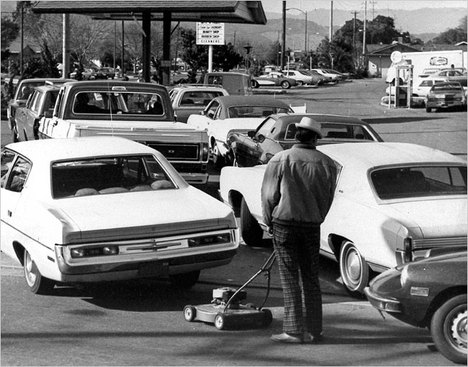
GasStationLine1974.jpg “Arjun Murti at Goldman Sachs studied the 1970s’ oil spikes. One had drivers lined up at a gas station in San Jose, Calif., in 1974.” Source of caption and photo: online version of the NYT article cited below.

The best part of the article below was the photo above of a gas line caused by the government’s imposing price ceilings on the price of gas. I’ve seen other photos of gas lines, but this is the first one I remember with someone waiting to fill up a lawn mower.

For the full story, see:
LOUISE STORY. “An Oracle of Oil Predicts $200-a-Barrel Crude.” The New York Times (Weds., May 21, 2008): C1 & C4.

In Many Capitalist Companies “People Think They’re Involved in Socialism”

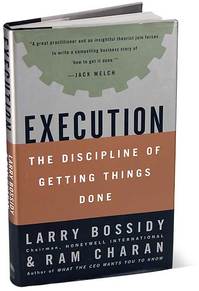
Empirical comparisons between capitalism and socialism are in some ways unfair to capitalism, because many capitalism managers act as though they believed in socialist ideas. The difference in productivity and economic growth would be even greater, if capitalist managers consistently acted as though they believed in capitalism. Consider the following, from a portion of Execution written by Larry Bossidy:

(p. 73) Larry: When I see companies that don’t execute, the chances are that they don’t measure, don’t reward, and don’t promote people who know how to get things done. Salary increases in terms of percentage are too close between top performers and those who are not. There’s not enough differentiation in bonus, or in stock options, or in stock grants. Leaders need the confidence to explain to a direct report why he got a lower than expected reward.
A good leader ensures that the organization makes these distinctions and that they become a way of life, down throughout the organization. Otherwise people think they’re involved in socialism. That isn’t what you want when you strive for a culture of execution. You have to make it clear to everybody that rewards and respect are based on performance.

Source:
Bossidy, Larry, Ram Charan, and Charles Burck. Execution: The Discipline of Getting Things Done. New York: Crown Business, 2002.
(Note: in the book, the quotation is presented as being Bossidy’s.)

Government Fails to Elevate

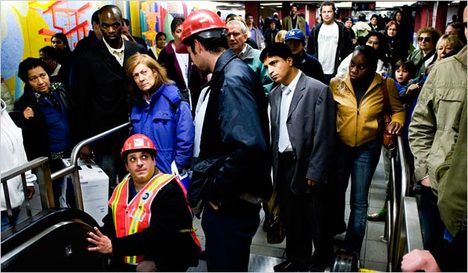
NewYorkBrokenEscalator.jpg “Charles Sterrazza, left, and Matthew Benzinger, both in hard hats, worked on an escalator under the watchful eyes of passengers.” Source of caption and photo: online version of the NYT article quoted and cited below.

(p. A18) New York City Transit has spent close to $1 billion to install more than 200 new elevators and escalators in the subway system since the early 1990s, and it plans to spend almost that much again for dozens more machines through the end of the next decade. It is an investment of historic dimensions, aimed at better serving millions of riders and opening more of the subway to the disabled.
. . .
These are the results:
¶One of every six elevators and escalators in the subway system was out of service for more than a month last year, according to the transit agency’s data.
¶The 169 escalators in the subway averaged 68 breakdowns or repair calls each last year, with the worst machines logging more than double that number. And some of the least reliable escalators in the system are also some of the newest, accumulating thousands of hours out of service for what officials described as a litany of mechanical flaws.
¶Two-thirds of the subway elevators — many of which travel all of 15 feet — had at least one breakdown last year in which passengers were trapped inside.
. . .
. . . the cost of all this goes beyond the hefty capital investment and the roughly $25 million spent each year on maintenance and repair. It can be calculated in terms of people delayed on their way to work, people injured in accidents, people forced to alter their travel routines. And for the disabled, it means that many areas of the subway system still cannot be reliably navigated.

For the full story, see:
WILLIAM NEUMAN. “$1 Billion Later, Subway Elevators Still Fail.” The New York Times (Mon., May 19, 2008): A1 & A18-A19.
(Note: ellipses added.)

NewYorkSubwayMap.jpg Source of map graphic: online version of the NYT article quoted and cited above.

Optimal Size of a Firm Depends on Trial and Error and Changing Circumstances

Rosenberg and Birdzell give an uncommon reason for economies of scale. This illustrated that the common list of reasons is not written in stone. As trial and error yields new ways of organizing business, the optimal size firm will shift back and forth.

(p. 157) The increase in both size and complexity of ironworks that followed throughout the nineteenth century was motivated by a desire to achieve economies in the use of fuel. As to size, within the practical limits of construction, large furnaces lose less heat by radiation than small furnaces and so are more fuel-efficient.

Source:
Rosenberg, Nathan, and L.E. Birdzell, Jr. How the West Grew Rich: The Economic Transformation of the Industrial World. New York: Basic Books, 1986.

Uncommon Common Sense: Bossidy Execution Book

ExecutionBK.jpg

Source of book image: http://a1055.g.akamai.net/f/1055/1401/5h/images.barnesandnoble.com/images/8280000/8285699.jpg

Bossidy and Charan’s book is not exactly a page-turner of unexpected insights, but the authors say some things that need saying.
Business gurus often forget that success depends on more than vision and inspiration. It depends on courage (to face brutal facts, and to fire the lazy or incompetent), and it requires persistent attention to enough of the details to know what needs to be done, and to know who is doing it.
Much of their practical advice is way easier said than done, but maybe it’s still worth saying.
It occurred to me while reading this book, that I sometimes write and speak as though innovation and economic growth are inevitable with the right institutions. But that is not so.
Even under the best institutions, progress still requires entrepreneurs and managers who work very hard, demonstrate courage, and who care about getting the job done.

Reference to book:
Bossidy, Larry, Ram Charan, and Charles Burck. Execution: The Discipline of Getting Things Done. New York: Crown Business, 2002.

Over-generalizing from Our Recent Experience

Rosenberg and Birdzell (1986) mention that Marx over-emphasized the centrality of factories to capitalism, because of the prominence of factories in the period of capitalism during Marx’s adulthood. They suggest that factories are only one phase, albeit an important one, in the development of capitalism.
And Schumpeter and Rosenberg may have done the same in his believe that large corporate labs would be able to routinize innovative entrepreneurial activity.
One relevant passage:

It is understandable that Marx, writing in 1848, should speak of modern industry as already a century old, for many of the institutions of industry in 1848 were already that old. Yet the greatest advances in the output of the capitalist engine of production, and the greatest changes in its modes of organization, still lay ahead. (1986, p. 184.)

Also relevant is the earlier:

In all Western countries, the inventory of physical facilities for economic production changes. The inventory at any given moment is unquestionably important, but it is like a single frame of a movie; taken alone, it misses all the action, and it is the action that we need to understand and that holds the promise of economic advance to non-Western countries. (1986, p. 144.)

Source:
Rosenberg, Nathan, and L.E. Birdzell, Jr. How the West Grew Rich: The Economic Transformation of the Industrial World. New York: Basic Books, 1986.

California’s Unreliable Power Supply

(p. A11) . . . consider the story of the Rancho Seco Nuclear Generating Station. Opened in 1975, it was capable of generating over 900 megawatts (MW) of electricity, enough to power upward of 900,000 homes. Fourteen years after powering up, the nuclear reactor shut down, thanks to fierce antinuclear opposition. Eventually, the facility was converted to solar power, and today generates a measly four MW of electricity. After millions of dollars in subsidies and other support, the entire state has less than 250 MW of solar capacity.
. . .
. . . : California now imports lots of energy from neighboring states to make up for having too few power plants. Up to 20% of the state’s power comes from coal-burning plants in Nevada, New Mexico, Utah, Colorado and Montana. Another significant portion comes from large-scale hydropower in Oregon, Washington State and the Hoover Dam near Las Vegas.
“California practices a sort of energy colonialism,” says James Lucier of Capital Alpha Partners, a Washington, D.C.-area investment group. “They leave those states to deal with the resulting pollution.”
. . .
The unreliable power grid is starting to rattle some Silicon Valley heavyweights. Intel CEO Craig Barrett, for instance, vowed in 2001 not to build a chip-making facility in California until power supplies became more reliable. This October, Intel opened a $3 billion factory near Phoenix for mass production of its new 45-nanometer microprocessors. Google has chosen to build the massive server farms that will fuel its expansion anywhere but in California.

For the full commentary, see:
MAX SCHULZ. “California’s Energy Colonialism.” The Wall Street Journal (Sat., May 3, 2008): A11.
(Note: ellipses added.)

Innovation More Likely When Society Open to Forming New Enterprises

(p. 258) It is entirely safe to generalize: innovation is more likely to occur in a society that is open to the formation of new enterprises than in a society that relies on its existing organizations for innovation.

Source:
Rosenberg, Nathan, and L.E. Birdzell, Jr. How the West Grew Rich: The Economic Transformation of the Industrial World. New York: Basic Books, 1986.