Tusk Helped Startups Enter by Mobilizing Consumers Who Would Benefit

(p. C6) In August [2018], Mayor Bill de Blasio signed a package of bills capping the number of cars driving in New York City for companies like Uber and Lyft and setting minimum pay for drivers. The mayor had long wanted such restrictions, but for years Uber had successfully pushed back, thanks in large part to strategist and venture capitalist Bradley Tusk.
“The problem is not only did this happen in New York, but now it’s going to happen everywhere,” laments Mr. Tusk, who worked as a consultant for Uber Technologies from 2010 to 2015, earning equity that was eventually worth around $100 million. Under his guidance, Uber mobilized its users to lobby against the legislation and made the case that its service provided transportation to people in the outer boroughs and jobs to immigrants and minorities.
. . .
Since working for Uber, Mr. Tusk has helped other tech companies in similar political battles. As he sees it, politicians too often sacrifice their constituents’ economic interests for their own political gain. “What’s good for politician X isn’t necessarily good for the businesses in his or her district,” he says. “Without at least some people like us, innovation gets crushed by politics and corruption and that’s really bad for the economy and for society.”
. . .
After serving as campaign manager of Mr. Bloomberg’s reelection effort, in 2010 Mr. Tusk founded Tusk Strategies with the goal of running campaigns for companies and institutions rather than politicians. At the time, Walmart was looking for a way to enter markets without pushback from powerful unions. Mr. Tusk urged city councils, including New York’s, to stop blocking its entry by polling customers, launching television ads and mobilizing constituents who wanted the choice of shopping at Walmart.
Then one of Mr. Bloomberg’s former deputy mayors called him with a proposition: “There’s this guy with a small transportation startup. He’s having some regulatory problems. Would you mind talking to him?” It was Uber. The New York City Taxi and Limousine Commission had sent Uber a cease and desist letter, and its then-CEO Travis Kalanick needed someone who understood New York politics. Mr. Tusk mounted successful campaigns on behalf of the company in New York and other cities, including Washington, D.C., and Los Angeles.
. . .
Does he see himself as an example of the revolving door between politics and business? “I’m absolutely using the savvy I learned in the political world–just in a different way than most,” he says. But he has no intentions of ever returning to government. “I felt like I could force more change on the system from the outside,” he says. “Not only am I not doing politics, but most of my work is making politicians crazy.”

For the full interview, see:
Alexandra Wolfe, interviewer. “”WEEKEND CONFIDENTIAL; Bradley Tusk from Political Insider to ‘Fixer’ for Tech.” The Wall Street Journal (Saturday, Sept. 1, 2018): C6.
(Note: ellipses, and bracketed year, added.)
(Note: the online version of the interview has the date Aug. 31, 2018, and the title “WEEKEND CONFIDENTIAL; How Bradley Tusk Went from Political Insider to ‘Making Politicians Crazy’.”)

The book under discussion above, is:
Tusk, Bradley. The Fixer: My Adventures Saving Startups from Death by Politics. New York: Portfolio, 2018.

More Boys Choose Math Fields Due to Their Weaker Verbal Skills

(p. C2) A key tenet of modern feminism is that women will have achieved equity only when they fill at least 50% of the positions once filled by men. In some fields, women have already surpassed that target–now comprising, for example, 50.7% of new American medical students, up from just 9% in 1965, and 80% of veterinary students. But the needle has hardly moved in many STEM fields–such as the physical sciences, technology, engineering and math, in which barely 20% of the students are female.
A new study suggests some surprising reasons for this enduring gap. Published last month in the journal Psychological Science, the study looked at nearly a half million adolescents from 67 countries who participated in the Program for International Student Assessment, the world’s largest educational survey. Every three years, PISA gauges the skills of 15-year-olds in science, reading and math reasoning. In each testing year, the survey focuses in depth on one of those categories.
. . .
Some fascinating gender differences surfaced. Girls were at least as strong in science and math as boys in 60% of the PISA countries, and they were capable of college-level STEM studies nearly everywhere the researchers looked. But when they examined individual students’ strengths more closely, they found that the girls, though successful in STEM, had even higher scores in reading. The boys’ strengths were more likely to be in STEM areas. The skills of the boys, in other words, were more lopsided–a finding that confirms several previous studies.

For the full commentary, see:
Susan Pinker. “Why Don’t More Women Choose STEM Careers?” The Wall Street Journal (Saturday, March 3, 2018): C2.
(Note: ellipsis added.)
(Note: the online version of the commentary has the date March 1, 2018, and has the title “Why Aren’t There More Women in Science and Technology?”)

The print version of the Psychological Science article discussed above, is:
Stoet, Gijsbert, and David C. Geary. “The Gender-Equality Paradox in Science, Technology, Engineering, and Mathematics Education.” Psychological Science 29, no. 4 (April 2018): 581-93.

Cuomo’s Buffalo Billion Fails to Cure Buffalo Blight

(p. A18) BUFFALO — More than six years ago, Gov. Andrew M. Cuomo announced his bold vision for New York’s second largest and perhaps longest-suffering city.
“We believe in Buffalo. Let’s put our money where our mouth is,” Mr. Cuomo said, announcing an economic development package of $1 billion. “That is a big ‘B’ — standing for Buffalo and standing for billion.”
. . .
“I think the Buffalo Billion sounds better than it probably turned out to be,” said Isaac Ehrlich, a SUNY distinguished professor of economics at the University at Buffalo.
Indeed, while construction work blossomed in early years, economists note broader employment growth in the city and region has consistently lagged behind the nation as a whole, as well as behind other Rust Belt cities, despite gains during the nation’s nine-year recovery. Perhaps more troubling, recent reports suggest that the job market essentially slowed to a crawl last year, as activity in manufacturing, retail and business services sectors flagged.
. . .
George Palumbo, an economics professor at Canisius College in Buffalo, said that the gleaming new buildings at the medical campus “take nice pictures,” but said the development was also illusory.
“You don’t have to go very far from that neighborhood to see Buffalo blight,” he said, “not Buffalo billion.”

For the full story, see:
Jesse McKinley. “Six Years Later, Cuomo’s ‘Buffalo Billion’ Project Yields Uneven Results.” The New York Times (Tuesday, July 3, 2018): A18.
(Note: ellipses added.)
(Note: the online version of the story has the date July 2, 2018, and has the title “‘Cuomo’s ‘Buffalo Billion’: Is New York Getting Its Money’s Worth?”)

Inventor of Fiber Optics “Didn’t Believe What Experts Said”

(p. A9) In the 1960s, Charles Kao often annoyed his wife, Gwen, by coming home late for dinner.
Dr. Kao, a refugee from the Chinese Communist revolution, told her his research for a British subsidiary of International Telephone & Telegraph Corp. could change the world one day.
. . .
In a 1966 paper written with George Hockham, he outlined the potential for using pulses of light to carry huge volumes of voice and data signals long distances through strands of glass that became known as optical fibers. Few took him seriously until several years later, when Corning Glass Works found ways to do just that.
. . .
Dr. Kao was once asked how long fiber optics would be used. Nothing better was likely to come along for 1,000 years, he said. “But don’t believe what I say,” he added, “because I didn’t believe what experts said either.”

For the full obituary, see:
James R. Hagerty. “‘Early Bet on Optical Fibers Yielded Pipes for Internet.” The New York Times (Saturday, Sept. 29, 2018): A9.
(Note: ellipses added.)
(Note: the online version of the obituary has the date Sept. 28, 2018, and has the title “‘Chinese Refugee Developed Fiber-Optic Technology That Made the Internet Possible.”)

In 10 Years after iPhone, Apple Added Almost 100,000 Jobs

iPhoneSalesPerYearGraph2018-10-29.png

Source of graph: online version of the WSJ article quoted and cited below.

(p. B1) SAN FRANCISCO–Since Apple Inc. launched the iPhone in June 2007, the smartphone revolution it unleashed has changed the way people work and socialize while reshaping industries from music to hotels.
It also has transformed the company in ways that co-founder Steve Jobs could hardly have foreseen.
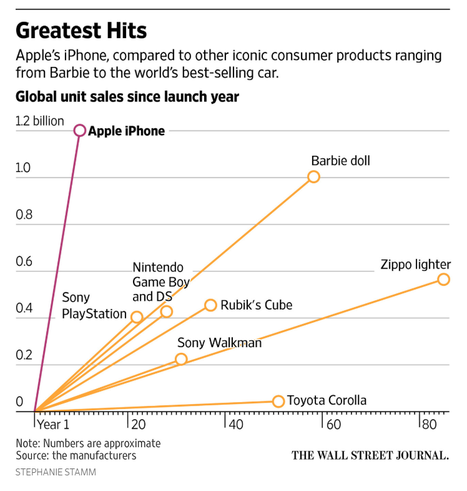
Ten years later, the iPhone is one of the best-selling products in history, with about 1.3 billion sold, generating more than $800 billion in revenue. It skyrocketed Apple into the business stratosphere, unlocking new markets, spawning an enormous services business and helping turn Apple into the world’s most valuable publicly traded company.
. . .
(p. B8) . . . , Apple didn’t open the device to application developers until 2008, when it added the App Store and began taking 30% of each app purchase.
Since then, app sales have generated roughly $100 billion in gross revenue as Apple has registered more than 16 million app developers world-wide.
. . .
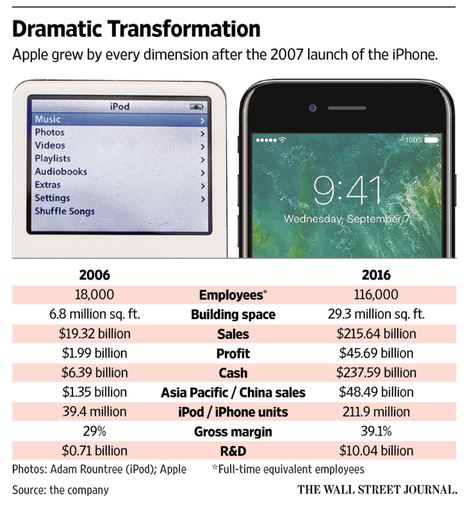
As sales surged, Apple staffed up. The company hired about 100,000 people in the 10-year span, bringing its global workforce to 116,000 from 18,000 in 2006. New workers were brought on to manage relationships with cellphone carriers, double the number of retail stores and maintain an increasingly complex supply chain.

iPhoneStatisticsTable2018-10-29.png

Source of graph: online version of the WSJ article quoted and cited below.

For the full story, see:
Tripp Mickle. “‘How iPhone Decade Reshaped Apple.” The Wall Street Journal (Wednesday, June 21, 2017): B1 & B8.
(Note: ellipses added.)
(Note: the online version of the story has the date June 20, 2017, and has the title “Among the iPhone’s Biggest Transformations: Apple Itself.”)

Steve Jobs’s Apple Is First U.S. Company Valued at $1 Trillion

(p. B1) Apple Inc. on Thursday [August 2, 2018] became the first U.S. company to surpass $1 trillion in market value, underscoring the iPhone maker’s explosive growth and its role in the technology industry’s ascent to the forefront of the global economy and markets.
. . .
Apple’s rise has been propelled by the sustained success of the iPhone developed under late co-founder Steve Jobs, a product visionary who helped revive the company from a death spiral in the late 1990s.

For the full story, see:
Tripp Mickle and Amrith Ramkumar. “Apple Value Surges to $1 Trillion.” The Wall Street Journal (Friday, August 3, 2018): B1 & B5.
(Note: ellipsis, and bracketed date, added.)
(Note: the online version of the story has the date Aug. 2, 2018, and has the title “Apple’s Market Cap Hits $1 Trillion.”)

More Job Security as Factory Work Requires More Technical Skills

(p. A3) A yearslong decline in the number of layoffs is providing a renewed level of job security to factory workers, who had seen their ranks thin since the late 1970s.
. . .
“We’ve become much more careful about letting people go,” said David Nicholson, chief executive of PVS Chemicals Inc., a Detroit manufacturer with 850 employees. “Most manufacturing jobs today are technology jobs. It takes a long time to train someone for that role, so you’re reluctant to let them go for what could be a short-term slowdown.”

For the full story, see:
Eric Morath. “Job Security Is a New Perk of Factory Employment.” The Wall Street Journals (Wednesday, July 11, 2018): A3.
(Notes: ellipsis added.)
(Note: the online version of the story has the date July 10, 2018, and has the title “Factory Workers’ New Perk: Job Security.”)

Disneyland Opened in “Confusion,” “Disorder,” and “Chaos”

(p. B11) On the mid-July day in 1955 when Disneyland opened in Anaheim, Calif., confusion reigned. More people stormed its grounds than expected, rides broke down, food and beverage supplies ran short, and a plumbers’ strike limited the number of working water fountains.
Out in the park that afternoon, amid the disorder, was Marty Sklar, a 21-year-old college junior who was editing the theme park’s 10-cent newspaper. At one point Fess Parker, in full costume as Disney’s television and big-screen Davy Crockett, complete with coonskin cap, approached him on horseback.
Spotting Mr. Sklar’s name tag, Mr. Parker called out for help.
“Marty,” he said, “get me out of here before this horse hurts someone!”
Disneyland recovered well from the early chaos. And Mr. Sklar went on to spend more than a half-century at the Walt Disney Company, as a close aide to Walt Disney himself and eventually as the principal creative executive of the company’s Imagineering unit, made up of the innovators who blend their imaginations and their technical expertise in devising every element of the company’s theme parks.
. . .
He soon became Mr. Disney’s chief ghostwriter for publicity materials, dedications, souvenir guides, speeches, slogans, presentations and short films, like the one that helped the company win approval to build Walt Disney World and Epcot in central Florida. He also collaborated with Walt and his brother, Roy, on Disney’s annual reports.
“It was pretty heady stuff for someone just closing in on his 30th birthday and only six or seven years out of college,” Mr. Sklar wrote in his autobiography, “Dream It! Do It: My Half-Century Creating Disney’s Magic Kingdoms” (2013).

For the full obituary, see:
Richard Sandomir. “Marty Sklar Dies at 83; Became Trusted Aide And Executive at Disney.” The New York Times (Friday, Aug. 4, 2017): B11.
(Note: ellipsis added.)
(Note: the online version of the obituary has the date Aug. 3, 2017, and has the title “Marty Sklar, Longtime Disney Aide and Executive, Dies at 83.”)

Sklar’s autobiography, mentioned above, is:
Sklar, Martin. Dream It! Do It!: My Half-Century Creating Disney’s Magic Kingdoms. Glendale, CA: Disney Editions, 2013.

A.I. Frees Workers from Drudgery More Than It Eliminates Jobs

(p. B1) New software is automating mundane office tasks in operations like accounting, billing, payments and customer service. The programs can scan documents, enter numbers into spreadsheets, check the accuracy of customer records and make payments with a few automated computer keystrokes.
The technology is still in its infancy, but it will get better, learning as it goes. So far, often in pilot projects focused on menial tasks, artificial intelligence is freeing workers from drudgery far more often than it is eliminating jobs.
. . .
(p. B4) The recent research has examined jobs as bundles of tasks, some of which seem ripe for replacement and others not. So the technology’s immediate impact will resemble the experience to date with robotic software, changing work more than destroying jobs.

For the full story, see:
Lohr, Steve. “Menial Tasks Ease A.I.’s Way Into Workplace.” The New York Times (Monday, Aug. 6, 2018): B1 & B4.
(Note: ellipsis added.)
(Note: the online version of the story has the date Aug. 5, 2018, and has the title “‘The Beginning of a Wave’: A.I. Tiptoes Into the Workplace.”)

“Tesla Is His Baby”

(p. B5) “Tesla is his baby,” said Deepak Ahuja, Tesla’s chief financial officer. “He takes it extremely personally.”
. . .
In preparing the assembly lines, Mr. Musk became convinced that the process should be close to fully automated, using robots rather than humans whenever possible. Doing so, he believed, could make cars move through the factory at one meter per second, 10 to 20 times the speed of existing lines.
So Tesla built a factory with hundreds of robots, many programmed to perform tasks that humans could easily do. One robot, which Mr. Musk nicknamed the “flufferbot,” was designed to simply place a sound-dampening piece of fiberglass atop the battery pack.
But the flufferbot never really worked. It would fail to pick up the fiberglass, or put it in the wrong place, frequently delaying production. It was eventually replaced by factory workers.
Mr. Musk has accepted responsibility for some of these missteps, occasionally with humor. In late June, he wore a T-shirt depicting a robot that passes butter. It was an inside joke, lampooning the notion of technology for technology’s sake.
After the debacle, Mr. Musk tweeted: “Excessive automation at Tesla was a mistake. To be precise, my mistake. Humans are underrated.”
. . .
“He is absolutely working incredibly hard, but Elon has always worked incredibly hard,” said Mr. Ahuja, Tesla’s chief financial officer. “He’s very tough, too. He can eat glass.”
. . .
“I know that it has been a difficult year for him,” said Gwynne Shotwell, the SpaceX president and chief operating officer. “Not because he’s frowning or throwing things, but because I can tell he’s physically exhausted.”

For the full story, see:
David Gelles. “In Elon Musk’s World, Brakes Are for Cars, Not C.E.O.s.” The New York Times (Wednesday, Aug. 29, 2018): B1 & B5.
(Note: ellipses added.)
(Note: the online version of the story has the date Aug. 28, 2018, and has the title “MARSEILLE DISPATCH; Yes, There Is a French McDonald’s That Is Beloved (by Its Staff).”)

Outsiders in France Defend McDonald’s

(p. A4) MARSEILLE, France — The nearly 20-year-old images have entered French folklore: peasants, farmers and ex-hippies dismantling a rural McDonald’s, panel by panel, in what became a symbol of France’s resistance to American fast food.
Today that aging newsreel is being played in sharp reverse. A group of workers and their union leaders in Marseille are fighting tooth-and-nail to save a McDonald’s from closing in a working-class, largely immigrant neighborhood. A so-called “Festival of Dignity” protest was recently organized by the McDonald’s employees in an effort to save their roughly 70 jobs.
Even though McDonald’s was once seen as a cultural menace to a glorious French tradition, the workers say this particular McDonald’s, in its quarter-century of existence, has played a vital role as a social integrator in one of France’s most troubled districts — providing employment and shielding local youth from pervasive drug-dealing, getting them out of jail and helping them stay out.
“Look, we’re not thugs here,” said Kamel Guemari, the restaurant’s assistant manager, who was hired at age 16 and is now 37. “We’re working. And we’re setting an example for the others. We’re playing a social role.”

For the full story, see:
Adam Nossiter. “MARSEILLE DISPATCH; French Workers Fight to Save a Beloved McDonald’s.” The New York Times (Thursday, Sept. 6, 2018): A4.
(Note: the online version of the story has the date Sept. 5, 2018, and has the title “MARSEILLE DISPATCH; Yes, There Is a French McDonald’s That Is Beloved (by Its Staff).”)