Venezuelans Flee Chávez’s Socialism

VenezuelanHomicide2011-11-10.jpg“Street crime, such as a man’s killing in Caracas last year, is high.” Note the big-brother-sized image of Chávez surveying what his socialism has wrought. Source of quoted part of caption and photo: online version of the WSJ article quoted and cited below.

Those who favor socialism should observe Venezuela carefully and ponder whether they like what they see.

(p. A13) Gerardo Urdaneta moved to Houston from Venezuela for a job in 1998, the same year Hugo Chávez was first elected president. Mr. Urdaneta, an energy-shipping specialist, planned for a temporary stop and wouldn’t even buy a house.

Thirteen years later, Mr. Chávez is still in power, Mr. Urdaneta is still here. He has been joined by thousands of other Venezuelans, and Houston shops now stock native delicacies like Pampero aged rum and guayanés cheese.
“There are Venezuelans everywhere,” Mr. Urdaneta, 50 years old, said. “Before we were passing through. That’s not the case anymore.”
Waves of white-collar Venezuelans have fled the country’s high crime rates, soaring inflation and expanding statist controls, for destinations ranging from Canada to Qatar. The top U.S. destinations are Miami, a traditional shopping mecca for Venezuelans, and Houston, which has long-standing energy ties to Venezuela, a major oil exporter.
There were some 215,000 Venezuelans in the U.S. in 2010, up from about 91,500 in 2000, according to the U.S. Census Bureau. The number of Venezuelans living in Spain has quintupled in the same period to more than 40,000, and the number of Venezuelan-born Spaniards has more than doubled to 90,000.

For the full story, see:
ÁNGEL GONZÁLEZ and EZEQUIEL MINAYA. “Venezuelan Diaspora Booms Under Chávez.” The Wall Street Journal (Mon., October 17, 2011): A13.
(Note: ellipsis added.)
(Note: the following phrase, at the end of the quoted portion above, is in the online, but not the print, version of the article: “and the number of Venezuelan-born Spaniards has more than doubled to 90,000.”

ZulianStafanoHoustonChocolateShop2011-11-10.jpg “Venezuelan exile Stefano Zullian owns a Houston chocolate shop.” Source of caption and photo: online version of the WSJ article quoted and cited above.

VenezuelanHomicideEmigrationGraph2011-11-10.jpgSource of graph: online version of the WSJ article quoted and cited above.

“What Happens in America Is Defined by Tort Lawyers”

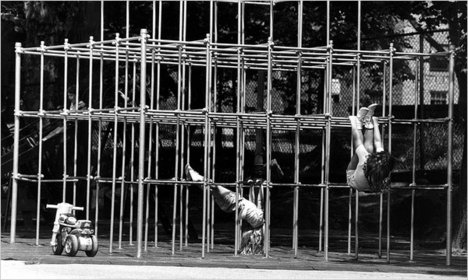
JungleGymRelic2011-11-09.jpg “CHILDHOOD RELIC; Jungle gyms, like this one in Riverside Park in Manhattan, have disappeared from most American playgrounds in recent decades.” Source of caption and photo: online version of the NYT article quoted and cited below.

(p. D3) “There is no clear evidence that playground safety measures have lowered the average risk on playgrounds,” said David Ball, a professor of risk management at Middlesex University in London. He noted that the risk of some injuries, like long fractures of the arm, actually increased after the introduction of softer surfaces on playgrounds in Britain and Australia.

“This sounds counterintuitive, but it shouldn’t, because it is a common phenomenon,” Dr. Ball said. “If children and parents believe they are in an environment which is safer than it actually is, they will take more risks. An argument against softer surfacing is that children think it is safe, but because they don’t understand its properties, they overrate its performance.”
Reducing the height of playground equipment may help toddlers, but it can produce unintended consequences among bigger children. “Older children are discouraged from taking healthy exercise on playgrounds because they have been designed with the safety of the very young in mind,” Dr. Ball said. “Therefore, they may play in more dangerous places, or not at all.”
Fear of litigation led New York City officials to remove seesaws, merry-go-rounds and the ropes that young Tarzans used to swing from one platform to another. Letting children swing on tires became taboo because of fears that the heavy swings could bang into a child.
“What happens in America is defined by tort lawyers, and unfortunately that limits some of the adventure playgrounds,” said Adrian Benepe, the current parks commissioner.

For the full story, see:
JOHN TIERNEY. “FINDINGS; Grasping Risk in Life’s Classroom.” The New York Times (Tues., July 19, 2011): D1 & D3.
(Note: the online version of the article is dated July 18, 2011, and has the title “FINDINGS; Can a Playground Be Too Safe?.”)

Unable to Compete with Cotton “European Textile Workers Bayed for Protection”

(p. 390) Cotton is such a commonplace material now that we forget that it was once extremely precious – more valuable than silk. But then in the seventeenth century, the East India Company began importing calicoes from India (from the city of Calicut, from which they take their name), and suddenly cotton became affordable. Calico was then essentially a collective term for chintzes, muslins, percales and other colourful fabrics, which caused unimaginable delight among western consumers because they were light and washable and the colours didn’t run. Although some cotton was grown in Egypt, India dominated the cotton trade, as we are reminded by the endless numbers of words that came into English by way of that trade: khaki, dungarees, gingham, muslin, pyjamas, shawl, seersucker, and so on.
The sudden surge of Indian cotton pleased consumers, but not (p. 391) manufacturers. Unable to compete with this wonder fabric, European textile workers bayed for protection almost everywhere, and almost everywhere they received it. The importation of finished cotton fabrics was banned in much of Europe throughout the eighteenth century.

Source:
Bryson, Bill. At Home: A Short History of Private Life. New York: Doubleday, 2010.
(Note: italics in original.)

The Penalty for Insulting the Future King

(p. 390) Brummell’s fall from grace was abrupt and irreversible. He and the Prince of Wales had a falling out and ceased speaking. At a social occasion, the prince pointedly ignored Brummell and instead spoke to his companion. As the prince withdrew, Brummell turned to the companion and made one of the most famously ill-advised remarks in social history. ‘Who’s your fat friend?’ he asked. Such an insult was social suicide. Shortly afterwards Brummell’s debts caught up with him and he fled to France. He spent the last two and a half decades of his life living in poverty, mostly in Calais, growing slowly demented but always looking, in his restrained and careful way, sensational.

Source:
Bryson, Bill. At Home: A Short History of Private Life. New York: Doubleday, 2010.

Wigmakers Petitioned King “to Make Wig-Wearing by Males Compulsory”

(p. 384) . . . , pretty abruptly, wigs went out of fashion. Wigmakers, in desperation, petitioned George III to make wig-wearing by males compulsory, but the king declined. By the early 1800s nobody wanted them and old wigs were commonly used as dust mops. Today they survive only in certain courtrooms in Britain and the Commonwealth. Judicial wigs these days are made of horsehair and cost about £600,
I’m told. To avoid a look of newness – which many lawyers fear might suggest inexperience – new wigs are customarily soaked in tea to give them a suitable air of age.

Source:
Bryson, Bill. At Home: A Short History of Private Life. New York: Doubleday, 2010.
(Note: ellipsis added.)

Reagan Fought “Tyranny” of Big Government

London-statue-of-Reagan-2011-08-10.jpg

Former Secretary of State Condolezza Rice, British Foreign Secretary William Hague and London statue of Ronald Reagan. Source of photo: http://static.guim.co.uk/sys-images/Guardian/Pix/pictures/2011/7/4/1309780763409/London-statue-of-Reagan-u-001.jpg

The McCarthy mentioned in the passage quoted below is a California representative who also serves as majority whip.

(p. A9) The statue of a smiling Reagan, dressed in a crisp suit, was paid for by the Ronald Reagan Presidential Foundation as part of a worldwide effort to promote his legacy, according to the organization’s executive director.
. . .
Though Mrs. Thatcher is in poor health and did not attend, she provided a statement that was read by Mr. Hague. “Through his strength and conviction,” she wrote, “he brought millions of people to freedom as the Iron Curtain finally came down.”
In a speech, Mr. McCarthy described Mr. Reagan’s fight not only against the forces of Communism, but against the “tyranny” of debt and big government. He and Mrs. Thatcher, he said, “did not move to the center to gather votes, they moved the center to them.”

For the full story, see:
RAVI SOMAIYA. “Finding a New Perch, Americana Takes a Stand in London.” The New York Times (Tues., July 5, 2011): A9.
(Note: ellipsis added.)
(Note: the online version of the article is dated July 4, 2011 and has the title “Statue of Reagan Is Unveiled in London.”)

Statute of Caps “Required People to Wear Caps Instead of Hats”

(p. 381) Sumptuary laws were enacted partly to keep people within their class, but partly also for the good of domestic industries, since they were often designed to depress the importation of foreign materials. For the same reason for a time there was a Statute of Caps, aimed at helping national capmakers through a depression, which required people to wear caps instead of hats. For obscure reasons, Puritans resented the law and were often fined for flouting it. But on the whole sumptuary laws weren’t much enforced. Various clothing restrictions were enshrined in (p. 382) statutes in 1337, 1363, 1463, 1483, 1510, 1533 and 1554, but records show they were never much enforced. They were repealed altogether in 1604.

Source:
Bryson, Bill. At Home: A Short History of Private Life. New York: Doubleday, 2010.

Obama Regulations Are “Choking Off Innovation”

From 2007 to 2010 Nina V. Fedoroff was the science and technology adviser to Secretary of State Hilary Clinton in the Obama administration. Fedoroff is currently a Professor of Biology at Penn State. The passages quoted below are from her courageous commentary in The New York Times op-ed section:

(p. A21) . . . even as the Obama administration says it wants to stimulate innovation by eliminating unnecessary regulations, the Environmental Protection Agency wants to require even more data on genetically modified crops, which have been improved using technology with great promise and a track record of safety. The process for approving these crops has become so costly and burdensome that it is choking off innovation.

Civilization depends on our expanding ability to produce food efficiently, which has markedly accelerated thanks to science and technology. The use of chemicals for fertilization and for pest and disease control, the induction of beneficial mutations in plants with chemicals or radiation to improve yields, and the mechanization of agriculture have all increased the amount of food that can be grown on each acre of land by as much as 10 times in the last 100 years.
These extraordinary increases must be doubled by 2050 if we are to continue to feed an expanding population. . . .
. . .
Myths about the dire effects of genetically modified foods on health and the environment abound, but they have not held up to scientific scrutiny. And, although many concerns have been expressed about the potential for unexpected consequences, the unexpected effects that have been observed so far have been benign. Contamination by carcinogenic fungal toxins, for example, is as much as 90 percent lower in insect-resistant genetically modified corn than in nonmodified corn. This is because the fungi that make the toxins follow insects boring into the plants. No insect holes, no fungi, no toxins.
. . .
Only big companies can muster the money necessary to navigate the regulatory thicket woven by the government’s three oversight agencies: the E.P.A., the Department of Agriculture and the Food and Drug Administration.
. . .
. . . the evidence is in. These crop modification methods are not dangerous. The European Union has spent more than $425 million studying the safety of genetically modified crops over the past 25 years. Its recent, lengthy report on the matter can be summarized in one sentence: Crop modification by molecular methods is no more dangerous than crop modification by other methods. Serious scientific bodies that have analyzed the issue, including the National Academy of Sciences and the British Royal Society, have come to the same conclusion.

For the full commentary, see:
NINA V. FEDOROFF. “Engineering Food for All.” The New York Times (Fri., August 19, 2011): A21.
(Note: ellipses added.)
(Note: the online version of the commentary was dated August 18, 2011.)

“It’s Our Right to Choose What We Want to Put in Our Bodies”

FoodSovereigntySign2011-08-06.jpg “Protesters outside the Los Angeles Courthouse on Thursday denounced the police’s moves against Rawesome, which offers raw milk products.” Source of caption and photo: online version of the NYT article quoted and cited below.

LOS ANGELES — Raw food enthusiasts fit right in here, in the earthy, health-conscious beach communities of Venice and Santa Monica, along with the farmers’ markets, health food stores and vegan restaurants.

But this week, the police cleared the shelves of Rawesome, an establishment in Venice Beach, loading $70,000 of raw, organic produce and dairy products on the back of a flatbed truck.
And then, on Thursday, James Stewart, the proprietor, was arraigned on charges of illegally making, improperly labeling and illegally selling raw milk products, as well as other charges related to Rawesome’s operations. Two farmers who work with Rawesome were also named in the district attorney’s complaint.
. . .
The raid on Rawesome has riled people here who say that unpasteurized milk is safer and healthier. About 150 raw food advocates gathered at the Los Angeles County Courthouse on Thursday to oppose the crackdown.
“It’s our right to choose what we want to put in our bodies,” Ms. Buttery said. “When members filled out an application, they were saying they wanted natural bacteria in their systems. We don’t want labeling. We don’t want animals full of antibiotics.”

For the full story, see:
IAN LOVETT. “Raw Food Co-op Is Raided in California.” The New York Times (Fri., August 5, 2011): A11.
(Note: ellipsis added.)
(Note: the online version of the story is dated August 4, 2011.)

If Truman Had Not Used the Bomb, Hundreds of Thousands More American Soldiers Would Have Died

MostControversialDecisionBK2011-08-10.jpg

Source of book image: online version of the WSJ review quoted and cited below.

(p. A15) . . . , the author reminds us of the hundreds of thousands of Japanese who had died in the conventional bombings of places like Tokyo and Kyoto while Roosevelt was president, but with relatively little opprobrium attaching to FDR. Father Miscamble cites as well the horrific massacre of innocents for which the Japanese were responsible, a savagery still being unleashed in the summer of 1945, and the awful cost of battle in the Pacific, including 6,000 American dead and 20,000 wounded at Iwo Jima and 70,000 casualties suffered while capturing Okinawa. With these precedents, Herbert Hoover warned Truman that an invasion of the Japanese home islands could result in the loss of between half a million and a million American lives. Marshall, Leahy and Gen. Douglas MacArthur each had his own projected figures, none of them wildly different from Hoover’s.

Under these circumstances, it was inconceivable that Truman would not have ordered the use of a potentially war-winning weapon the moment it could be deployed. It is impossible to imagine the depth of the public’s fury if after the war Americans had discovered that their president, out of concern for his own conscience, had not used the weapons but instead condemned hundreds of thousands of American soldiers to certain death on the beaches and in the cities of mainland Japan.

For the full review, see:
ANNE JOLIS. “BOOKSHELF; In Defense Of ‘Little Boy’; Herbert Hoover warned President Truman that invading Japan would cost at least half a million American lives.” The Wall Street Journal (Weds., July 13, 2011): A15.
(Note: ellipsis added.)

Book reviewed:
Miscamble, Wilson D. The Most Controversial Decision: Truman, the Atomic Bombs, and the Defeat of Japan, Cambridge Essential Histories. New York: Cambridge University Press, 2011.

In Greece “Entrepreneurial Activity Was Denigrated”

CoustasDanaosGreekShippiingEntrep2011-08-10.jpg

John Coustas. Source of image: online version of the WSJ article quoted and cited below.

(p. A15) Athens

If you’ve ever wondered why so many Greeks succeed in shipping, John Coustas has a plausible theory: “Greek shipping has nothing to do with the Greek state.”
His firm, Danaos Corporation, is a case in point. Mr. Coustas took over the company, which owns container ships, from his father in 1987 and has since transformed it from a three-vessel outfit into the third-largest company of its kind in the world, with a fleet of 56 ships. Danaos is incorporated in the Marshall Islands, a popular and stable jurisdiction for the global industry, and handles many of its operations through its German, Ukrainian, Russian and Tanzanian offices.
Nevertheless, Mr. Coustas is deeply concerned with the fate of his country. The government is now on the brink of default after passing its latest round of spending cuts and tax hikes. Yet the biggest risk to Greece, he says, is brain drain, that “all the good people, who really have something to offer, are either leaving or seriously considering it.”
. . .
On top of misguided government spending, Mr. Coustas says entrepreneurial activity was denigrated for many years and profit was regarded as “wrong.” “Anyone who wanted to make an investment here was considered a kind of bloodsucker.”

For the full commentary, see:
ANNE JOLIS. “Greece: Where Profit Is Taboo; A shipping magnate on the fate of his country.” The Wall Street Journal (Weds., July 13, 2011): A15.
(Note: ellipsis added.)