Biofuels Like Ethanol Raise Food Costs About 30%

(p. 5) Until January [2008], Keith Collins was the longtime and widely respected chief economist for the Department of Agriculture. In that position, he was a frequent booster of government policies that encouraged biofuel production.
In the months after his departure, he was hired by Kraft Foods Global to analyze the impact of biofuels on food prices. He delivered a stunning, and unexpected, roundhouse to his former employers.
The Bush administration had said biofuels were a minor factor in rising food costs. In a May 1 [2008] press conference, Edward P. Lazear, chairman of the White House Council of Economic Advisers, said, “The bottom line is that we think that ethanol accounts for somewhere between 2 and 3 percent of the overall increase in global food prices.”
A month later, in Rome at a United Nations conference on the food crisis, the agriculture secretary, Ed Schafer, echoed Mr. Lazear’s analysis in defending American biofuels policy.
But Mr. Collins pointed out that the administration’s analysis was more like a back-of-the-envelope calculation, and that it hadn’t accounted for the impact of biofuels on crops other than corn. The push for ethanol has led farmers to grow more corn and less of other food crops, one factor in rising prices for commodities like wheat.
Based on his own analysis, Mr. Collins maintains that biofuels have caused 23 to 35 percent of the increases in food costs.

For the full commentary, see:
ANDREW MARTIN. “THE FEED; The Man Who Dared to Question Ethanol.” The New York Times, SundayBusiness Section (Sun., July 13, 2008): 5.
(Note: bracketed years added.)
Feds Drop Charge Against 4th Amendment Flasher

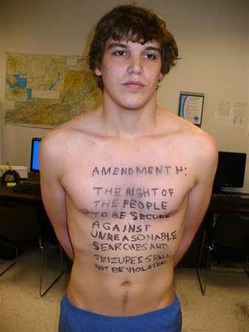
AaronTobeyAaronFourthAmendmentFlasher2013-08-04.jpg

Source of photo: http://tsanewsblog.com/wp-content/uploads/2013/01/AaronTobeyHero1.jpg (The WSJ article, cited below, had a similar photo in the print version of the article, but did not include it with the online version.)

(p. B6) Richmond International Airport officials have reached a settlement with Aaron Tobey, the so-called Fourth Amendment flasher.

Mr. Tobey in 2010 was arrested for alleged disorderly conduct at a checkpoint of the Virginia airport for stripping down to his running shorts. On his bare chest, Mr. Tobey had scrawled text of the Fourth Amendment on his chest in protest of the use of full-body scanners, which produced near-naked images of passengers.
The charge against him was dropped.
. . .
Government attorneys agreed not to appeal the Fourth Circuit ruling or further prosecute Mr. Tobey for interfering with TSA procedures, according to the Rutherford Institute, which represented him.
“Frankly, the nation would be better served if all government officials were required to undertake a training course on what it means to respect the constitutional rights of the citizenry,” said John W. Whitehead, president of the Rutherford Institute, a conservative legal defense group.

For the full story, see:
Gershman, Jacob. “Airport Settles Lawsuit Over Full-Body Scanners.” The Wall Street Journal (Mon., July 15, 2013,): B6.
(Note: ellipsis added.)
(Note: the online version of the article has the date July 14, 2013.)

Steel Bankruptcies Led to Better Steel Industry Processes

(p. 3) A few years ago, an industry whose history and mythology were indelible parts of the American identity was dying. The great steel mills of Pennsylvania and the Midwest had literally built this country, but the twin burdens of competition and self-inflicted wounds had brought them to the edge of extinction.
. . .
Yet steel’s savior was not the government bailouts it ardently sought but exactly what it so long tried to avoid: bankruptcy. Only when the companies failed were they successfully slimmed down and retooled into smaller but profitable ventures.
. . .
Bethlehem Steel, whose steel was used in the Hoover Dam, the Chrysler building and the George Washington Bridge, filed for bankruptcy in October 2001. It was followed by National Steel, Weirton Steel, Georgetown Steel and many others. The pain was great.
And necessary, some say. “If the steel companies had gotten all they wanted in terms of loan guarantees and import quotas, they would never have gotten better,” said Richard Fruehan, director of the Sloan Study on Competitiveness in the Steel Industry. “The bankruptcies forced their hand.”

For the full commentary, see:
DAVID STREITFELD. “THE NATION; Is Steel’s Revival a Model for Detroit?” The New York Times, Week in Review Section (Sun., November 23, 2008): 3.
(Note: ellipses added.)
(Note: the online version of the commentary is dated November 22, 2008.)

In the Plex Helps Us Understand Entrepreneurs Page and Brin

InThePlexBK2013-04-06.jpg

Source of book image: http://mastersofmedia.hum.uva.nl/wp-content/uploads/2011/09/intheplex.jpg

In the Plex goes from detail to detail of the values, actions and quirks of a large cast of characters who have been involved in the Google story. I did not find the book as consistently gripping as Isaacson’s Steve Jobs biography.
But some of the details help suggest new hypotheses, or test old ones, on important issues of entrepreneurship and technological progress. Some parts are revealing of the goals and methods of Page and Brin.
During the next weeks I will quote some of the more interesting passages.

Book discussed:
Levy, Steven. In the Plex: How Google Thinks, Works, and Shapes Our Lives. New York: Simon & Schuster, 2011.

Hunter-Gatherers Had High Child Mortality and Died Before Age 40

(p. 31) Child mortality in foraging tribes was severe. A survey of 25 hunter-gatherer tribes in historical times from various continents revealed that, on average, 25 percent of children died before they were 1, and 37 percent died before they were 15. In one traditional hunter-gatherer tribe, child mortality was found to be 60 percent. Most historical tribes had a population growth rate of approximately zero. This stagnation is evident, says Robert Kelly in his survey of hunting-gathering peoples, because “when formerly mobile people become sedentary, the rate of population growth increases.” All things being equal, the constancy of farmed food breeds more people.
While many children died young, older hunter-gatherers did not have (p. 32) it much better. It was a tough life. Based on an analysis of bone stress and cuts, one archaeologist said the distribution of injuries on the bodies of Neanderthals was similar to that found on rodeo professionals–lots of head, trunk, and arm injuries like the ones you might get from close encounters with large, angry animals. There are no known remains of an early hominin who lived to be older than 40. Because extremely high child mortality rates depress average life expectancy, if the oldest outlier is only 40, the median age was almost certainly less than 20.

Source:
Kelly, Kevin. What Technology Wants. New York: Viking Adult, 2010.

Wittgenstein Heirs Lost Family Wealth and “Found Little Happiness”

TheHouseOfWittgensteinBK2013-07-21.jpg

Source of book image: online version of the WSJ review quoted and cited below.

(p. W10) As he lay dying during Christmas 1912 — from a gruesome throat cancer — the Viennese industrialist Karl Wittgenstein no doubt took some comfort in the fact that he was leaving to his heirs one of the largest fortunes in Europe. He had acquired his wealth in just 30 years, the period during which Wittgenstein, an engineer, transformed a small steel mill into Europe’s largest steel cartel through a combination of hard work, luck and ruthlessness. As der österreichische Eisenkönig (the “Austrian iron king”), he was the chief executive, principal shareholder or director of dozens of industrial companies and banks that provided the ore, manufacturing and financing for most of the steel products of the Habsburg Empire.

In his spare time, Wittgenstein acquired a spectacular house in Vienna, grandly styled as the family’s Palais Wittgenstein.
. . .
Today, though, the Wittgenstein millions are gone and the Palais replaced by a hideous concrete apartment block. “Riches,” Adam Smith wrote, “. . . very seldom remain long in the same family.” Alexander Waugh’s grimly amusing “The House of Wittgenstein” shows how the family fortune was lost and how the family members themselves, despite instances of prodigious talent and accomplishment, found little happiness in their own lives or pleasure in their sibling relations.

For the full review, see:
JAMES F. PENROSE. “BOOKS; A Viennese Blend: Riches and Rancor; Blessed by Musical and Intellectual Gifts, and Lots of Money, a Family Still Struggled to Find Harmony.” The Wall Street Journal (Sat., March 1, 2009): W10.
(Note: ellipsis added; italics in original.)
(Note: the online version of the review has the date February 28, 2009.)

The book under review is:
Waugh, Alexander. The House of Wittgenstein: A Family at War. New York: Doubleday, 2009.

For Right to Rise, French Youth Must Leave France’s “Decrepit, Overcentralized Gerontocracy”

(p. 4) The French aren’t used to the idea that their country, like so many others in Europe, might be one of emigration — that people might actually want to leave. To many French people, it’s a completely foreign notion that, around the world and throughout history, voting with one’s feet has been the most widely available means to vote at all.
. . .
When the journalist Mouloud Achour, the rapper Mokless and I published a column in the French daily Libération last September, arguing that France was a decrepit, overcentralized gerontocracy and that French youths should pack their bags and go find better opportunities elsewhere in the world, it caused an uproar.
. . .
It was a divide between those who have found their place in the system and believe fervently in defending the status quo, and those who are aware that a country that has tolerated a youth unemployment rate of 25 percent for nearly 30 years isn’t a place where the rising generations can expect to rise to much of anything.

For the full commentary, see:
FELIX MARQUARDT. “OPINION; The Best Hope for France’s Young? Get Out.” The New York Times, SundayReview Section (Sun., June 30, 2013): 4.
(Note: ellipses added.)
(Note: the online version of the commentary is dated June 29, 2013.)

“Quality of Life Is Better” with a Home Electricity Generator

LaDucaCharlesGeneratorBuyer2013-07-22.jpg “AGAINST ALL STORMS; Charles LaDuca of Bethesda, Md., spent about $12,000 to buy and install a 14-kilowatt generator, below.” Source of caption and photo: online version of the NYT article quoted and cited below.

(p. F8) After Tropical Storm Irene pummeled the Northeast in 2011, Keith and Barbara Wolff realized it was time to act. Though they were spared during Irene, several other storms had cut the power to their home in Brookfield, Conn., forcing them to throw out food, wear sweaters to keep warm and find coffee shops to recharge their cellphones and laptops.

So the Wolffs did what many of their neighbors had done: They bought a portable, gasoline-powered generator that produced enough electricity to run many of their essential appliances, including their refrigerator, water well, hot water tank, heater and home offices.
The Wolffs paid about $1,000 for a 7,500-watt generator made by Generac. A week after paying an electrician $900 to hook up the unit to their electrical system, they put their new purchase to work when a snowstorm knocked out their power for nine days.
“It was a pretty hefty investment, but it was well worth it because when it’s cold out, you want to at least be able to take a shower,” Mr. Wolff said. “There are two things you can do: Be completely aggravated and non-functional or do a workaround so your quality of life is better.”

For the full story, see:
KEN BELSON. “Power Grids Iffy, Populous Areas Go for Generators.” The New York Times (Thurs., April 25, 2013): F8.
(Note: the online version of the article is dated April 24, 2013.)

GeneracGeneratorBoughtByLaDuca2013-07-23.jpg

Source of photo: online version of the NYT article quoted and cited above.

Falling Computer Prices Cured the “Digital Divide”

(p. 304) The more evident the power of the internet as an uplifting force became, the more evident the divide between the digital haves and have-nots. One sociological study concluded that there were “two Americas” emerging. The citizens of one America were poor people who could not afford a computer, and of the other, wealthy individuals equipped with PCs who reaped all the benefits. During the 1990s, when technology boosters like me were promoting the advent of the internet, we were often asked: What are we going to do about the digital divide? My an-(p. 305)swer was simple: nothing. We didn’t have to do anything, because the natural history of a technology such as the internet was self-fulfilling. The have-nots were a temporary imbalance that would be cured (and more) by technological forces. There was so much profit to be made connecting up the rest of the world, and the unconnected were so eager to join, that they were already paying higher telecom rates (when they could get such service) than the haves. Furthermore, the costs of both computers and connectivity were dropping by the month. At that time most poor in America owned televisions and had monthly cable bills. Owning a computer and having internet access was no more expensive and would soon be cheaper than TV. In a decade, the necessary outlay would become just a $100 laptop. Within the lifetimes of all born in the last decade, computers of some sort (connectors, really) will cost $5.

Source:
Kelly, Kevin. What Technology Wants. New York: Viking Adult, 2010.

The French and Japanese Believe Water Cleans the Anus Better than Dry Paper

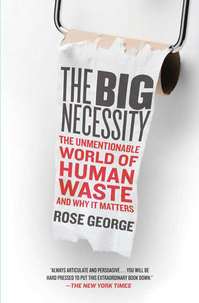
TheBigNecessityBK2013-07-21.jpg

Source of the book image: http://jacketupload.macmillanusa.com/jackets/high_res/jpgs/9780805090833.jpg

(p. C34) Ms. George’s book is lively . . . . It is hard not to warm to a writer who can toss off an observation like this one: “I like engineers. They build things that are useful and sometimes beautiful — a brick sewer, a suspension bridge — and take little credit. They do not wear black and designer glasses like architects. They do not crow.”
. . .
In Japan, where toilets are amazingly advanced — most of even the most basic have heated seats and built-in bidet systems for front and rear — the American idea of cleaning one’s backside with dry paper is seen as quaint at best and disgusting at worst. As Ms. George observes: “Using paper to cleanse the anus makes as much sense, hygienically, as rubbing your body with dry tissue and imagining it removes dirt.”

For the full review, see:
DWIGHT GARNER. “BOOKS OF THE TIMES; 15 Minutes of Fame for Human Waste and Its Never-Ending Assembly Line.” The New York Times (Fri., December 12, 2008): C34.
(Note: ellipses added.)
(Note: the online version of the review has the date December 11, 2008.)

The book under review, is:
George, Rose. The Big Necessity: The Unmentionable World of Human Waste and Why It Matters. New York: Metropolitan Books, 2008.

Biofuels Are Bad for the Planet

(p. A13) Biofuels are under siege from critics who say they crowd out food production. Now these fuels made from grass and grain, long touted as green, are being criticized as bad for the planet.
At issue is whether oil alternatives — such as ethanol distilled from corn and fuels made from inedible stuff like switch grass — actually make global warming worse through their indirect impact on land use around the world.
For example, if farmers in Brazil burn and clear more rainforest to grow food because farmers in the U.S. are using their land to grow grain for fuel, that could mean a net increase in emissions of carbon dioxide, the main “greenhouse gas” linked to climate change.
. . .
A study published in February [2008] in the journal Science found that U.S. production of corn-based ethanol increases emissions by 93%, compared with using gasoline, when expected world-wide land-use changes are taken into account. Applying the same methodology to biofuels made from switch grass grown on soil diverted from raising corn, the study found that greenhouse-gas emissions would rise by 50%.
Previous studies have found that substituting biofuels for gasoline reduces greenhouse gases. Those studies generally didn’t account for the carbon emissions that occur as farmers world-wide respond to higher food prices and convert forest and grassland to cropland.

For the full story, see:
STEPHEN POWER. “If a Tree Falls in the Forest, Are Biofuels To Blame? It’s Not Easy Being Green.” The Wall Street Journal (Tues., November 11, 2008): A13.
(Note: ellipsis, and bracketed year, added.)

Two relevant articles appeared in Science in the Feb. 29, 2008 issue:
Fargione, Joseph, Jason Hill, David Tilman, Stephen Polasky, and Peter Hawthorne. “Land Clearing and the Biofuel Carbon Debt.” Science 319, no. 5867 (Feb. 29, 2008): 1235-38.
Searchinger, Timothy, Ralph Heimlich, R. A. Houghton, Fengxia Dong, Amani Elobeid, Jacinto Fabiosa, Simla Tokgoz, Dermot Hayes, and Tun-Hsiang Yu. “Use of U.S. Croplands for Biofuels Increases Greenhouse Gases through Emissions from Land-Use Change.” Science 319, no. 5867 (Feb. 29, 2008): 1238-40.