In the England of the Late 1600s, Coffeehouses Were “Crucibles of Creativity”

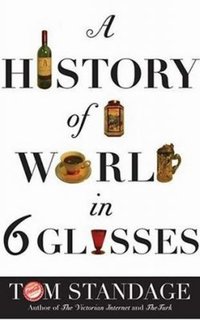
AHistoryOfTheWorldInSixGlassesBK2013-07-04.jpg

Source of book image: http://www.drinkoftheweek.com/wp-content/plugins/simple-post-thumbnails/timthumb.php?src=/wp-content/thumbnails/23682.jpg&w=250&h=400&zc=1&ft=jpg

(p. 8) Like coffee itself, coffeehouses were an import from the Arab world.
. . .
Patrons were not merely permitted but encouraged to strike up conversations with strangers from entirely different walks of life. As the poet Samuel Butler put it, “gentleman, mechanic, lord, and scoundrel mix, and are all of a piece.”
. . .
. . . , coffeehouses were in fact crucibles of creativity, because of the way in which they facilitated the mixing of both people and ideas. Members of the Royal Society, England’s pioneering scientific society, frequently retired to coffeehouses to extend their discussions. Scientists often conducted experiments and gave lectures in coffeehouses, and because admission cost just a penny (the price of a single cup), coffeehouses were sometimes referred to as “penny universities.” It was a coffeehouse argument among several fellow scientists that spurred Isaac Newton to write his “Principia Mathematica,” one of the foundational works of modern science.
Coffeehouses were platforms for innovation in the world of business, too. Merchants used coffeehouses as meeting rooms, which gave rise to new companies and new business models. A London coffeehouse called Jonathan’s, where merchants kept particular tables at which they would transact their business, turned into the London Stock Exchange. Edward Lloyd’s coffeehouse, a popular meeting place for ship captains, shipowners and traders, became the famous insurance market Lloyd’s.
And the economist Adam Smith wrote much of his masterpiece “The Wealth of Nations” in the British Coffee House, a popular meeting place for Scottish intellectuals, among whom he circulated early drafts of his book for discussion.

For the full commentary, see:
TOM STANDAGE. “OPINION; Social Networking in the 1600s.” The New York Times, SundayReview Section (Sun., June 23, 2013): 8.
(Note: ellipses added.)
(Note: the online version of the commentary has the date June 22, 2013.)

The author of the commentary is also the author of a related book:
Standage, Tom. A History of the World in Six Glasses. New York: Walker & Company, 2005.
Office Workers Switch Tasks Every 11 Minutes and Take 25 Minutes to Return to Original Task

(p. 12) As economics students know, switching involves costs. But how much? When a consumer switches banks, or a company switches suppliers, it’s relatively easy to count the added expense of the hassle of change. When your brain is switching tasks, the cost is harder to quantify.
There have been a few efforts to do so: Gloria Mark of the University of California, Irvine, found that a typical office worker gets only 11 minutes between each interruption, while it takes an average of 25 minutes to return to the original task after an interruption. But there has been scant research on the quality of work done during these periods of rapid toggling.

For the full commentary, see:
BOB SULLIVAN and HUGH THOMPSON. “GRAY MATTER; Brain, Interrupted.” The New York Times, SundayReview Section (Sun., May 5, 2013): 12.
(Note: the online version of the commentary has the date May 3, 2013.)

The Gloria Mark paper referred to in the commentary is:
Mark, Gloria, Victor M. Gonzalez, and Justin Harris. “No Task Left Behind? Examining the Nature of Fragmented Work.” Proceedings of ACM CHI’05, Portland, OR, (April 2-7, 2005): 321-30.

Another relevant Gloria Mark paper is:
Mark, Gloria, Daniela Gudith, and Ulrich Kloecke. “The Cost of Interrupted Work: More Speed and Stress.” Proceeding of the Twenty-sixth Annual SIGCHI Conference on Human Factors in Computing Systems (CHI’08), Florence, Italy, ACM Press (2008): 107-10.

Walker Says Those Who Call Him “Patent Troll” Want His Property Without Paying

WalkerJayPatentDefender2013-06-28.jpg

Source of caption and photo: online version of the WSJ article quoted and cited below.

(p. B1) Jay Walker turned his idea for “name your own price” Internet auctions into a fortune by starting Priceline.com Inc. Now the entrepreneur is trying to cash in on his ideas by suing other companies.

Since it was founded in 1994 as a research lab, Walker Digital LLC has made much of its money by spinning out its inventions, like online travel agent Priceline and vending-machine firm Vendmore Systems LLC, as independent businesses.
. . .
Mr. Walker defends his newly aggressive tactics, which some critics compare to those of “patent trolls,” a derogatory term for firms that opportunistically enforce patents. Without the lawsuits, he said, his patents could expire while other companies exploit them. Patents have a 20-year lifespan.
“Not only are we not a troll, but the people who want to label me are often the same ones that want to use our property and not pay,” Mr. Walker said in an interview.

For the full story, see:
JOHN LETZING. “Founder of Priceline Spoiling for a Fight Over Tech Patents.” The Wall Street Journal (Mon., August 22, 2011): B1 & B10.
(Note: ellipsis added.)

Amish Break the Golden Rule

(p. 237) If we apply the ubiquity test–what happens if everyone does it?–to the Amish way, the optimization of choice collapses. By constraining the suite of acceptable occupations and narrowing education, the Amish are holding back possibilities not just for their children but indirectly for all.
If you are a web designer today, it is only because many tens of thousands of other people around you and before you have been expanding the realm of possibilities. They have gone beyond farms and home shops to invent a complex ecology of electronic devices that require new expertise and new ways of thinking. If you are an accountant, untold numbers of creative people in the past devised the logic and tools of accounting for you. If you do science, your instruments and field of study have been created by others. If you are a photographer, or an extreme sports athlete, or a baker, or an auto mechanic, or a nurse–then your potential has been given an opportunity by the work of others. You are being expanded as others expand themselves.
. . .
. . . as you embrace new technologies, you are indirectly working for future generations of Amish, and for the minimite homesteaders, even though they are not doing as much for you. Most of what you adopt they will ignore. But every once in a while your adoption of “something that doesn’t quite work yet” (Danny Hillis’s definition of technology) will evolve into an appropriate tool they can use. It might be a solar grain dyer; it might be a cure for cancer.

Source:
Kelly, Kevin. What Technology Wants. New York: Viking Adult, 2010.
(Note: ellipses added.)

Property Rights, Flexible Work Rules, Open Markets Are Keys to Economic Growth

BalanceBK2013-06-28.jpg

Source of book image: online version of the WSJ review quoted and cited below.

(p. A11) Messrs. Hubbard and Kane argue, as do others, that certain policies and core principles are the key: property rights, flexible work rules, open markets. For the authors, such matters explain economic growth entirely.

To those who would cite the primacy of technological breakthroughs, Messrs. Hubbard and Kane assert that inventions only spark growth if there are systems in place (such as intellectual-property rights) that enable inventions to flourish and their value to spread. “The wheel and the windmill were invented many times,” they write, “then forgotten, until finally one society had the institutional framework to implement them widely and pass them on permanently.” In short, “institutions explain innovation.”

For the full review, see:
Matthew Rees. “BOOKSHELF; How the Mighty Fall; The Roman empire eventually lost its economic vitality thanks to price controls, heavy taxes and state-sponsored debt relief.” The Wall Street Journal (Fri., June 21, 2013): A11.
(Note: ellipses added.)
(Note: the online version of the review has the date June 20, 2013.)

The book under review, is:
Hubbard, Glenn, and Tim Kane. Balance: The Economics of Great Powers from Ancient Rome to Modern America. New York: Simon & Schuster, 2013.

Mainstream Climatologists Lower Best Guess Estimates of Global Warming (and Find High End Estimates “Pretty Implausible”)

(p. D1) Since 1896, scientists have been trying to answer a deceptively simple question: What will happen to the temperature of the earth if the amount of carbon dioxide in the atmosphere doubles?
Some recent scientific papers have made a splash by claiming that the answer might not be as bad as previously feared. This work — if it holds up — offers the tantalizing possibility that climate change might be slow and limited enough that human society could adapt to it without major trauma.
. . .
In 1979, after two decades of meticulous measurements had made it clear that the carbon dioxide level was indeed rising, scientists used computers and a much deeper understanding of the climate to calculate a likely range of warming. They found that the response to a doubling of carbon dioxide would not be much below three degrees Fahrenheit, nor was it likely to exceed eight degrees.
In the years since, scientists have been (p. D6) pushing and pulling within that range, trying to settle on a most likely value. Most of those who are expert in climatology subscribe to a best-estimate figure of just over five degrees Fahrenheit.
. . .
What’s new is that several recent papers have offered best estimates for climate sensitivity that are below four degrees Fahrenheit, rather than the previous best estimate of just above five degrees, and they have also suggested that the highest estimates are pretty implausible.
Notice that these recent calculations fall well within the long-accepted range — just on the lower end of it.

For the full story, see:
JUSTIN GILLIS. “BY DEGREES; A Change in Temperature.” The New York Times (Tues., May 14, 2013): D1 & D6.
(Note: ellipses added.)
(Note: the online version of the article has the date May 13, 2013.)

iPhone: “A Gleaming World of Innovation and Opportunity, of Capitalism Behaving Well”

SubwayIphoneUse2013-06-21.jpg “The theft of electronic devices like iPhones has fueled a rise in subway crime this year, the police say. In the past, New Yorkers were mugged, sometimes killed, for bomber jackets, Cazal glasses and Air Jordan sneakers.” Source of caption: print version of the NYT article quoted and cited below. Source of photo: online version of the NYT article quoted and cited below.

(p.24) The current spate of iPhone thefts feels, if anything, more poignant than disruptive. Apple products have always read as cooler than their rivals’ because their design suggests a gleaming world of innovation and opportunity, of capitalism behaving well — a world that seems ever diminishing, ever less accessible to the struggling and young.

Unlike the sneakers and glasses that caused such a fury in the ’80s and ’90s, iPhones didn’t originate in the celebrity system. They come with a democratic ethos (if not the analogous price tag); BlackBerrys are for suits, but even a child can work an iPhone. Wasn’t everyone supposed to have a shot?

For the full story, see:
GINIA BELLAFANTE. “BIG CITY; Easy to Use and Easy to Steal, a Status Object Inches Out of Reach.” The New York Times, First Section (Sun., October 30, 2011): 24.
(Note: the first paragraph quoted above is from the print version, rather than from the somewhat different online version. The second quoted paragraph is the same in both versions.)
(Note: the online version of the story has the date October 28, 2011, and has the slightly different title “BIG CITY; Easy to Use, or Steal, but Inching Out of Reach.”)

“Self-Reliant” Amish Depend on the Technologies of the Outside World

(p. 230) The Amish are a little sensitive about this, but their self-reliant lifestyle as it is currently practiced is heavily dependent on the greater technium that surrounds their enclaves. They do not mine the metal they build their mowers from. They do not drill or process the kerosene they use. They don’t manufacture the solar panels on their roofs. They don’t grow or weave the cotton in their clothes. They don’t educate or train their own doctors. They also famously do not enroll in armed forces of any kind. (But in compensation for that, the Amish are world-class volunteers in the outside world. Few people volunteer more often, or with (p. 231) more expertise and passion, than the Amish/Mennonites. They travel by bus or boat to distant lands to build homes and schools for the needy.) If the Amish had to generate all their own energy, grow all their clothing fibers, mine all metal, harvest and mill all lumber, they would not be Amish at all because they would be running large machines, dangerous factories, and other types of industry that would not sit well in their backyards (one of the criteria they use to decide whether a craft is appropriate for them). But without someone manufacturing this stuff, they could not maintain their lifestyle or prosperity. In short, the Amish depend on the outside world for the way they currently live. Their choice of minimal technology adoption is a choice–but a choice enabled by the technium. Their lifestyle is within the technium, not outside it.

Source:
Kelly, Kevin. What Technology Wants. New York: Viking Adult, 2010.

Discrete Caution Is Not Always Prudent in Corrupt China

TheLittleRedGuardBK2013-06-22.jpg

Source of book image: online version of the WSJ review quoted and cited below.

(p. A13) When economic reform and the seductive breeze of political liberalization come to China in the 1980s, the author’s cautious father tells his children that if they want to succeed they should be discreet. He urges his son, who is at Shanghai’s Fudan University, not to waste his time on useless foreign books. When the son first reads Shakespeare, he thinks that the expression “to be or not to be” is taken from Confucius. His father tells him that asking for too much freedom can land you in jail. “If you are not careful the government could crush you like a bug.” Not long after this warning, the student democracy movement was smashed apart at Tiananmen Square, though Mr. Huang’s father did not live to see it.

In the end, it is the father who suffers as his world collapses. Toward the end of his life he was told by the Party that he was to be rewarded for devising a money-saving program at his state factory with promotion and a better wage. Instead the promotion went to the girlfriend of the local Party secretary, and the firm’s bosses split his wage rise among themselves. Embittered and exhausted, he died of a heart attack in 1988, ahead of his mother.

For the full review, see:
MICHAEL FATHERS. “BOOKSHELF; Coming of Age In Mao’s China; Death cannot be controlled by the party, but disposing of a body can. So the author’s father built a coffin in secret at his mother’s request..” The Wall Street Journal (Mon., April 30, 2012): C4.
(Note: ellipsis added.)
(Note: the online version of the article has the date April 29, 2012.)

The book under review, is:
Huang, Wenguang. The Little Red Guard: A Family Memoir. New York: Riverhead Books, 2012..

$30 Million First National Bank Regulatory Costs Due to Dodd-Frank Replacing Clear Rules with Regulator “Wild Card” Leeway

(p. 1D) The president of First National of Nebraska, the nation’s largest privately held banking firm, said new federal regulatory and compliance efforts stand to cost the company as much as $30 million this year.
“It is a big uncertainty in the banking world,” said Dan O’Neill, speaking Wednesday at the company’s annual meeting in Omaha. “They are not operating off of concrete rules. A lot of it is their interpretation.”
The federal Consumer Financial Protection Bureau was formed as a result of the federal Dodd-Frank laws passed in 2010 after widespread bank failures and bailouts using taxpayer money. . . .
. . .
The bureau, he said, worries banks because there is not a “clear body of rules” from which the regulator is operating in evaluating the fairness of a bank’s business practices. He said the agency’s regulators have a lot of leeway in deciding what to do af-(p. 2D)ter examining a bank; penalties for running afoul include fines.
“So it is a bit of a wild card,” he said.

For the full story, see:
Russell Hubbard. “First National Chief Says Regulatory Costs Mounting.” Omaha World-Herald (THURSDAY, JUNE 20, 2013): 1D-2D.
(Note: ellipses added.)

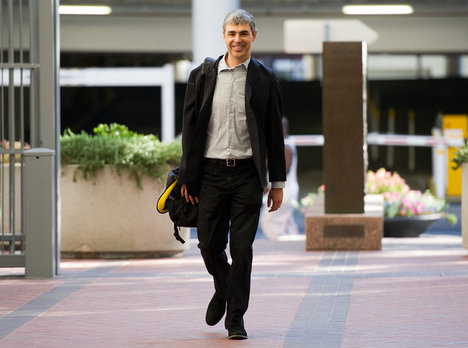
Larry Page Makes an O.K. Decision Now, Rather than a Perfect Decision Later

PageLarryGoogleCEO2013-06-21.jpg “Larry Page has pushed for quicker decision-making and jettisoned more than 25 projects that were not up to snuff.” Source of caption and photo: online version of the NYT article quoted and cited below.

(p. A1) MOUNTAIN VIEW, Calif. — Larry Page, Google’s chief executive, so hates wasting time at meetings that he once dumped his secretary to avoid being scheduled for them. He does not much like e-mail either — even his own Gmail — saying the tedious back-and-forth takes too long to solve problems.
. . .
(p. A3) Borrowing from the playbooks of executives like Steven P. Jobs and Mayor Michael R. Bloomberg, he has put his personal imprint on the corporate culture, from discouraging excessive use of e-mail to embracing quick, unilateral decision-making — by him, if need be.
“Ever since taking over as C.E.O., I have focused much of my energy on increasing Google’s velocity and execution, and we’re beginning to see results,” Mr. Page, 38, told analysts recently.
. . .
Despite the many external pressures on Google, it is dominant in its business and highly profitable. But, when asked at a recent conference about the biggest threat to his company, Mr. Page answered in one word, “Google.”
The problem was that the company had ballooned so quickly — it now has more than 31,000 employees and $27.3 billion in revenue so far this year — that it had become sclerotic. A triumvirate of Mr. Page, his co-founder, Sergey Brin, and Eric E. Schmidt, Google’s former chief and current chairman, had to agree before anything could be done. The unwieldy management and glacial pace of decision-making were particularly noticeable in the Valley, where start-ups overtake behemoths in months.
It is different now.
“It’s much more of a style like Steve Jobs than the three-headed monster that Google was,” said a former Google executive who has spoken with current executives about the changes and spoke anonymously to preserve business relationships. “When Eric was there, you’d walk into a product meeting or a senior staff meeting, and everyone got to weigh in on every decision. Larry is much more willing to make an O.K. decision and make it now, rather than a perfect decision later.”

For the full story, see:
CLAIRE CAIN MILLER. “Google’s Chief Works to Trim a Bloated Ship.” The New York Times (Thurs., November 10, 2011): A1 & A3.
(Note: ellipses added.)
(Note: the online version of the story has the date November 9, 2011.)