Limited Choice Is Cost of Amish Community Closeness

(p. 230) . . . the cost of . . . closeness and dependency is limited choice. No education beyond eighth grade. Few career options for guys, none besides homemaker for girls. For the Amish and minimites, one’s fulfillment must blossom inside the traditional confines of a farmer, tradesman, or housewife. But not everyone is born to be a farmer. Not every human is ideally matched to the rhythms of horse and corn and seasons and the eternal close inspection of village conformity. Where in the Amish scheme of things is the support for a mathematical genius or a person who might spend all day composing new music?

Source:
Kelly, Kevin. What Technology Wants. New York: Viking Adult, 2010.
(Note: ellipses added.)

We Should Disenthrall Ourselves of False Scientific Certainties

An Optimists Tour of the Future CoverBK2013-06-21.jpg

Source of book image: http://2.bp.blogspot.com/-ELpfH2bTO7c/Tb53WpKuDxI/AAAAAAAADrE/Zq8BQiiasJc/s640/An+Optimists+Tour+of+the+Future+Cover.jpg

(p. C4) Among the scientific certainties I have had to unlearn: that upbringing strongly shapes your personality; that nurture is the opposite of nature; that dietary fat causes obesity more than dietary carbohydrate; that carbon dioxide has been the main driver of climate change in the past.

I came across a rather good word for this kind of unlearning–“disenthrall”–in Mark Stevenson’s book “An Optimist’s Tour of the Future,” published just this week. Mr. Stevenson borrows it from Abraham Lincoln, whose 1862 message to Congress speaks of disenthralling ourselves of “the dogmas of the quiet past” in order to “think anew.”
Mr. Stevenson’s disenthrallment comes in the course of a series of sharp and fascinating interviews with technological innovators and scientific visionaries. This disenthralls him of the pessimism about the future and nostalgia about the past that he barely realized he had and whose “fingers reach deep into [his] soul.” It eventually turns him into an optimist almost as ludicrously sanguine about the 21st century as I am: “I steadfastly refuse to believe that human society can’t grow, improve and learn; that it can’t embrace change and remake the world better.”
Along the way, Mr. Stevenson is struck by other examples of how the way he thinks and reasons is “in thrall to a world that is passing.” The first of these bad habits is linear thinking about the future. . . .
We expect to see changes coming gradually, but because things like computing power or the cheapness of genome sequencing change exponentially, technologies can go from impossible to cheap quite suddenly and with little warning.

For the full commentary, see:
MATT RIDLEY. “MIND & MATTER; A Key Lesson of Adulthood: The Need to Unlearn.” The Wall Street Journal (Sat., February 5, 2011): C4.
(Note: ellipsis added.)

The book praised by Ridley, in the passages quoted above, is:
Stevenson, Mark. An Optimist’s Tour of the Future: One Curious Man Sets out to Answer “What’s Next?”. New York: Avery, 2011.

Remedial Ed Does Not Remediate

(p. C4) Two economists looked at the achievements of 453,000 students who took a basic-skills test upon entering both two- and four-year public colleges in Texas in the 1990s. . . .
. . . the authors focused on the 93,000 students who either barely passed or barely failed the test. Those students, with nearly identical skills, got treated very differently: Most who barely failed took remedial courses; most who barely passed took college-level courses.
But there was no difference in subsequent achievement between those two groups. In fact, students who got remedial help were slightly less likely to finish one year of college. The study found no effects of remediation on income seven years after starting college.

For the full story, see:
CHRISTOPHER SHEA. “Week in Ideas; Education; Remedial Ed Needs Help.” The Wall Street Journal (Sat., February 5, 2011): C4.
(Note: ellipses added.)

The article summarized in the passages quoted above, is:
Martorell, Paco, and Isaac McFarlin, Jr. “Help or Hindrance? The Effects of College Remediation on Academic and Labor Market Outcomes.” Review of Economics and Statistics 93, no. 2 (May 2011): 436-54.

Self-Taught Ovshinsky Created New Field in Physics and Licensed His Patents

OvshinskyStanfordSelfTaughtInventorPhysicist2013-06-21.jpg

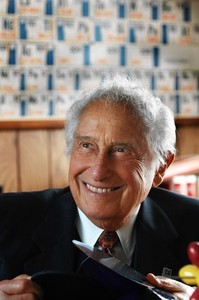
“Stanford Ovshinsky helped to establish a new field of physics.” Source of caption and photo: online version of the WSJ obituary quoted and cited below.

(p. B5) Inspired by the structure of the brain, Stanford Ovshinsky created a new class of semiconductors that helped lead to flat-panel displays, solar cells and nickel-metal hydride batteries for cars, laptops and cameras.

Mr. Ovshinsky, who died Wednesday [October 17, 2012] at age 89, was an industrialist and self-taught scientific prodigy who helped found a new field of physics that studies the electronics of amorphous materials resembling glass.
. . .
“It was like discovering a new continent, like discovering America,” said Hellmut Fritzsche, former chairman of physics department at the University of Chicago who worked with Mr. Ovshinsky. “Nobody in the past 50-60 years has created such a revolution in science.”
The new materials–dubbed ovonics–were switches like transistors but worked better for many applications.
Mr. Ovshinsky used his discovery to fund a publicly traded research laboratory that teamed up with companies such as 3M Co., Atlantic Richfield Oil Corp. and General Motors, for which he developed the battery that powered the EV1, GM’s electric car.
Companies around the world license his patents.
What made Mr. Ovshinsky’s work particularly remarkable was that he had little connection to mainstream physics.
His education stopped after high school, . . .

For the full obituary, see:
STEPHEN MILLER. “Stanford Ovshinsky 1922-2012; An Inventor of Chips and Batteries.” The Wall Street Journal (Fri., October 19, 2012): B5.
(Note: ellipses, and bracketed date, added.)
(Note: the online version of the obituary has the date October 18, 2012.)

Amish “Are Big Boosters of Genetically Modified Corn”

(p. 222) The Amish use disposable diapers (why not?), chemical fertilizers, and pesticides, and they are big boosters of genetically modified corn. In Europe this corn is called Frankenfood. I asked a few of the Amish elders about that last one. Why do they plant GMOs? Well, they reply, corn is susceptible to the corn borer, which nibbles away at the bottom of the stem and occasionally topples the stalk. Modern 500-horsepower harvesters don’t notice this fall; they just suck up all the material and spit out the corn into a bin. The Amish harvest their corn semimanually. It’s cut by a chopper device and then pitched into a thresher. But if there are a lot of stalks that are broken, they have to be pitched by hand. That is a lot of very hard, sweaty work. So they plant Bt corn. This genetic mutant carries the genes of the corn borer’s enemy, Bacillus thuringiensis, which produces a toxin deadly to the corn borer. Fewer stalks are broken and the harvest can be aided with machines, so yields are up. One elder Amish man whose sons run his farm said he was too old to be pitching heavy, broken cornstalks, and he told his sons that he’d only help them with the harvest if they planted Bt corn. The alternative was to purchase expensive, modern harvesting equipment, which none of them wanted. So the technology of genetically modified crops allowed the Amish to continue using old, well-proven, debt-free equipment, which accomplished their main goal of keeping the family farm together. They did not use these words, but they made it clear that they considered genetically modified crops appropriate technology for family farms.

Source:
Kelly, Kevin. What Technology Wants. New York: Viking Adult, 2010.
(Note: italics in original.)

Nate Silver “Chides Environmental Activists for Their Certainty”

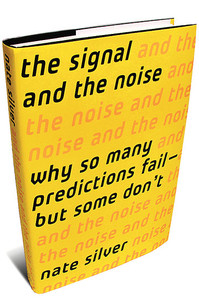
TheSignalAndTheNoiseBK2013-05-13.jpg

Source of book image: http://si.wsj.net/public/resources/images/OB-US032_bkrvno_GV_20120924132722.jpg

(p. 12) In recent years, the most sophisticated global-warming skeptics have seized on errors in the forecasts of the United Nations’ International Panel on Climate Change (I.P.C.C.) in order to undermine efforts at greenhouse gas reduction. These skeptics note that global temperatures have increased at only about half the rate the I.P.C.C. predicted in 1990, and that they flatlined in the 2000s (albeit after rising sharply in the late ’90s).

Silver runs the numbers to show that the past few decades of data are still highly consistent with the hypothesis of man-made global warming. He shows how, at the rate that carbon dioxide is accumulating, a single decade of flat temperatures is hardly invalidating. On the other hand, Silver demonstrates that projecting temperature increases decades into the future is a dicey proposition. He chides some environmental activists for their certainty — observing that overambitious predictions can undermine a cause when they don’t come to pass . . .

For the full review, see:
NOAM SCHEIBER. “Known Unknowns.” The New York Times Book Review (Sun., November 4, 2012): 12.
(Note: ellipsis added.)
(Note: the online version of the review has the date November 2, 2012.)

The book under review, is:
Silver, Nate. The Signal and the Noise: Why So Many Predictions Fail — but Some Don’t. New York: The Penguin Press, 2012.

Cars Increase Our Individual Freedom

(p. A13) Cars appeal powerfully to one of the most important conservative values: individual freedom. Straphangers in public conveyances can only travel in groups, moving along with hordes of strangers according to schedules imposed by others. Bicyclists, free as they may be, are clearly limited by distance and time constraints. Once you get into a car, however, you go wherever you want, whenever you want, subject only to your ability to put gas in the tank.

For the full commentary, see:
MICHAEL MEDVED. “OPINION; Honk If You Were Ever Devoted to a Car; I asked for a chance to say a proper goodbye to our family Plymouth. The night before we traded the car in, I slept in it.” The Wall Street Journal (Sat., March 9, 2013): A13.
(Note: the online version of the commentary has the date March 8, 2013.)

Heart Disease Affected Ancients Who Differed in Culture, Class and Diet

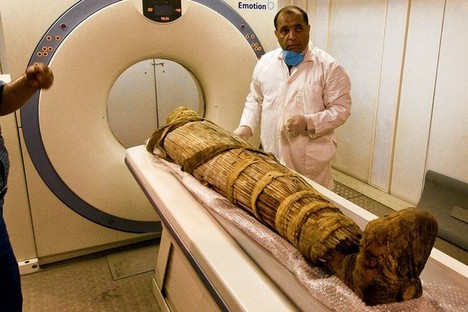
EgyptologistPreparesMummy2013-06-16.jpg “Egyptologist Dr. Gomaa Abd el-Maksoud prepares the mummy Hatiay (New Kingdom, 18th Dynasty, 1550-1295 BCE) for scanning. Hatiay was found to have evidence of extensive vascular disease.” Source of caption and photo: online version of the WSJ article quoted and cited below.

(p. A4) SAN FRANCISCO–It turns out there is nothing new about heart disease.

Researchers who examined 137 mummies from four cultures spanning 4,000 years said Sunday they found robust evidence of atherosclerosis, or hardening of the arteries, challenging widely held assumptions that cardiovascular disease is largely a malady of current times.
An international research team of cardiologists, radiologists and archeologists used CT scanners to evaluate the mummies, hunting for deposits of calcium in arterial walls that are a telltale sign of hardening of the arteries that can lead to heart attacks and strokes. They found that 47, or 34%, of the mummies had such deposits, suggesting, they said, that cardiovascular disease was more common in historic times than many experts think.
. . .
The same researchers reported similar findings in 2009 from Egyptian mummies. Because those specimens were believed to have been from the upper echelons of society, the researchers surmised their calcified arteries could have developed from high-fat diets. But by expanding the research to other cultures, including Puebloans of what is now the U.S. Southwest, the researchers believe all levels of society were at risk, regardless of diet.

For the full story, see:
RON WINSLOW. “U.S. NEWS; Telltale Finding on Heart Disease.” The Wall Street Journal (Mon., March 11, 2013): A6.
(Note: the online version of the story has the date March 10, 2013.)

Amish Factory Uses Pneumatics in Place of Electricity

(p. 219) The Amish also make a distinction between technology they have at work and technology they have at home. I remember an early visit to an Amish man who ran a woodworking shop near Lancaster, Pennsylvania. . . .
. . .
(p. 220) While the rest of his large workshop lacked electricity beyond that naked bulb, it did not lack power machines. The place was vibrating with an ear-cracking racket of power sanders, power saws, power planers, power drills, and so on. Everywhere I turned there were bearded men covered in sawdust pushing wood through screaming machines. This was not a circle of Renaissance craftsman hand-tooling masterpieces. This was a small-time factory cranking out wooden furniture with machine power. But where was the power coming from? Not from windmills.
Amos took me around to the back where a huge SUV-sized diesel generator sat. It was massive. In addition to a gas engine there was a very large tank, which, I learned, stored compressed air. The diesel engine burned petroleum fuel to drive the compressor that filled the reservoir with pressure. From the tank, a series of high-pressure pipes snaked off toward every corner of the factory. A hard rubber flexible hose connected each tool to a pipe. The entire shop ran on compressed air. Every piece of machinery was running on pneumatic power. Amos even showed me a pneumatic switch, which he could flick like a light switch to turn on some paint-drying fans running on air.
The Amish call this pneumatic system “Amish electricity.” At first, pneumatics were devised for Amish workshops, but air power was seen as so useful that it migrated to Amish households. In fact, there is an entire cottage industry in retrofitting tools and appliances to run on Amish electricity. The retrofitters buy a heavy-duty blender, say, and yank out the electrical motor. They then substitute an air-powered motor of appropriate size, add pneumatic connectors, and bingo, your Amish mom now has a blender in her electricity-less kitchen. You can get a pneumatic sewing machine and a pneumatic washer/dryer (with propane heat). In a display of pure steam-punk (air-punk?) nerdiness, Amish hackers try to outdo one another in building pneumatic versions of electrified contraptions. Their mechanical skill is quite impressive, particularly since none went to school beyond the eighth grade. They (p. 221) love to show off their geekiest hacks. And every tinkerer I met claimed that pneumatics were superior to electrical devices because air was more powerful and durable, outlasting motors that burned out after a few years of hard labor. I don’t know if this claim of superiority is true or merely a justification, but it was a constant refrain.

Source:
Kelly, Kevin. What Technology Wants. New York: Viking Adult, 2010.
(Note: ellipses added.)

Behind the Iron Curtain, Those Who Opposed “Were to Be Destroyed by “Cutting Them Off Like Slices of Salami””

Iron-CurtainBK2013-05-13.jpg

Source of book image: http://www.opednews.com/populum/uploaded/iron-curtain-20882-20130113-95.jpg

(p. 16) That Soviet tanks carried Moscow-trained agents into Poland, Hungary, Romania, Bulgaria, Czechoslovakia and East Germany was known in the West at the time and has been well documented since. When those agents set out to produce not only a friendly sphere of Soviet influence but also a cordon of dictatorships reliably responsive to Russian orders, Winston Churchill was moved to warn, just days after the Nazis’ surrender in 1945, that an Iron Curtain was being drawn through the heart of Europe. (He coined the metaphor in a message to President Truman a full year before he used it in public in Fulton, Mo.) And Matyas Rakosi, the “little Stalin” of Hungary, was well known for another apt metaphor, describing how the region’s political, economic, cultural and social oppositions were to be destroyed by “cutting them off like slices of salami.”

Applebaum tracks the salami slicing as typically practiced in Poland, Hungary and Germany, and serves up not only the beef but also the fat, vinegar and garlic in exhausting detail. She shows how the knives were sharpened before the war’s end in Soviet training camps for East European Communists, so that trusted agents could create and control secret police forces in each of the “liberated” nations. She shows how reliable operatives then took charge of all radio broadcasting, the era’s most powerful mass medium. And she demonstrates how the Soviet stooges could then, with surprising speed, harass, persecute and finally ban all independent institutions, from youth groups and welfare agencies to schools, churches and rival political parties.
Along the way, millions of Germans, Poles, Ukrainians and Hungarians were ruthlessly driven from their historic homes to satisfy Soviet territorial ambitions. Millions more were deemed opponents and beaten, imprisoned or hauled off to hard labor in Siberia. In Stalin’s paranoid sphere, not even total control of economic and cultural life was sufficient. To complete the terror, he purged even the Communist leaders of each satellite regime, accusing them of treason and parading them as they made humiliating confessions.
It is good to be reminded of these sordid events, now that more archives are accessible and some witnesses remain alive to recall the horror.

For the full review, see:
MAX FRANKEL. “Stalin’s Shadow.” The New York Times (Sun., November 25, 2012): 16.
(Note: the online version of the review has the date November 21, 2012.)

The book under review, is:
Applebaum, Anne. Iron Curtain: The Crushing of Eastern Europe, 1944-1956. New York: Doubleday, 2012.

Cuban Government Employees “Are Known for Surly Service, Inefficiency, Absenteeism and Pilfering”

(p. A10) However small, . . . , the private sector is changing the work culture on an island where state employees earn meager salaries and are known for surly service, inefficiency, absenteeism and pilfering.
Sergio Alba Marín, who for years managed the restaurants of a state-owned hotel and now owns a popular fast-food restaurant, said he was very strict with his employees and would not employ workers trained by the state.
“They have too many vices — stealing, for one,” said Mr. Alba, who was marching with his 25 employees and two large banners emblazoned with the name of his restaurant, La Pachanga. “You can’t change that mentality.”
“Even if you could, I don’t have time,” he added. “I have a business to run.”

For the full story, see:
VICTORIA BURNETT. “HAVANA JOURNAL; Amid Fealty to Socialism, a Nod to Capitalism.” The New York Times (Thurs., May 2, 2013): A6 & A10.
(Note: ellipsis added.)
(Note: the online version of the story has the date May 1, 2013.)