“The Million-Dollar Question” for “Our Long Economic Slump”: Why “the Severe Downturn in Jobs”?

(p. 5) [There are] . . . two underappreciated aspects of our long economic slump. First, it has exacted the harshest toll on the young — even harsher than on people in their 50s and 60s, who have also suffered. And while the American economy has come back more robustly than some of its global rivals in terms of overall production, the recovery has been strangely light on new jobs, even after Friday’s better-than-expected unemployment report. American companies are doing more with less.
“This still is a very big puzzle,” said Lawrence F. Katz, a Harvard professor who was chief economist at the Labor Department during the Clinton administration. He called the severe downturn in jobs “the million-dollar question” for the economy.

For the full commentary, see:
DAVID LEONHARDT. “CAPITAL IDEAS; The Idled Young Americans.” The New York Times, SundayReview Section (Sun., May 5, 2013): 5.
(Note: ellipsis, and words in brackets, added.)
(Note: the online version of the commentary has the date May 3, 2013.)
Will Apple Innovate Without Jobs?

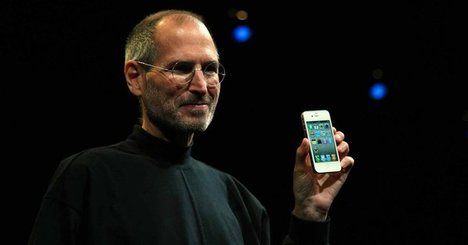
JobsSteveHoldingIphone2013-06-28.jpg “Steve Jobs, introducing the iPhone 4 in January [2011].” Source of caption and photo: online version of the NYT article quoted and cited below.

(p. B4) “The good news for Apple is that the product road map in this industry is pretty much in place two and three years out,” said David B. Yoffie, a professor at the Harvard Business School. “So 80 percent to 90 percent of what would happen in that time would be the same, even without Steve.”

“The real challenge for Apple,” Mr. Yoffie continued, “will be what happens beyond that road map. Apple is going to need a new leader with a new way of recreating and managing the business in the future.”
. . .
His design decisions, Mr. Jobs explained, were shaped by his understanding of both technology and popular culture. His own study and intuition, not focus groups, were his guide. When a reporter asked what market research went into the iPad, Mr. Jobs replied: “None. It’s not the consumers’ job to know what they want.”
. . .
Great products, Mr. Jobs once explained, were a triumph of taste, of “trying to expose yourself to the best things humans have done and then trying to bring those things into what you are doing.”
Mr. Yoffie said Mr. Jobs “had a unique combination of visionary creativity and decisiveness,” adding: “No one will replace him.”

For the full story, see:
STEVE LOHR. “Without Its Master of Design, Apple Will Face Challenges.” The New York Times (Thurs., August 25, 2011): B1 & B4.
(Note: ellipses in text, and bracketed year in caption, added.)
(Note: the online version of the story has the date August 24, 2011, and the slightly longer title “Without Its Master of Design, Apple Will Face Many Challenges.”)

Chinese Peasants Applied Precautionary Principle to Scythe Technology

(p. 249) In a letter Orville Wright wrote to his inventor friend Henry Ford, Wright recounts a story he heard from a missionary stationed in China. Wright told Ford the story for the same reason I tell it here: as a cautionary tale about speculative risks. The missionary wanted to improve the laborious way the Chinese peasants in his province harvested grain. The local farmers clipped the stalks with some kind of small hand shear. So the missionary had a scythe shipped in from America and demonstrated its superior productivity to an enthralled crowd. “The next morning, however, a delegation came to see the missionary. The scythe must be destroyed at once. What, they said, if it should fall into the hands of thieves; a whole field could be cut and carried away in a single night.” And so the scythe was banished, progress stopped, because nonusers could imagine a possible–but wholly improbable–way it could significantly harm their society.

Source:
Kelly, Kevin. What Technology Wants. New York: Viking Adult, 2010.

Record Companies Refused to See Efficiency of Napster Distribution System

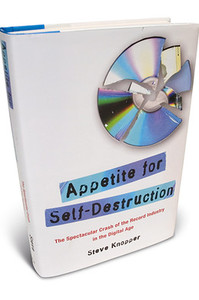
AppetiteForSelfDestructionBK2013-07-13.jpg

Source of book image: online version of the WSJ review quoted and cited below.

(p. A15) . . . the central character in “Appetite for Self-Destruction” is technological change.
. . .
Record labels scrambled to negotiate with Napster and develop a legal version of the service with multiple revenue streams. The attempts all failed. In Mr. Knopper’s telling, there were unreasonable demands on all sides. But he faults music executives for “cling[ing] to the old, suddenly inefficient model of making CDs and distributing them to record stores. . . . In this world, the labels controlled — and profited from — everything.” In the new world being ushered in by Napster, he writes, control was shifting “to a snot-nosed punk and his crazy uncle.”
The labels’ inability to reach an agreement with Napster destroyed “the last chance for the record industry as we know it to stave off certain ruin,” Mr. Knopper writes in a typically overheated passage. Had a deal been consummated, he suggests, a legal version of Napster might have generated revenues of $16 billion in 2002 and saved the industry. Whether or not the author’s estimate is accurate, his larger point remains: The music industry’s big mistake was trying to protect a business model that no longer worked. Litigation would not keep music consumers offline.

For the full review, see:
JEREMY PHILIPS. “BUSINESS BOOKSHELF; Spinning Out of Control; How the record industry missed out on a chance to compete in a new digital world.” The Wall Street Journal (Weds., February 11, 2009): A15.
(Note: first two ellipses added; third ellipsis in original.)

The book under review is:
Knopper, Steve. Appetite for Self-Destruction: The Spectacular Crash of the Record Industry in the Digital Age. New York: Free Press, 2009.

Due to Global Warming, Chicago “Winters Have Softened”

(p. 20) Before anyone accuses me of being some latter-day A. J. Liebling, whose 1952 book “Chicago: The Second City” infuriated residents, let me say there are some good things about living here. The beauty of Lake Michigan. A former rail yard has become Millennium Park. Thanks to global warming, the winters have softened.

For the full review, see:
RACHEL SHTEIR. “Chicago Manuals.” The New York Times Book Review (Sun., April 21, 2013): 1 & 20-21.
(Note: the online version of the review has the date April 18, 2013.)

The Decay of River Rouge’s Diseconomies of Scale

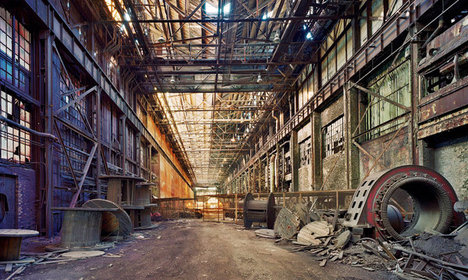
RiverRougeFordRollingHall2013-06-28.jpg “The rolling hall at Ford’s River Rouge plant, one of Andrew Moore’s photographs of Detroit.” Source of caption and of the Andrew Moore photo: online version of the NYT article quoted and cited below.

Ford’s River Rouge plant near Detroit is a standard textbook example of diseconomies of scale (aka diminishing returns to scale). The image above is an apt illustration of the consequences of diseconomies of scale.

(p. 19) A Connecticut native, Mr. Moore moved to New York in 1980, living near South and John Streets in Lower Manhattan. At night he would wander the neighborhood taking pictures of the construction of the South Street Seaport, which kindled an interest in documenting “life in flux,” he said. “I like places in transformation, the process of becoming and changing.”
. . .
Photos like those of the enormous rolling hall at Ford’s River Rouge plant and a sunset over the Bob-Lo Island boat dock were inspired, Mr. Moore said, by 19th-century American landscape painters like Frederic Church and Martin Johnson Heade.

For the full story, see:
MIKE RUBIN. “Capturing the Idling of the Motor City.” The New York Times, Arts&Leisure Section (Sun., August 21, 2011): 19.
(Note: ellipsis added.)
(Note: the online version of the story has the date August 18, 2011.”)

Andrew Moore has a book of his photos of Detroit:
Moore, Andrew, and Philip Levine. Andrew Moore: Detroit Disassembled. Bologna, Italy: Damiani/Akron Art Museum, 2010.

Millions Die Due to Precautionary Principle Ban of DDT

(p. 248) . . . , malaria infects 300 million to 500 million people worldwide, causing 2 million deaths per year. It is debilitating to those who don’t die and leads to cyclic poverty. But in the 1950s the level of malaria was reduced by 70 percent by spraying the insecticide DDT around the insides of homes. DDT was so successful as an insecticide that farmers eagerly sprayed it by the tons on cotton fields–and the molecule’s by-products made their way into the water cycle and eventually into fat cells in animals. Biologists blamed it for a drop in reproduction rates for some predatory birds, as well as local die-offs in some fish and aquatic life species. Its use and manufacture were banned in the United States in 1972. Other countries followed suit. Without DDT spraying, however, malaria cases in Asia and Africa began to rise again to deadly pre-1950s levels. Plans to reintroduce programs for household spraying in malarial Africa were blocked by the World Bank and other aid agencies, who refused to fund them. A treaty signed in 1991 by 91 countries and the EU agreed to phase out DDT altogether. They were relying on the precautionary principle: DDT was probably bad; better safe than sorry. In fact DDT had never been shown to hurt humans, and the environmental harm from the miniscule amounts of DDT applied in homes had not been measured. But nobody could prove it did not cause harm, despite its proven ability to do good.

Source:
Kelly, Kevin. What Technology Wants. New York: Viking Adult, 2010.
(Note: ellipsis added.)

Samuel Adams Is Underrated Founder Because He Burned His Paper Trail

SamelAdamsALifeBK2013-07-09.jpg

Source of book image: online version of the WSJ review quoted and cited below.

(p. A17) “Samuel Adams: A Life” makes it abundantly clear why the British so detested Adams. He started talking independence more than a decade before the Declaration and did more than anyone to organize opposition to colonial taxes and to make “no taxation without representation” a rallying cry. . . .
. . .
If Mr. Stoll’s biography lacks the narrative power of books on other Founders, such as David McCullough’s “John Adams,” the reason may be that the paper trail left by Samuel Adams is frustratingly short. He destroyed much of his correspondence during the revolutionary years, fearful that it could fall into the wrong hands. Some of the letters that remain end with the words “burn this.” This Adams wasn’t playing for the history books. He was trying to plot a revolution. Mr. Stoll makes a convincing case that Samuel Adams is not just the most underrated of the Founders but also one of the most admirable, down-to-earth and principled (he worked to abolish slavery).

For the full review, see:
JONATHAN KARL. “Revolution Is No Tea Party; Rabble-rouser, wordsmith, strategist and defender of liberty.” The Wall Street Journal (Tues., November 3, 2008): A17.
(Note: ellipses added.)

The book under review is:
Stoll, Ira. Samuel Adams: A Life. New York: Free Press, 2008.

Why Wind Power Has Not, and Will Not, Replace a Single Conventional Power Plant

(p. A17) After decades of federal subsidies–almost $24 billion according to a recent estimate by former U.S. Sen. Phil Gramm–nowhere in the United States, or anywhere else, has an array of wind turbines replaced a single conventional power plant. Nowhere.
But wind farms do take up space. The available data from wind-power companies, with which the Environmental Protection Agency agrees, show that the most effective of them can generate about five kilowatts per acre. This means 300 square miles of land–192,000 acres–are necessary to generate the 1,000 megawatts (a billion watts) of electricity that a conventional power plant using coal, nuclear energy or natural gas can generate on a few hundred acres. A billion watts fulfills the average annual power demand of a city of 700,000.
. . .
The promise that wind and solar power could replace conventional electricity production never really made sense. It’s known to everybody in the industry that a wind turbine will generate electricity 30% of the time–but it’s impossible to predict when that time will be. A true believer might be willing to do without electricity when the wind is not blowing, but most people will not. And so, during the 30% of the time the blades are spinning, conventional power plants are also spinning on low, waiting to operate during the other 70% of the time.

For the full commentary, see:
JAY LEHR. “OPINION; The Rationale for Wind Power Won’t Fly; Physical limitations will keep this energy source a niche provider of U.S. electricity needs.” The Wall Street Journal (Tues., June 18, 2013): A17.
(Note: ellipsis added.)
(Note: the online version of the commentary has the date June 17, 2013.)

Project Entrepreneur Would Rather Change the World than Buy a Luxury Car

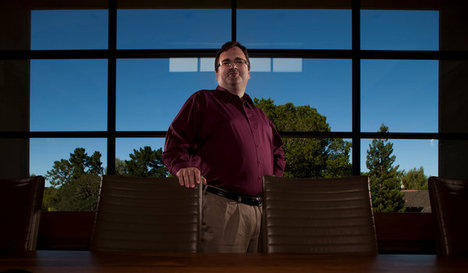
HoffmanReidGreylockPartners2013-06-28.jpg“Reid Hoffman at Greylock Partners foresees a tectonic shift coming in the Web, with data and its many uses as the new linchpin, replacing identity and relationships.” Source of caption and photo: online version of the NYT article quoted and cited below.

(p. 5) As an executive vice president, it was up to Mr. Hoffman to manage external relations. “He was the firefighter in chief at PayPal,” Mr. Thiel says. “Though that diminishes his role because there were many, many fires.”

Mr. Hoffman emerged as a connector and high-level strategist. He packed his schedule with meetings, charmed credit card companies and soothed the regulators.
PayPal survived, and when the company went public, in 2002, Mr. Hoffman and many of his colleagues became multimillionaires.
Mr. Thiel splurged on a Ferrari. Mr. Hoffman wanted to buy an Audi but instead invested his newfound riches in one of the first solar panel companies to come out of Silicon Valley, Nanosolar, and bought an Acura instead.
“I started to think about the value of money,” he says. “I thought if I only had $75,000, would I rather invest in a luxury car or make a play in changing the world?”
Nanosolar became a multibillion-dollar enterprise.

For the full story, see:
EVELYN M. RUSLI. “A King of Connections; How Reid Hoffman of LinkedIn Became Tech’s Go-To Guy.” The New York Times, SundayBusiness Section (Sun., November 6, 2011): 1 & 5.
(Note: ellipsis added.)
(Note: the online version of the article has the date November 5, 2011, and has the title “A King of Connections Is Tech’s Go-To Guy.”)

The Precautionary Principle Stops Technological Progress

(p. 247) All versions of the Precautionary Principle hold this axiom in common: A technology must be shown to do no harm before it is embraced. It must be proven to be safe before it is disseminated. If it cannot be proven safe, it should be prohibited, curtailed, modified, junked, or ignored. In other words, the first response to a new idea should be inaction until its safety is established. When an innovation appears, we should pause. Only after a new technology has been deemed okay by the certainty of science should we try to live with it.
On the surface, this approach seems reasonable and prudent. Harm must be anticipated and preempted. Better safe than sorry. Unfortunately, the Precautionary Principle works better in theory than in practice. “The precautionary principle is very, very good for one thing–stopping technological progress,” says philosopher and consultant Max More. Cass R. Sunstein, who devoted a book to debunking the principle, says, “We must challenge the Precautionary Principle not because it leads in bad directions, but because read for all it is worth, it leads in no direction at all.”

Source:
Kelly, Kevin. What Technology Wants. New York: Viking Adult, 2010.