Diversity of Sources of What We Consume in a Free Market

Matt Ridley’s wonderful riff below reminds one of Leonard Read’s classic essay “I, Pencil,” made even more famous by Milton Friedman’s rendition of it.

(p. 35) As I write this, it is nine o’clock in the morning. In the two hours since I got out of bed I have showered in water heated by North Sea gas, shaved using an American razor running on electricity made from British coal, eaten a slice of bread made from French wheat, spread with New Zealand butter and Spanish marmalade, then brewed a cup of tea using leaves grown in Sri Lanka, dressed myself in clothes of Indian cotton and Australian wool, with shoes of Chinese leather and Malaysian rubber, and read a newspaper made from Finnish wood pulp and Chinese ink. I am now sitting at a desk typing on a Thai plastic keyboard (which perhaps began life in an Arab oil well) in order to move electrons through a Korean silicon chip and some wires of Chilean copper to display text on a computer designed and manufactured by an American firm. I have consumed goods and services from dozens of countries already this morning. Actually, I am guessing at the nationalities of some of these items, because it is almost impossible to define some of them as coming from any country, so diverse are their sources.

Source:
Ridley, Matt. The Rational Optimist: How Prosperity Evolves. New York: Harper, 2010.

Indian Middle Class: “The State Is Preventing Me from Doing What I Want to Do”

NagParthoIndianEntrepreneur2011-11-14.jpg“Partho Nag, a childhood friend of Shubhrangshu Roy’s who lives in the same New Delhi suburb. Mr. Nag, who runs an IT service company out of his home, joined Mr. Roy and other friends as they volunteered at the Hazare protests. “We’ve been told since our childhoods, ‘Politics is bad, don’t get into politics,'” Mr. Nag said. “But the point is that somebody has to clean it up. We can’t just scold people.”” Source of caption and photo: online version of the NYT article quoted and cited below.

(p. 1) DWARKA, India — Shubhrangshu Barman Roy and his childhood friends are among the winners in India’s economic rise. They have earned graduate degrees, started small companies and settled into India’s expanding middle class. They sometimes take vacations together and meet for dinners or parties, maybe to celebrate a new baby or a new business deal.

Yet in August, Mr. Roy and his friends donned white Gandhi caps, boarded a Metro train in this fast-growing suburb of the Indian capital and rode into New Delhi like a band of revolutionaries to join the large anticorruption demonstrations led by the rural activist Anna Hazare. They waved Indian flags, distributed water to the crowds and vented their outrage at India’s political status quo.
“I could feel that people really wanted change,” Mr. Roy, 36, recalled proudly.
It may seem unlikely that middle-class Indians would crave change. They mostly live in rapidly growing cities and can afford cars, appliances and other conveniences that remain beyond the reach of most Indians. Theirs is the fastest growing demographic group in the country, and their buying power is expected to triple in the next 15 years, making India one of the most important consumer markets in the world.
But buying power is not political power, at least not yet in India. The wealthier India has become, the more politically disillusioned many of the beneficiaries have grown — an Indian paradox. The middle class has vast economic clout yet often remains politically marginalized in a huge democracy where the rural masses still dominate the outcome of elections and the tycoon class has the ear of politicians.
. . .
(p. 10) “This middle class is less about ‘what the state can do for me’ than ‘the state is preventing me from doing what I want to do,’ ” said Devesh Kapur, director of the Center for the Advanced Study of India at the University of Pennsylvania.
The Hazare movement rattled India’s political establishment because it offered a glimpse of what could happen if the middle class was mobilized across the country. Professionals and college students provided the organizational spine, and money, that brought hundreds of thousands of people of all backgrounds onto the streets in what many described as a political awakening.
. . .
Mr. Roy and his friends, including Mr. Nag, had grown up in New Delhi in the same government housing development. They were all the sons of government bureaucrats who would later offer similar advice: Get a government job.
“He always insisted,” Mr. Nag recalled of his father’s prodding. “But we had an idea that a government job was too lousy.”
They were teenagers in the early 1990s when Indian leaders embarked on the reforms that began dismantling the stifling licensing regulations that had choked the economy. Private enterprise, large and small, would steadily emerge as the engine of Indian growth and the delivery vehicle of growing aspirations. Mr. Nag would open a small IT service firm. Two other friends would start a textile trading company. Mr. Roy would earn graduate degrees and start a consulting firm.
. . .
On a recent afternoon, Mr. Roy pointed to a crude asphalt scar in the road where workers had installed an underground water connection. The scar extended along the road toward Mr. Roy’s house, only to abruptly turn left in the direction of another building.
“You see this?” he asked, angrily. “This is a connection that comes here, but it is illegal.”
For Mr. Roy, the scar in the street marks the corruption and collusion and the failure of the state to deliver on its end of India’s social contract. His family is supposed to get water from a legal connection for $4 a month. Except that water is unusable. For years, his father had paid a fee to fill large jugs from a private water tanker — until his father slipped while carrying one of them.
Mr. Roy then spent about $1,000 to build an underground water storage tank beside his home. Now, every week a tanker delivers a $30 shipment of water into the tank, while Mr. Roy also buys bottled water for drinking, bringing his monthly bill to about $160. Mr. Roy suspects that local officials, rather than correcting the situation, allow it to continue in exchange for kickbacks from the owners of the private water tankers. In the end, though, he pays.
These tales of petty graft proliferate across India, but especially in cities, analysts say, for the simple reason that cities now have more money.
McKinsey Global Institute, a consulting group, has estimated that India’s middle class could grow to nearly 600 million people by 2030. Today, nearly three-quarters of India’s gross domestic product comes from cities, where less than a third of India’s population lives, an imbalance that correlates with the divide between middle-class economic and political power.
“For politicians, the city has primarily become a site of extraction, and the countryside is predominantly a site of legitimacy and power,” Ashutosh Varshney, an India specialist at Brown University, wrote recently. “The countryside is where the vote is; the city is where the money is. Villages do have corruption, but the scale of corruption is vastly greater in cities.”

For the full story, see:
JIM YARDLEY. “INDIA’S WAY; Protests Help Awaken a Goliath in India.” The New York Times, First Section (Sun., October 30, 2011): 1 & 10.
(Note: ellipses added.)
(Note: the online version of the article is dated October 29, 2011 and has the title “INDIA’S WAY; Protests Awaken a Goliath in India.”)

AFA Scholars Predict Sovereign Defaults

At the Chicago American Finance Association (AFA) meetings (held in conjunction with the AEA meetings), I attended a panel discussion on Fri., Jan. 6, 2012 on “Sovereign Default.” The session was chaired by Simon Johnson, and included Kenneth Singleton and Carmen Reinhart (who has co-authored a much-discussed book on the history of economic crises). (Martin Feldstein was supposed to participate but did not, and I did not catch the name of the scholar who replaced him on the panel).
When asked if they expected multiple countries in Europe to default in the near to medium term, all panel members agreed that such default would happen. (The consensus was that Greece, and at least a couple of other countries, would eventually default—the Euros needed to bail them out were too large, even if the Germans and the ECB changed course and wanted to try.) Before seeing the panel, I was not aware that expert academic opinion was so agreed on this prediction.
There was less certainty about whether this would necessarily lead to the end of the Euro. Reinhart pointed out that even in Greece, where austerity is severe and unpopular, there is currently little popular support for abandoning the Euro.
The panelists seemed to believe that sovereign defaults might lead to slow growth, high taxes and inflation, but might not lead to catastrophe.
Reinhart suggested that Europe, and maybe also the United States and the rest of the world, might just muddle along for an extended period.

Gentle Oshman Inspired Loyalty as He Made Work Fun in Silicon Valley

OshmanMKennethSiliconValleyMentor2011-11-14.jpg

“M. Kenneth Oshman” Source of caption and photo: online version of the NYT obituary quoted and cited below.

(p. 19) M. Kenneth Oshman, who helped create one of the early successful technology start-up firms in Silicon Valley, one that embodied the informal management style that came to set the Valley apart from corporate America, died on Saturday in Palo Alto, Calif. He was 71.
. . .
In the 1970s and ’80s, Rolm was the best example of an emerging Silicon Valley management style that effectively broke down the barrier between work and play. Setting out to recruit the most talented technical minds, Rolm became known as a great place to work, so much so that it was nicknamed “G.P.W.”
Early on as chief executive, Mr. Oshman took funds normally used for company Christmas parties and used them to help construct a company recreational center, consisting of swimming pools, racquetball courts, exercise rooms and other amenities to attract new employees and underline the image that Rolm was a fun place to work.
But there was a tradeoff, said Keith Raffel, who left a staff position on Capitol Hill to become an assistant to Mr. Oshman at Rolm before starting his own company.
“The quid pro quo was you would be driven and work really hard,” he said.
With a gentle, understated style, Mr. Oshman stood apart from other well-known leaders in Silicon Valley, many of whom were seen as capricious and even tyrannical. He was a mentor to a generation of Silicon Valley technologists and able to inspire a kind of loyalty in his employees not frequently seen in high-tech industries.

For the full obituary, see:
JOHN MARKOFF. “M. Kenneth Oshman, Silicon Valley Mentor, Dies at 71.” The New York Times, First Section (Sun., August 10, 2011): A10.
(Note: ellipsis added.)
(Note: the online version of the obituary is dated August 10, 2011 and has the title “M. Kenneth Oshman, Who Brought Fun to Silicon Valley, Dies at 71.”)

Happiness Depends Most on Being Free to Choose

(p. 27) Getting richer is not the only or even the best way of getting happier. Social and political liberation is far more effective, says the political scientist Ronald Ingleheart: the big gains in happiness come from living in a society that frees you to make choices about your lifestyle – about where to live, who to marry, how to express your sexuality and so on. It is the increase in free (p. 28) choice since 1981 that has been responsible for the increase in happiness recorded since then in forty-five out of fifty-two countries. Ruut Veenhoven finds that ‘the more individualized the nation, the more citizens enjoy their life.’

Source:
Ridley, Matt. The Rational Optimist: How Prosperity Evolves. New York: Harper, 2010.

Pedro de Verona Rodrigues Pires Wins Ibrahim Prize for Achievement in African Leadership

PiresPedroDeVeronaRodrigues2011-11-14.jpg

“Pedro de Verona Rodrigues Pires” Source of caption and photo: online version of the NYT article quoted and cited below.

(p. A10) MONROVIA, Liberia — Pedro de Verona Rodrigues Pires, the former president of Cape Verde, the desertlike archipelago about 300 miles off the coast of West Africa, has won one of the world’s major prizes, the $5 million Ibrahim Prize for Achievement in African Leadership.

The record of governing in Africa has been poor enough lately that the Mo Ibrahim Foundation decided not to award the prize for the past two years. In many African countries, leaders have refused to leave office after losing elections, tried to alter constitutions to ensure their continued tenure or gone back on pledges not to run for re-election.
. . .
Mr. Pires served two terms — 10 years — as president until stepping down last month. During that period, the foundation noted, Cape Verde became only the second African nation to move up from the United Nations’ “least developed” category. The foundation says the prize is given only to a democratically elected president who has stayed “within the limits set by the country’s constitution, has left office in the last three years and has demonstrated excellence in office.”

For the full story, see:
ADAM NOSSITER. “Ex-President of Cape Verde Wins Good-Government Prize.” The New York Times (Tues., October 11, 2011): A10.
(Note: ellipsis added.)
(Note: the online version of the article is dated October 10, 2011.)

Mackay Warned about Delusions, then Was Deluded by Bubble

(p. B1) Can you spot a bubble?
Ever since 1841, when a Scottish journalist named Charles Mackay published the book known today as “Extraordinary Popular Delusions and the Madness of Crowds,” the answer has seemed clear. If you watch carefully for signs of euphoria, you can sidestep the damage when markets go mad.
But bubble spotting isn’t as simple as Mackay made it sound–even, it turns out, for Mackay himself. Investors should always guard against the glib assertions of pundits who claim they can detect bubbles before they burst.
. . .
But new research tells the untold tale of Mackay’s own behavior in the face of a bubble–and it is a shocker. A mathematician and former cryptographer at Bell Labs named Andrew Odlyzko has spent much of the past decade researching a forgotten stock mania. One of its biggest boosters was none other than Charles Mackay.
A bubble in British railroad stocks began in 1844, only three years after Mackay published his book, and it didn’t start to collapse until late 1845. Even with the history of market folly fresh in his mind, Mackay urged British investors to pile into railway stocks, whose extravagant prices were based on absurdly unrealistic projections of future growth.
The most famous critic of bubbles who ever lived fell like a chump for a craze that was unfolding before his very eyes. On Oct. 2, 1845, Mackay wrote that “those who sound the alarm of an approaching railway crisis have somewhat exaggerated the danger.”
He went on to ridicule anyone who argued that “the Railway mania of the present day” was similar to the devastating bubbles he had described in his own book. “There is no reason whatever to fear” a crash, he concluded.
He couldn’t have been more wrong. From 1845 to the bottom in 1850, railway stocks fell by two-thirds–the equivalent of roughly $1 trillion of losses in today’s money. Mackay never fessed up to his own extraordinary delusion.

For the full commentary, see:
JASON ZWEIG. “THE INTELLIGENT INVESTOR; The Extraordinary Popular Delusion of Bubble Spotting.” The Wall Street Journal (Sat., NOVEMBER 5, 2011): B1.
(Note: ellipsis added.)

Few Banks Give S.B.A. Loans, They Take Two Years, and Have “Absolutely No Flexibility”

BlumenthalNeilEntrepreneur2011-11-14.jpg“Neil Blumenthal, one of the founders of Warby Parker, an online eyewear company, was invited to Washington in an initiative to encourage companies owned by members of the millennial generation.” Source of caption and photo: online version of the NYT article quoted and cited below.

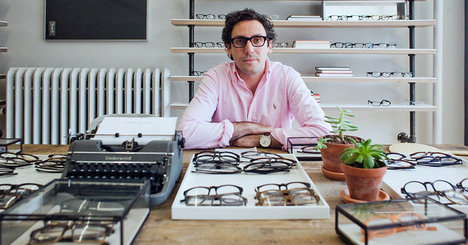
(p. B7) Mr. Blumenthal, 31, one of the founders of Warby Parker, an online eyewear company that sells designer frames for less than $100, was among 150 young chief executives invited to Washington by Our Time, a youth advocacy group, . . .
. . .
The following is a condensed version of a recent conversation in which Mr. Blumenthal spoke, among other things, about what politicians don’t understand about business, . . .
. . .
Q. What was it like trying to get an S.B.A. loan?
A. Finding a bank that did S.B.A.-term loans was a challenge. We were surprised that they needed two years and that banks had absolutely no flexibility. Many of the loan officers said we had a reputable business that was cash-flow positive and we had the most sophisticated business plan they’d ever seen, but they can’t provide loans to people who don’t have two years of tax returns.
Q. Isn’t that a reasonable request when you’re talking about using taxpayer dollars to guarantee a loan to a private company?
A. I understand where the banks are coming from. It probably was necessary to implement hard and fast rules to stop the bleeding when the crisis hit, but they should be looking at the policies and thinking: Does this make sense now?
Q. Was the application process difficult?
A. We had to sign so many documents that my hand hurt after I was done. I had to pledge not to open a zoo, swimming pool or aquarium. It struck me as strange. Yes, it’s the bank’s duty to do due diligence, but this was just a silly restriction.
Q. But there was a happy ending, right?
A. Yes, after being turned down by 15 banks, it was a personal relationship that introduced us to a regional bank in New Jersey that gave us a $200,000 loan.
Q. What reasons did the 15 banks give for turning you down?
A. They didn’t have the authority to bypass the rule that you have to have two years of tax returns.
Q. Was your company profitable at the time?
A. Yes, we were profitable and we had a ton of traction. We had higher customer satisfaction scores than Zappos or Apple. A rational bank should have wanted to support us, even though we were a more risky bet than a company that had been around longer.
Q. What did the bank that lent you money do differently? Did it demand collateral?
A. We came through a personal relationship at a very high level at a regional bank in New Jersey that didn’t have the draconian guidelines because their management was empowered to make decisions. For the $200,000 S.B.A.-backed loan that we got, the bank wanted $100,000 in collateral in either cash or marketable products. The reason they wanted so much collateral was that if we default, the regional bank is not going to go through the process of getting the money from the S.B.A. because it’s so onerous.
. . .
Q. Are you involved in the political process?
A. We have never met with politicians. I don’t know the first thing about how to get heard. My suspicion is that it’s to donate a lot of money.
. . .
Q. What do you make of the economic turmoil we’ve been experiencing?
A. It highlights that it might be too much to ask Washington to help with entrepreneurship when they can’t even get the basics right, like maintaining a decent credit rating.

For more of the conversation, see:
HANNAH SELIGSON. “SMALL BUSINESS; Young Entrepreneur Sees Little Help In Washington.” The Wall Street Journal (Thurs., August 18, 2011): C12.
(Note: ellipses added.)
(Note: the online version of the article is dated August 17, 2011.)

In 1800 the Life of a Peasant Was Not Pleasant

(p. 12) There are people today who think life was better in the past. They argue that there was not only a simplicity, tranquility, sociability and spirituality about life in the distant past that has been lost, but a virtue too. This rose-tinted nostalgia, please note, is generally confined to the wealthy. It is easier to wax elegiac for the life of a peasant when you do not have to use a long-drop toilet. Imagine that it is 1800, somewhere in Western Europe or eastern North America. The family is gathering around the hearth in the (p. 13) simple timber-framed house. Father reads aloud from the Bible while mother prepares to dish out a stew of beef and onions. The baby boy is being comforted by one of his sisters and the eldest lad is pouring water from a pitcher into the earthenware mugs on the table. His elder sister is feeding the horse in the stable. Outside there is no noise of traffic, there are no drug dealers and neither dioxins nor radioactive fall-out have been found in the cow’s milk. All is tranquil; a bird sings outside the window.
Oh please! Though this is one of the better-off families in the village, father’s Scripture reading is interrupted by a bronchitic cough that presages the pneumonia that will kill him at 53 – not helped by the wood smoke of the fire. (He is lucky: life expectancy even in England was less than 40 in 1800.) The baby will die of the smallpox that is now causing him to cry; his sister will soon be the chattel of a drunken husband. The water the son is pouring tastes of the cows that drink from the brook. Toothache tortures the mother. The neighbour’s lodger is getting the other girl pregnant in the hayshed even now and her child will be sent to an orphanage. The stew is grey and gristly yet meat is a rare change from gruel; there is no fruit or salad at this season. It is eaten with a wooden spoon from a wooden bowl. Candles cost too much, so firelight is all there is to see by. Nobody in the family has ever seen a play, painted a picture or heard a piano. School is a few years of dull Latin taught by a bigoted martinet at the vicarage. Father visited the city once, but the travel cost him a week’s wages and the others have never travelled more than fifteen miles from home. Each daughter owns two wool dresses, two linen shirts and one pair of shoes. Father’s jacket cost him a month’s wages but is now infested with lice. The children sleep two to a bed on straw mattresses on the floor. As for the bird outside the window, tomorrow it will be trapped and eaten by the boy.

Source:
Ridley, Matt. The Rational Optimist: How Prosperity Evolves. New York: Harper, 2010.

Newly Found Fossils Indicate Life Evolved Soon After the Late Heavy Bombardment

TubularMicrofossilsOldestLife2011-11-11.jpg

“A collection of tubular microfossils found in 3.4-billion-year-old sandstone from Western Australia.” Source of caption and photo: online version of the NYT article quoted and cited below.

(p. A1) A team of Australian and British geologists have discovered fossilized, single-cell organisms that are 3.4 billion years old and that the scientists say are the oldest known fossils on earth.

Their assertion, if sustained, confirms the view that life evolved on earth surprisingly soon after the Late Heavy Bombardment, a reign of destruction in which waves of asteroids slammed into the primitive planet, heating the surface to molten rock and boiling the oceans into an incandescent mist. The bombardment, which ended around 3.85 billion years ago, would have sterilized the earth’s surface of any incipient life.
The claim is also a new volley in a long-running conflict over who has found the oldest fossil.
The new microfossils are described in Sunday’s issue of Nature Geoscience by a team led by David Wacey of the University of Western Australia and Martin D. Brasier of the University of Oxford. The fossils were found in sandstone at the base of the Strelley Pool rock formation in Western Australia.
The sandstone, 3.4 billion years ago, was a beach on one of the few islands that had started to (p. A3) appear above the ocean’s surface. Conditions were very different from those of today. The moon orbited far closer to earth, raising huge tides. The atmosphere was full of methane, since plants had not yet evolved to provide oxygen, and greenhouse warming from the methane had heated the oceans to the temperature of a hot bath.
It was in these conditions, the geologists believe, that organisms resembling today’s bacteria lived in the crevices between the pebbles on the beach. Examining thin slices of rock under the microscope, they have found structures that look like living cells, some in clusters that seem to show cell division.
Cell-like structures in ancient rocks can be deceiving — many have turned out to be artifacts formed by nonbiological processes. In this case, the geologists have gathered considerable circumstantial evidence that the structures they see are biological. With an advanced new technique, they have analyzed the composition of very small spots within the cell-like structures. “We can see carbon, sulfur, nitrogen and phosphorus, all within the cell walls,” Dr. Brasier said.

For the full story, see:
NICHOLAS WADE. “Team Claims It Has Found Oldest Fossils.” The New York Times (Mon., August 22, 2011): A1 & A3.
(Note: the online version of the article has the date August 21, 2011.)

Colleges Not Good at Producing Innovative Start-Up Entrepreneurs

(p. 5) I typed these words on a computer designed by Apple, co-founded by the college dropout Steve Jobs. The program I used to write it was created by Microsoft, started by the college dropouts Bill Gates and Paul Allen.
And as soon as it is published, I will share it with my friends via Twitter, co-founded by the college dropouts Jack Dorsey and Evan Williams and Biz Stone, and Facebook — invented, among others, by the college dropouts Mark Zuckerberg and Dustin Moskovitz, and nurtured by the degreeless Sean Parker.
American academia is good at producing writers, literary critics and historians. It is also good at producing professionals with degrees. But we don’t have a shortage of lawyers and professors. America has a shortage of job creators. And the people who create jobs aren’t traditional professionals, but start-up entrepreneurs.
In a recent speech promoting a jobs bill, President Obama told Congress, “Everyone here knows that small businesses are where most new jobs begin.”
Close, but not quite. In a detailed analysis, the National Bureau of Economic Research found that nearly all net job creation in America comes from start-up businesses, not small businesses per se. (Since most start-ups start small, we tend to conflate two variables — the size of a business and its age — and incorrectly assume the former was the relevant one, when in fact the latter is.)
If start-up activity is the true engine of job creation in America, one thing is clear: our current educational system is acting as the brakes. Simply put, from kindergarten through undergraduate and grad school, you learn very few skills or attitudes that would ever help you start a business. Skills like sales, networking, creativity and comfort with failure.
. . .
If I were betting on the engines of future job creation, I wouldn’t put my money on college students cramming for tests and writing papers with properly formatted M.L.A.-style citations in order to bolster their résumés for careers in traditional professions and middle-management jobs in large corporate and government bureaucracies.
I’d put my money on the kids who are dropping out of college to start new businesses. If we want to get out of the jobs mess we’re in, we should hope that more will follow in their footsteps.

For the full commentary, see:
MICHAEL ELLSBERG. “Will Dropouts Save America?.” The New York Times, SundayReview Section (Sun., October 23, 2011): 5.
(Note: ellipsis added.)
(Note: the online version of the article has the date October 22, 2011.)

The commentary above is in a spirit similar to Ellsberg’s book:
Ellsberg, Michael. The Education of Millionaires: It’s Not What You Think and It’s Not Too Late. New York: Portfolio Hardcover, 2011.