REVISE THIS ONE: Patents Needed to Provide Money for “the Many Fruitless Experiments”

(p. 234) . . . ; together, Watt and Arkwright wrote a manuscript entitled “Heads of a Bill to explain and amend the laws relative to Letters Patent and grants of privileges for new inventions,” essentially a reworking of Coke’s Statute of 1623 that had created England’s first patent law. In addition to its policy prescriptions, which were largely an unsuccessful argument against the requirement that patent applications be (p. 235) as specific as possible, the manuscript offered a remarkable insight into Watt’s perspective on the life of the inventor, who should, in Watt’s own (perhaps inadvertently revealing) words, “be considered an Infant, who cannot guard his own Rights”:

An engineer’s life without patent is not worthwhile . . . few men of ingenuity make fortunes without suffering to think seriously whether the article he manufactures might, or might not, be Improved. The man of ingenuity in order to succeed must seclude himself from Society, he must devote the whole powers of his mind to that one object, he must persevere in spite of the many fruitless experiments he makes, and he must apply money to the expenses of these experiments, which strict Prudence would dedicate to other purposes. By seclusion from the world he becomes ignorant of its manners, and unable to grapple with the more artful tradesman, who has applied the powers of his mind, not to the improvement of the commodity he deals in, but to the means of buying cheap and selling dear, or to the still less laudable purpose of oppressing such ingenious workmen as their ill fate may have thrown into his power.

Source:
Rosen, William. The Most Powerful Idea in the World: A Story of Steam, Industry, and Invention. New York: Random House, 2010.
(Note: the second ellipsis and the italics in original; the first ellipsis added.)

Cuban Government Gets Billions by “Exporting” Doctors; Some Defect

RamirezFelixCubanDoctor2011-01-21.jpg “Dr. Felix Ramírez in Gambia in 2008.” Source of caption and photo: online version of the WSJ article quoted and cited below.

(p. A1) Felix Ramírez slipped into an Internet cafe in the West African nation of The Gambia, scoured the Web for contact information for U.S. diplomats, then phoned the U.S. embassy in Banjul, the capital.

He told the receptionist he was an American tourist who had lost his passport, and asked to speak to the visa section. As he waited to be connected, he practiced his script: “I am a Cuban doctor looking to go to America. When can we meet?”
Dr. Ramírez says he was told to go to a crowded Banjul supermarket and to look for a blond woman in a green dress–an American consular official. They circled one another a few times, then began to talk.
That furtive meeting in September 2008 began a journey for the 37-year-old surgeon that ended in May 2009 in Miami, where he became a legal refugee with a shot at citizenship.
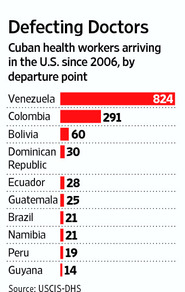
Dr. Ramírez is part of a wave of Cubans who have defected to the U.S. since 2006 under the little-known Cuban Medical Professional Parole immigration program, which allows Cuban doctors and some other health workers who are serving their government overseas to enter the U.S. immediately as refugees. Data released to The Wall Street Journal under the Freedom of Information Act shows that, through Dec. 16, 1,574 CMPP visas have been issued by U.S. consulates in 65 countries.
Cuba has been sending medical “brigades” to foreign countries since 1973, helping it to win friends abroad, to back “revolutionary” regimes in places like Ethiopia, Angola and Nicaragua, and perhaps most importantly, to earn hard currency. Communist Party newspaper Granma reported in June that Cuba had 37,041 doctors and other health workers in (p. A12) 77 countries. Estimates of what Cuba earns from its medical teams–revenue that Cuba’s central bank counts as “exports of services”–vary widely, running to as much as $8 billion a year. Many Cubans complain that the brigades have undermined Cuba’s ability to maintain a high standard of health care at home.

For the full story, see:
JOEL MILLMAN. “New Prize in Cold War: Cuban Doctors.” The Wall Street Journal (Sat., JANUARY 15, 2011): A1 & A12.

CubanDefectingDoctorsGraph2011-01-21.jpg

Source of graph: online version of the WSJ article quoted and cited above.

Fluorescent Bulbs Burn Out Much Faster than Utility Predicted

(p. A5) When it set up its bulb program in 2006, PG&E Corp. thought its customers would buy 53 million compact fluorescent bulbs by 2008. It allotted $92 million for rebates, the most of any utility in the state. Researchers hired by the California Public Utilities Commission concluded earlier this year that fewer bulbs were sold, fewer were screwed in, and they saved less energy than PG&E anticipated.

As a result of these and other adjustments, energy savings attributed to PG&E were pegged at 451.6 million kilowatt hours by regulators, or 73% less than the 1.7 billion kilowatt hours projected by PG&E for the 2006-2008 program.
One hitch was the compact-fluorescent burnout rate. When PG&E began its 2006-2008 program, it figured the useful life of each bulb would be 9.4 years. Now, with experience, it has cut the estimate to 6.3 years, which limits the energy savings. Field tests show higher burnout rates in certain locations, such as bathrooms and in recessed lighting. Turning them on and off a lot also appears to impair longevity.

For the full story, see:
REBECCA SMITH. “The New Light Bulbs Lose a Little Shine; Compact Fluorescent Lamps Burn Out Faster Than Expected, Limiting Energy Savings in California’s Efficiency Program.” The Wall Street Journal (Weds., JANUARY 19, 2011): A5.

More Economic Freedom in World (But Not in U.S.)

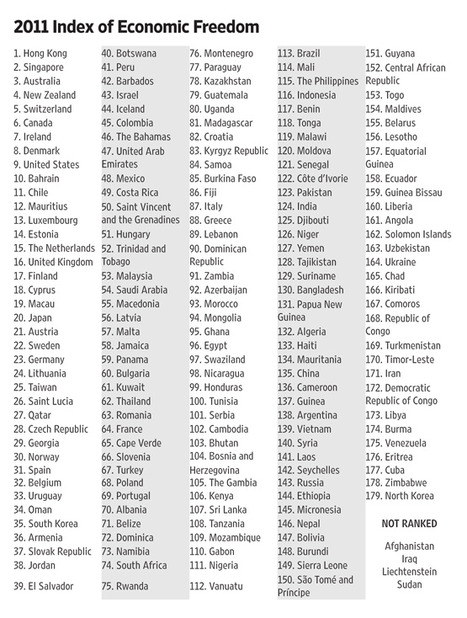
FreedomIndexTable2011.jpgSource of table: online version of the WSJ article quoted and cited below.

(p. A15) Riots in Greece and France! An IMF bailout for Ireland! The Euro under threat! A new government in London! Tea parties in America! Is it the end of capitalism? Many were predicting just that last year.

The 2011 Index of Economic Freedom, released today by the Heritage Foundation and The Wall Street Journal, tells a different story. The Index records countries’ commitment to the free enterprise/capitalist system by measuring 10 categories of economic freedom: fiscal soundness and openness to trade and investment, government size, business and labor regulation, property rights, corruption, monetary stability and financial competition.
The good news this year? One hundred and seventeen countries, mainly developing and emerging market economies, improved their scores, and the average level of economic freedom around the world improved by about a third of a point on the Index’s 0 to 100 scale.
. . .
For the U.S. and the U.K., the Index of Economic Freedom confirms what those countries’ voters already knew, that there is an urgent need for real change. The U.S. dropped to ninth place in the 2011 Index from eighth (its lowest economic freedom score in a decade), and the UK fell all the way to 16th place from 11th.

For the full commentary, see:
TERRY MILLER. “The U.S. Loses Ground on Economic Freedom.” The Wall Street Journal (Weds., JANUARY 12, 2011): A15.
(Note: ellipsis added.)
(Note: the last sentence quoted above is the slightly more informative print version rather than the slightly less informative online version.)

When Yarn Was Scarce There Was Less Incentive to Develop Power Looms

(p. 223) Though power looms had existed, at least in concept, for centuries (under his sketch for one, Leonardo himself wrote, “This is second only to the printing press in importance; no less useful in its practical application; a lucrative, beautiful, and subtle invention”), there was little interest in them so long as virtually all the available yarn could be turned into cloth in cottages. This fact reinforced the weaver’s independence; but it also encouraged another group of innovative types who were getting ready to put spinning itself on an industrial footing.

Source:
Rosen, William. The Most Powerful Idea in the World: A Story of Steam, Industry, and Invention. New York: Random House, 2010.

Those Who Paid Attention to Risk, Did Better in Crisis

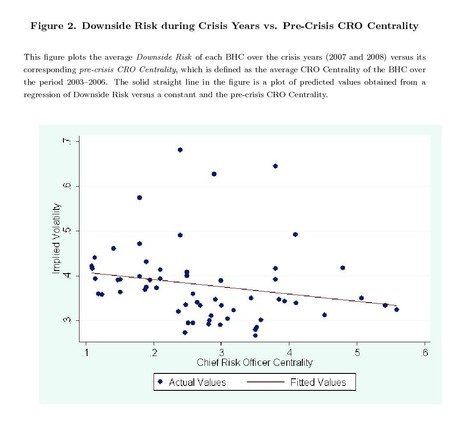
DownsideRiskCROcentralityGraph2010-1.jpgSource of graph: screen capture from p. 43 of NBER paper referenced below.

At the American Economic Association meetings in Denver from January 6-9, I attended several sessions dealing the causes and cures of the economic crisis of the last few years.
One issue that came up more than once was whether, and to what extent, various decision makers were blameworthy in what happened. Was this a crisis that well-trained, hard-working and prudent managers, regulators and legislators should have seen coming? Or was it a once in 100 year storm that nobody should be expected to have foreseen?
One compelling bit of evidence was presented in a talk on January 8th by Charles Calomiris in which he presented a graph from a 2010 NBER paper by Ellul and Yerramilli. The graph, shown above, indicates that firms that took risk seriously, as proxied by their giving an important pre-crisis role to a Chief Risk Officer (CRO), tended to suffer less downside volatility during the crisis.

Source:

Ellul, Andrew, and Vijay Yerramilli. “Stronger Risk Controls, Lower Risk: Evidence from U.S. Bank Holding Companies.” NBER Working Paper # 16178, July 2010.

Economic Importance of Inarticulate Knowledge Undermines Case for Central Planning

(p. 78) . . . the intelligence of humans, though immensely strengthened by articulation, nonetheless contains a large component of tacit understanding by individuals who know more than they can say. If this is also true with respect to the sorts of knowledge relevant to our economic activities, then no comprehensive planning agency could obtain the sort of knowledge necessary for economic planning, for it would lie buried deep in the minds of millions of persons.

Source:
Lavoie, Don. National Economic Planning: What Is Left? Washington, DC: Cato Institute, 1985.
(Note: ellipsis added.)

What Motivated Paterno to Win 400 Games—“Gettin’ Paid”

Paterno400WinsGettinPaidClip.jpgSource of image: screen capture from YouTube clip referenced below.

What motivates employees? Economists have emphasized pay as the primary incentive, while recognizing that there may be “compensating differentials” for aspects of the work that are pleasant or unpleasant.
In recent years many non-economists, such as Daniel Pink in Drive, have emphasized non-pecuniary incentives.
Joe Paterno entered the debate at age 83, after he became the first major college coach to win 400 games on November 6, 2010.
Right after the victory, he was interviewed on the field by “Heather” of ESPN. Starting at 1:33 seconds into the clip referenced below, here is the key dialogue:

Heather: “Coach Paterno, what has motivated you to get to this point?”

Paterno: “Oh geez, I don’t know—gettin’ paid.”

Source: YouTube clip at http://www.youtube.com/watch?v=jQzdVeYtm5w
(Note: the clip was posted on 11/6/10 by shellymic and has the title “Joe Pa FIRST to 400 Wins!”)

Artisan’s Skills Were Still Required for Kay’s Flying Shuttle

(p. 223) Kay’s flying shuttle made it possible for weavers to produce a wider product, which they called “broadloom,” but doing so was demanding. Weaving requires that the weft threads be under constant tension in order to make certain that each one is precisely the same length as its predecessor; slack is the enemy of a properly woven cloth. Using a flying shuttle to carry weft threads through the warp made it possible to weave a far wider bolt of cloth, but the required momentum introduced the possibility of a rebound, and thereby a slack thread. Kay’s invention still needed a skilled artisan to catch the shuttle and so avoid even the slightest bit of bounce when it was thrown across the loom.

Source:
Rosen, William. The Most Powerful Idea in the World: A Story of Steam, Industry, and Invention. New York: Random House, 2010.

UNESCO Condemns Africans to Live in a Poorer Past: More on Why Africa is Poor

DjenneMaliBrickBuildings2011-01-12.jpg “As a World Heritage site, Djenné, Mali, must preserve its mud-brick buildings, from the Great Mosque, in the background, to individual homes.” Source of caption and photo: online version of the NYT article quoted and cited below.

(p. 4) DJENNÉ , Mali — Abba Maiga stood in his dirt courtyard, smoking and seething over the fact that his 150-year-old mud-brick house is so culturally precious he is not allowed to update it — no tile floors, no screen doors, no shower.

“Who wants to live in a house with a mud floor?” groused Mr. Maiga, a retired riverboat captain.
With its cone-shaped crenellations and palm wood drainage spouts, the grand facade seems outside time and helps illustrate why this ancient city in eastern Mali is an official World Heritage site.
But the guidelines established by Unesco, the cultural arm of the United Nations, which compiles the heritage list, demand that any reconstruction not substantially alter the original.
“When a town is put on the heritage list, it means nothing should change,” Mr. Maiga said. “But we want development, more space, new appliances — things that are much more modern. We are angry about all that.”
. . .
Mahamame Bamoye Traoré, the leader of the powerful mason’s guild, surveyed the cramped rooms of the retired river boat captain’s house, naming all the things he would change if the World Heritage rules were more flexible.
“If you want to help someone, you have to help him in a way that he wants; to force him to live in a certain way is not right,” he said, before lying on the mud floor of a windowless room that measured about 6 feet by 3 feet.
“This is not a room,” he said. “It might as well be a grave.”

For the full story, see:
NEIL MacFARQUHAR. “Ancient City in Mali Rankled by Rules for Life in Cultural Spotlight.” The New York Times, First Section (Sun., January 9, 2011): 4.
(Note: ellipsis added.)
(Note: the online version of the article is dated January 8, 2011 and had the title “Mali City Rankled by Rules for Life in Spotlight.”)

DjenneMaliResidents2011-01-12.jpg “Many residents of Djenné say they long for more modern homes, but Unesco preservation guidelines limit alterations to original structures.” Source of caption and photo: online version of the NYT article quoted and cited above.

Cornucopians Win Another Bet with Malthusians

(p. D1) Five years ago, Matthew R. Simmons and I bet $5,000. It was a wager about the future of energy supplies — a Malthusian pessimist versus a Cornucopian optimist — and now the day of reckoning is nigh: Jan. 1, 2011.

The bet was occasioned by a cover article in August 2005 in The New York Times Magazine titled “The Breaking Point.” It featured predictions of soaring oil prices from Mr. Simmons, who was a member of the Council on Foreign Relations, the head of a Houston investment bank specializing in the energy industry, and the author of “Twilight in the Desert: The Coming Saudi Oil Shock and the World Economy.”
I called Mr. Simmons to discuss a bet. To his credit — and unlike some other Malthusians — he was eager to back his predictions with cash. He expected the price of oil, then about $65 a barrel, to more than triple in the next five years, even after adjusting for inflation. He offered to bet $5,000 that the average price of oil over the course of 2010 would be at least $200 a barrel in 2005 dollars.
I took him up on it, not because I knew much about Saudi oil production or the other “peak oil” arguments that global production was headed downward. I was just following a rule learned from a mentor and a friend, the economist Julian L. Simon.
As the leader of the Cornucopians, the optimists who believed there would always be abundant supplies of energy and other resources, Julian figured that betting was the best way to make his argument. Optimism, he found, didn’t make for cover stories and front-page headlines.
. . .
(p. D3) When I found a new bettor in 2005, the first person I told was Julian’s widow, Rita Simon, a public affairs professor at American University. She was so happy to see Julian’s tradition continue that she wanted to share the bet with me, so we each ended up each putting $2,500 against Mr. Simmons’s $5,000.
. . .
The past year the price has rebounded, but the average for 2010 has been just under $80, which is the equivalent of about $71 in 2005 dollars — a little higher than the $65 at the time of our bet, but far below the $200 threshold set by Mr. Simmons.
What lesson do we draw from this? I’d hoped to let Mr. Simmons give his view, but I’m very sorry to report that he died in August, at the age of 67. The colleagues handling his affairs reviewed the numbers last week and declared that Mr. Simmons’s $5,000 should be awarded to me and to Rita Simon on Jan. 1, . . .

For the full commentary, see:
JOHN TIERNEY. “Findings; Economic Optimism? Yes, I’ll Take That Bet.” The New York Times (Tues., December 28, 2010): D1 & D3.
(Note: ellipses added.)
(Note: the online version of the article is dated December 27, 2010.)