Ronald Reagan Would Be 100 Today; He Got the Job Done

A couple of years ago, I read a collection of recollections of Ronald Reagan by some of those who had known him. I jotted down a few notes on what was important in the collection:
Mike Wallace’s entry is a good one.  He has a telling exchange with Reagan where Reagan says he is not a politician.  Wallace is flabbergasted.  He says to the effect:  Mr. Reagan, how can you say you are not a politician when you are planning to run for the highest political office in the land?
Reagan’s response is that he’s not seeking the office for glory or self-aggrandizement; rather he’s seeking it because there’s a job that needs to get done.
In a later entry, someone (Cap Weinberger, maybe?) recounts an episode while Governor where someone warns Reagan that if he vetoes a certain bill (on teacher pay, maybe?) he will not get re-elected. Reagan’s response was: ‘I didn’t come here to get re-elected.’
Years ago I remember reading in a newspaper somewhere that an ordinary citizen saw Reagan in a park, at a time well after his announcement about having Alzheimer’s.  The citizen went up to Reagan and thanked him for what he had done to preserve freedom.  Reagan smiled and responded ‘that is my job.’

The book of recollections is:
Hannaford, Peter, ed. Recollections of Reagan: A Portrait of Ronald Reagan: William Morrow & Company, 1997.

Polar Bears Can Survive Global Warming

(p. 3A) ANCHORAGE, Alaska (AP) — . . .

A study report published Wednesday rejects the often­ used concept of a “tipping point,” or point of no return, when it comes to sea ice and the big bear that has become the symbol of climate change woes. . . .
Another research group proj­ects that even if global warming doesn’t slow, a thin, icy refuge for the bears would still remain between Greenland and Canada.
. . .
A . . . study was to be pre­sented Thursday at the Ameri­can Geophysical Union confer­ence in San Francisco. That research considers a future in which global warming continues at the same pace.
And it shows that a belt from the northern archipelago of Canada to the northern tip of Greenland will likely still have ice because of various winds and currents.
The sea ice forms off Siberia in an area that’s called “the ice factory” and is blown to this belt, which is like an “ice cube tray,” said Robert Newton of the Lamont-Doherty Earth Observa­tory at Columbia University.
That “sea ice refuge” will be good for polar bears and should continue for decades to come, maybe even into the next cen­tury, he said.

For the full story, see:
AP. “Scientists: It’s Not Too Late for Polar Bears After All.” Omaha World-Herald (Thurs., December 16, 2010): 3A.
(Note: ellipses added.)

The first article mentioned is:
Amstrup, Steven C., Eric T. DeWeaver, David C. Douglas, Bruce G. Marcot, George M. Durner, Cecilia M. Bitz, and David A. Bailey. “Greenhouse Gas Mitigation Can Reduce Sea-Ice Loss and Increase Polar Bear Persistence.” Nature 468, no. 7326 (December 16, 2010): 955-58.

A poster on an earlier version of the second paper can be found at:
Pfirman, Stephanie, Bruno Tremblay, Charles Fowler, and Robert Newton. “The Arctic Sea Ice Refuge.” March 2010.

The reference to the second paper is:
Pfirman, Stephanie, Robert Newton, Bruno Tremblay, and Brenden P. Kelly. “The Last Arctic Sea-Ice Refuge?” In Presented at meetings of American Geophysical Union, December 2010.

Healthy Longevity Can Mean You “Get a Do-Over in Life”

PoolGidComic2011-02-02.jpg “Gid Pool performing at the Buford Variety Theater . . . ” Source of caption and photo: online version of the WSJ article quoted and cited below.

(p. R1) It’s easy, these days, to think about later life and retirement as limiting. And with good reason: The economy remains fragile; nest eggs are smaller than they should be; and Social Security and Medicare are looking pale. Millions of people are delaying retirement and scaling back plans for the future.

And then there’s Gid Pool.
Almost five years ago, on something of a lark, he enrolled in a class near his home in North Port, Fla., that taught stand-up comedy. He was 61 years old. Today, he performs in clubs, theaters, colleges and corporate settings throughout much of the South, playing at times to hundreds of people and clearing as much as $1,000 an evening. For good measure, he spends, on average, a week each month on cruise ships, where he teaches comedy classes.
. . .
“I was thinking last night about how lucky I am, at this stage in my life, to have something that really gets me up in the morning,” he says. “I saw my grandfather, an engineer on the Illinois Central Railroad, turn my age with a body beaten down by his daily job. My father was a pilot in World War II and suffered all his adult life from an injury in a plane crash.
“Today I’m part of a generation that has literally been given a second chance to live a first life. People say you don’t get a do-over in life. I beg to differ.”

For the full story, see:
GLENN RUFFENACH. “Did You Hear the One About the Retired Real-Estate Agent? He became a stand-up comedian. And he has never been happier.” The Wall Street Journal (Mon., December 20, 2010): R1 & R9.
(Note: ellipsis added.)

“Inventors Are Sometimes Beneficiaries of Their Own Ignorance”

William Rosen gives us a thought-provoking anecdote about Edmund Cartwright, the inventor of the first power loom:

(p. 238) He was also, apparently, convinced of the practicality of such a machine by the success of the “Mechanical Turk,” a supposed chess-playing robot that had mystified all of Europe and which had not yet been revealed as one of the era’s great hoaxes: a hollow figurine concealing a human operator. Inventors are sometimes beneficiaries of their own ignorance.

Source:
Rosen, William. The Most Powerful Idea in the World: A Story of Steam, Industry, and Invention. New York: Random House, 2010.

Suppliers Hold Back Some Supply When They Expect Prices to Rise in the Future

YuFengChineseCottonFarmer2011-02-01.jpg “Farmer Yu Feng tends his stockpile of roughly 7,700 pounds of cotton that he is storing in his home in Huji, China.” Source of caption and photo: online version of the WSJ article quoted and cited below.

In my Micro Principles classes I explain some of the variables that shift demand curves and some of the variables that shift supply curves. Supply curves, for instance, can be shifted by a change in the expectations of future prices. So, if suppliers come to expect that prices will go up in the future, that will shift the supply curve today to the left.
When I saw the photo above, I thought it was a wonderful illustration of the point.

(p. B1) Yu Lianmin, a cotton farmer in Huji, China, harvested 6,600 pounds of cotton this year. Despite record cotton prices, he didn’t sell any of it.
Instead, mounds of cotton are piled up in two empty rooms of Mr. Yu’s home, and the homes of many of the farmers in his small township of Yujia, which is part of the bigger township of Huji in northern Shandong province, 220 miles southeast of Beijing.
. . .
“I think there’s still hope for prices to go higher,” he said.
. . .
Expectations that prices will rise are driving the apparent stockpiling, . . .

For the full story, see:
CAROLYN CUI. “Chinese Take a Cotton to Hoarding.” The Wall Street Journal (Sat., January 29, 2011): B1 & B11.
(Note: ellipses added.)

Federal Regulations Hurt Small Toy Makers

(p. C12) The story begins in 2007, an unusually good year for Peapods Natural Toys and Baby Care, in St. Paul, Minn., and many similar mom-and-pop businesses. Frightened by news that toys made in China contained unsafe levels of lead, customers were looking for alternatives to the usual big-box offerings. Just as organic farmers gain market share whenever there’s a food-safety panic, the lead scare boosted sales of artisanal children’s goods. “People wanted made-in-USA products, and we were the only place in town that had them,” says Dan Marshall, the owner of Peapods.

Vendors offering organic materials and a personal touch seemed poised to prosper. But the short-term boon soon turned into a long-term disaster. In response to the lead panic, Congress passed the Consumer Product Safety Improvement Act, or CPSIA, by an overwhelming majority. The law mandates third-party testing and detailed labels not only for toys but for every single product aimed at children 12 and under.
. . .
Although big companies like Mattel could spread the extra costs over millions of toys, Mr. Marshall’s small-scale suppliers couldn’t. Unable to afford thousands of dollars in testing per product, some went out of business. Others moved production to China to cut costs. Many slashed their product lines, reserving the expensive new tests for only their top sellers. The European companies that used to sell Peapods such specialty items as wooden swords and shields or beeswax-finished cherry-wood rattles simply abandoned the U.S. market. The survivors jacked up prices.

For the full commentary, see:
VIRGINIA POSTREL. “COMMERCE & CULTURE; Small Crafts vs. Big Government.” The Wall Street Journal (Sat., January 29, 2011): C12.
(Note: ellipsis added.)

Feds Protect Us from Freshly Baked Cookies

MastersElementaryBakeSale2011-01-30.jpg
“Schools like Omaha’s Masters Elementary, which held a recent holiday bake sale, count on the profits from selling cupcakes, caramel corn and other goodies to raise money for field trips and other activities.” Source of caption and photo: online version of the Omaha World-Herald article quoted and cited below.

(p. 1A) A business club at Millard West High School peddles freshly baked cookies, raking in $15,000 annually to help send students to national conferences.

At Omaha’s Masters Elementary, cupcakes, fudge and other bake-sale treats raise $500 for field trips, rain jackets for the safety patrol and playground equipment.

But the federal government could slam the brakes on those brownies and lower the boom on the lemon bars.
A child nutrition bill passed recently by Congress gives a fed­eral agency the power to limit the frequency of school bake sales and other school-sponsored fundraisers that sell unhealthy food.
To some, the bake sale provision makes about as much sense as leav­ing the marshmallows out of Rice Krispies treats.
It maybe makes sense for the fed­eral government to monitor the qual­ity of ground beef, eggs and milk sold in grocery stores. But caramel corn and snicker doodles whipped up by parents for school bake sales?
“Aren’t there more important (p. 2A) things for them to be wor­ried about?” Sandy Hatcher, president of Masters’ parent organization, said of the fed­eral government.

For the full story, see:
MICHAEL O’CONNOR. “Putting the brakes on bake sales; New federal rules on frequency during school day may affect fundraising.” Omaha World-Herald (Sun., December 12, 2010): 1A-2A.

Carlyle (and Rosen) on Arkwright

(p. 236) The greatest hero-worshipper of them all, Thomas Carlyle. described Arkwright as

A plain, almost gross, bag-checked, potbellied, much enduring, much inventing man and barber… . French Revolutions were a-brewing: to resist the same in any measure, imperial Kaisers were impotent without the cotton and cloth of England, and it was this man that had to give England the power of cotton…. It is said ideas produce revolutions, and truly they do; not spiritual ideas only, but even mechanical. In this clanging clashing universal Sword-dance which the European world now dances for the last half-century, Voltaire is but one choragus [leader of a movement, from the old Greek word for the sponsor of a chorus] where Richard Arkwright is another.

. . .
Arkwright was not a great inven-(p. 237)tor, but he was a visionary, who saw, better than any man alive, how to convert useful knowledge into cotton apparel and ultimately into wealth: for himself, and for Britain.

Source:
Rosen, William. The Most Powerful Idea in the World: A Story of Steam, Industry, and Invention. New York: Random House, 2010.
(Note: internal ellipses in original; ellipsis between paragraphs added.)

“It Isn’t the Consumers’ Job to Know What They Want”

iPadChild2011-01-21.jpg “Steven P. Jobs has played a significant role in a string of successful products at Apple, including the iPad, shown above, which was introduced last year.” Source of caption and photo: online version of the NYT article quoted and cited below.

(p. B1) Shortly before the iPad tablet went on sale last year, Steven P. Jobs showed off Apple’s latest creation to a small group of journalists. One asked what consumer and market research Apple had done to guide the development of the new product.

“None,” Mr. Jobs replied. “It isn’t the consumers’ job to know what they want.”
For years, and across a career, knowing what consumers want has been the self-appointed task of Mr. Jobs, Apple’s charismatic co-founder. Though he has not always been right, his string of successes at Apple is uncanny. His biggest user-pleasing hits include the Macintosh, the iMac, iBook, iPod, iPhone and iPad.
But as he takes a medical leave of absence, announced on Monday, the question is: Without him at the helm, can Apple continue its streak of innovation, particularly in an industry where rapid-fire product cycles can make today’s leader tomorrow’s laggard?
. . .
(p. B4) With the iPad tablet, Apple jump-started a product category. But with the iPod (a music and media player) and iPhone (smartphone), Apple moved into markets with many millions of users using rival products, but he gave consumers a much improved experience.
“These are seeing-around-the-corner innovations,” said John Kao, an innovation consultant to corporations and governments. “Steve Jobs is totally tuned into what consumers want. But these are not the kind of breakthroughs that market research, where you are asking people’s opinions, really help you make.”
Regis McKenna, a Silicon Valley investor and marketing consultant, said employees at Apple stores provide the company with a powerful window into user habits and needs, even if it is not conventional market research.
“Steve visits the Apple store in Palo Alto frequently,” said Mr. McKenna, a former consultant to Apple.
. . .
In a conversation years ago, Mr. Jobs said he was disturbed when he heard young entrepreneurs in Silicon Valley use the term “exit strategy” — a quick, lucrative sale of a start-up. It was a small ambition, Mr. Jobs said, instead of trying to build companies that last for decades, if not a century or more.
That was a sentiment, Mr. Jobs said, that he shared with his sometime luncheon companion, Andrew S. Grove, then the chief executive of Intel.
“There are builders and traders,” Mr. Grove said on Tuesday. “Steve Jobs is a builder.”

For the full story, see:

STEVE LOHR. “The Missing Tastemaker?” The New York Times (Weds., JANUARY 19, 2011): B1 & B4.

(Note: ellipses added.)
(Note: the online version of the article is dated January 18, 2011 and has the title “Can Apple Find More Hits Without Its Tastemaker?.”)


Patent Processing Delay Increases to 3.82 Years

Economists who study patents, sometimes have found that outside of pharmaceuticals, patents seldom have strong positive effects on innovation. That has led some economists and policy advisers to conclude that the patent system has more costs than benefits. But another possibility, supported by facts in the article quoted below, is that the patent system is badly designed and badly implemented.
So rather than abandon the patent system, maybe we should reform its rules, and allow the Patent Office to keep all of its fees to use for hiring and training more staff to process patents.

(p. 4A) MILWAUKEE — A year and a half after President Barack Obama appointed an IBM Corp. executive to fix the U.S. Patent and Trademark Office, it still cannot keep up with its work­load, continuing to battle the ef­fects of years of congressional raids on its funding.
. . .
Also unchanged is a bureau­cracy that publishes entire pat­ent applications online 18 months after they are filed, whether they have been acted upon or not. That puts American ingenuity up for grabs, free to anyone with an Internet connection.
. . .
Applications now languish so long that technologies can be­come obsolete before a patent is ruled upon.
Consider:
>> The agency took 3.82 years on average for each patent it is­sued last year, up from 3.66 years in 2009 and 3.47 in 2008. Many took years longer.
>> The total number of appli­cations awaiting a final decision remains stuck at 1.22 million, nearly unchanged from levels of the past three years.
>> The agency imposed a hiring freeze in 2009 and lost examiners last year, and has been unable to replace them because of budget constraints.
In 2010, the Patent Office col­lected $53 million in fees that it wasn’t allowed to keep, according to limits imposed by Congress.
Delays by the Patent Office often inflict the deepest damage on garage inventors and start-up companies that may have no oth­er assets than their unprotected ideas.
. . .
“A lot of companies actually die awaiting their patent because the Patent Office is so slow,” said Michel, the former patent court judge.

For the full story, see:
MILWAUKEE JOURNAL SENTINEL. “Patent agency more harm than help for many inventors; Though more than 1 million applications are stalled, they’re already posted online.” Omaha World-Herald (Sun., January 23, 2011): 4A.
(Note: ellipses added.)

Stranded Chinese Drivers Curse Government and Buy Noodles from Entrepreneurs

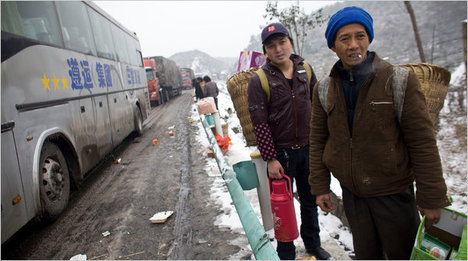
StrandedTrafficChinaEntrepreneurs2011-01-21.jpg“Enterprising residents of Hetaocun sold food to stranded travelers at a markup.” Source of caption and photo: online version of the NYT article quoted and cited below.

(p. A7) HETAOCUN, China — Compared with some of the more spectacular recent traffic jams in China, among them a 60-mile snarl last summer that paralyzed a major artery outside Beijing for two weeks, the thousands of travelers who spent the night trapped on a snow-coated highway in southwest Guizhou Province on Monday did not even warrant a mention in the local news media.
. . .
Stranded drivers chain-smoked, stomped their feet against the chill and cursed the government for failing to come to their rescue. As the night wore on, fuel lines froze and cellphone batteries died.
The residents of Hetaocun, however, saw the unmoving necklace of taillights from their mountain village and got entrepreneurial. They roused children from their beds, loaded boxes of instant noodles into baskets and began hawking their staples to a captive clientele. The 500 percent markup did not appear to dent sales.
“It rarely snows here, so this is a good thing,” said Yi Zhonggui, 42, as he wove past stalled vehicles with his wife and 4-year-old daughter lugging thermoses of hot water.
As the supply of noodles ran low, residents began gathering up the walnuts that give the village its name. In between cries of “walnuts, walnuts,” salesmen like Chen Xianneng obliged the desperate with snippets of news from the front, even if the information was based on hearsay.

For the full story, see:
ANDREW JACOBS. “Hetaocun Journal; As Traffic Backs Up, Villagers See Opportunity.” The New York Times (Weds., JANUARY 19, 2011): A7.
(Note: ellipsis added.)
(Note: the online version of the article is dated January 18, 2011 and has the title “Hetaocun Journal; In China, Traffic Jam Benefits Enterprising Villagers.”)