
Federal Food Regs Drive Sharon Penner to Stop Baking for Nebraska Children

PennerSharonSlicesHerBakedBread2013-06-11.jpg “Sharon Penner slices fresh bread, which she bakes a few times a week for Hampton, Neb., students. Penner, who has fed the town’s schoolchildren for 43 years, saw new school nutrition rules that cut many of her goodies as a sign it was time to retire. With her in the school kitchen is assistant Judy Hitzemann.” Source of caption and photo: online version of the Omaha World-Herald article quoted and cited below.

Have we gone too far when the preferences of Michelle Obama rule over the preferences of the parents of Hampton, Nebraska? And is it clear that the parents are wrong in thinking that fresh-baked bread (see photo above) and a timely pat on the shoulder (see photo below), are worth some extra calories?

(p. 1A) HAMPTON, Neb. — Blame the broccoli. Blame the mandarin oranges. Blame all their cousins, from apples to yams, for removing Mrs. Penner’s butter bars from the school lunch counter.

Then blame Mrs. Obama for removing Mrs. Penner.
So goes the thinking in this no-stoplight village of 423 people about 20 minutes northwest of York.
When the new federal school nutrition mandates went into effect this year, championed by first lady Michelle Obama, fresh-baked brownies, cookies and other sugary goodies disappeared from the school menu. And Sharon Penner, who has been feeding schoolchildren here for 43 years, decided it was a sign from above to retire.
Friday [May 17, 2013] will be the last school lunch the 70-year-old prepares for the Hampton Hawks.
Mrs. Penner is hanging up her apron.
“She is?” asked an incredulous sixth-grader named Treavar Pekar. (p. 2A) He stopped cold from scrubbing some of the six tables in the small cafeteria when I broke the news after lunch.
“NOOOOO!!!!!”
That about sums up the community response.

For the full story, see:
Grace, Erin. “Time to Hang Up Her Purple Apron.” Omaha World-Herald (FRIDAY, MAY 17, 2013): 1A-2A.
(Note: ellipses, and bracketed date, added.)
(Note: the online version of the article has the title “Grace: Hampton lunch lady ready to hang up apron.”)

PennerSharonComfortsBryceJoseph2013-06-11.jpg “Sharon Penner with Bryce Joseph, who needed some help after dropping his breakfast tray.” Source of caption and photo: online version of the Omaha World-Herald article quoted and cited above.

If Anarcho-Primitives Destroy Civilization, Billions of City-Dwellers Will Die

(p. 211) . . . , the . . . problem with destroying civilization as we know it is that the alternative, such as it has been imagined by the self-described “haters of civilization,” would not support but a fraction of the people alive today. In other words, the collapse of civilization would kill billions. Ironically, the poorest rural inhabitants would fare the best, as they could retreat to hunting and gathering with the least trouble, but billions of urbanites would die within months or even weeks, once food ran out and disease took over. The anarcho-primitives are rather sanguine about this catastrophe, arguing that accelerating the collapse early might save lives in total.

Source:
Kelly, Kevin. What Technology Wants. New York: Viking Adult, 2010.
(Note: ellipses added.)

Patents Turned Steam from Toy to Engine

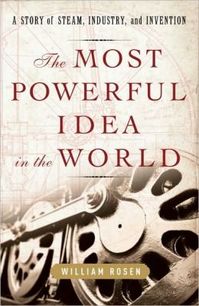
TheMostPowerfulIdeaInTheWorldBK2013-05-13.JPG

Source of book image: http://img2.imagesbn.com/p/9781400067053_p0_v1_s260x420.JPG

(p. 20) The obvious audience for Rosen’s book consists of those who hunger to know what it took to go from Heron of Alexandria’s toy engine, created in the first century A.D., to practical and brawny beasts like George and Robert Stephenson’s Rocket, which kicked off the age of steam locomotion in 1829. But Rosen is aiming for more than a fan club of steam geeks. The “most powerful idea” of his title is not an early locomotive: “The Industrial Revolution was, first and foremost, a revolution in invention,” he writes, “a radical transformation in the process of invention itself.” The road to Rocket was built with hundreds of innovations large and small that helped drain the mines, run the mills, and move coal and then people over rails.
. . .
Underlying it all, Rosen argues, was the recognition that ideas themselves have economic value, which is to say, this book isn’t just gearhead wonkery, it’s legal wonkery too. Abraham Lincoln, wondering why Heron’s steam engine languished, claimed that the patent system “added the fuel of interest to the fire of genius.” Rosen agrees, offering a forceful argument in the debate, which has gone on for centuries, over whether patents promote innovation or retard it.
Those who believe passionately, as Thomas Jefferson did, that inventions “cannot, in nature, be a subject of property,” are unlikely to be convinced. Those who agree with the inventors James Watt and Richard Arkwright, who wrote in a manuscript that “an engineer’s life without patent is not worthwhile,” will cheer. Either way, Rosen’s presentation of this highly intellectual debate will reward even those readers who never wondered how the up-and-down chugging of a piston is converted into consistent rotary motion.

For the full review, see:
JOHN SCHWARTZ. “Steam-Driven Dreams.” The New York Times (Sun., August 29, 2010): 20.
(Note: ellipsis added; italicized words in original.)
(Note: the online version of the review has the date August 26, 2010.)

The book under review, is:
Rosen, William. The Most Powerful Idea in the World: A Story of Steam, Industry, and Invention. New York: Random House, 2010.

Berkshire Agrees to Buy No More than 25% of DaVita, Firm Accused of Medicare Fraud

Warren Buffett’s Berkshire Hathaway has agreed to cap its ownership of DaVita Healthcare Partners at 25%. A previous entry on this blog quoted a story saying that Ted Weschler is behind Berkshire’s purchases of DaVita stock. An even earlier entry on this blog discussed accusations that DaVita Healthcare Partners has committed substantial healthcare fraud by charging the taxpayer millions of dollars for medicine that is needlessly thrown away.

(p. 2D) Berkshire agreed not to buy more than 25 percent of DaVita HealthCare Partners Inc., a national network of medical infusion clinics.
Berkshire investment manager Ted Weschler has been buying DaVita stock for Berkshire since joining the Omaha investment company last year, totaling about 14 percent of the company, Bloomberg reported.
Weschler and DaVita President Javier Rodriguez signed a “standstill agreement” last week, a document often intended to clarify whether an investor wants to acquire controlling interest in a business. Some have speculated that Berkshire wants to acquire all of DaVita’s stock, which artificially inflates the price of its shares.
DaVita legal officer Kim Rivera said Berkshire is a “supportive investor with a long-term view.”

For the full story, see:
Steve Jordon. “WARREN WATCH; At Berkshire meeting, See’s candymaker outshines Warren Buffett.” Omaha World-Herald (SUNDAY, MAY 12, 2013): 1D & 2D.

After Failing to Enslave Indians, Starving Jamestown Colonists Ate 14-Year-Old Girl

JamestownFourteenYearOldCannibalized2013-05-14.jpg

“A facial reconstruction of a 14-year-old girl whose skull shows signs that her remains were used for food after her death and burial.” Source of caption and image: online version of the NYT article quoted and cited below.

Acemoglu and Robinson in the long, but thought-provoking, opening chapter of their Why Nations Fail book, discuss starvation at the Jamestown colony. Only they don’t mainly attribute it to a harsh winter or a slow rescue from England, as does the article quoted below (it is from the New York Times, after all).
Economists Acemoglu and Robinson (p. 23) instead criticize the colony’s initial plan to thrive by enslaving natives to bring them gold and food. Eventually John Smith made the bold suggestion that the colonists should try to work to produce something to eat or to trade. The rulers of the colony ignored Smith, resulting in starvation and cannibalism.

(p. A11) Archaeologists excavating a trash pit at the Jamestown colony site in Virginia have found the first physical evidence of cannibalism among the desperate population, corroborating written accounts left behind by witnesses. Cut marks on the skull and skeleton of a 14-year-old girl show that her flesh and brain were removed, presumably to be eaten by the starving colonists during the harsh winter of 1609.

The remains were excavated by archaeologists led by William Kelso of Preservation Virginia, a private nonprofit group, and analyzed by Douglas Owsley, a physical anthropologist at the National Museum of Natural History in Washington. The skull bears tentative cuts to the forehead, followed by four strikes to the back of the head, one of which split the skull open, according to an article in Smithsonian magazine, where the find was reported Wednesday.
It is unclear how the girl died, but she was almost certainly dead and buried before her remains were butchered. According to a letter written in 1625 by George Percy, president of Jamestown during the starvation period, the famine was so intense “thatt notheinge was Spared to mainteyne Lyfe and to doe those things which seame incredible, as to digge upp deade corpes outt of graves and to eate them.”

For the full story, see:
NICHOLAS WADE. “Girl’s Bones Bear Signs of Cannibalism by Starving Virginia Colonists.” The New York Times (Thurs., May 2, 2013): A11.
(Note: ellipsis added.)
(Note: the online version of the story has the date May 1, 2013.)

The Acemoglu book mentioned above is:
Acemoglu, Daron, and James Robinson. Why Nations Fail: The Origins of Power, Prosperity, and Poverty. New York: Crown Business, 2012.

JamestownBonesShowCannibalism2013-05-14.jpg “Human remains from the Jamestown colony site in Virginia bearing evidence of cannibalism.” Source of caption and photo: online version of the NYT article quoted and cited above.
Moore’s Law: Inevitable or Intel?

I believe that Moore’s Law remained true for a long time, not because it was inevitable, but because an exemplary company worked very hard and effectively to make it true.

(p. 159) In brief, Moore’s Law predicts that computing chips will shrink by half in size and cost every 18 to 24 months. For the past 50 years it has been astoundingly correct.

It has been steady and true, but does Moore’s Law reveal an imperative in the technium? In other words is Moore’s Law in some way inevitable? The answer is pivotal for civilization for several reasons. First, Moore’s Law represents the acceleration in computer technology, which is accelerating everything else. Faster jet engines don’t lead to higher corn yields, nor do better lasers lead to faster drug discoveries, but faster computer chips lead to all of these. These days all technology follows computer technology. Second, finding inevitability in one key area of technology suggests invariance and directionality may be found in the
rest of the technium.

Source:
Kelly, Kevin. What Technology Wants. New York: Viking Adult, 2010.

The Eccentric History of How Bureaucratic Paper-Pushing Drives Clerks Crazy

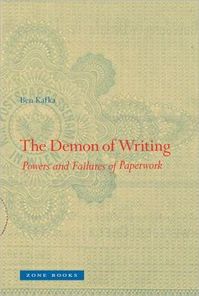
TheDemonOfWritingBK2013-05-13.jpg

Source of book image: http://d.gr-assets.com/books/1360928417l/15904345.jpg

(p. C4) If paperwork studies have an unofficial standard-bearer and theoretician, it’s Mr. Kafka. In “The Demon of Writing” he lays out a concise if eccentric intellectual history of people’s relationship with the paperwork that governs (and gums up) so many aspects of modern life. The rise of modern bureaucracy is a well-established topic in sociology and political science, where it is often related as a tale of increasing order and rationality. But the paper’s-eye view championed by Mr. Kafka tells a more chaotic story of things going wrong, or at least getting seriously messy.

It’s an idea that makes perfect sense to any modern cubicle dweller whose overflowing desk stands as a rebuke to the utopian promise of the paperless office. But Mr. Kafka traces the modern age of paperwork to the French Revolution and the Declaration of the Rights of Man, which guaranteed citizens the right to request a full accounting of the government. An explosion of paper followed, along with jokes, gripes and tirades against the indignity of rule by paper-pushing clerks, a fair number of whom, judging from the stories in Mr. Kafka’s book, went mad.

For the full story, see:
JENNIFER SCHUESSLER. “The Paper Trail Through History.” The New York Times (Mon., December 17, 2012): C1 & C4.
(Note: the online version of the story has the date December 16, 2012.)

Kafka’s book, mentioned above, is:
Kafka, Ben. The Demon of Writing: Powers and Failures of Paperwork. Cambridge, Mass.: Zone Books, 2012.

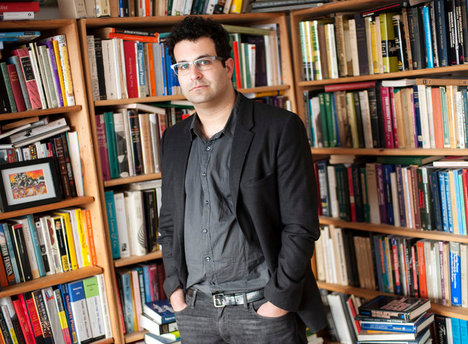
KafkaBenAuthor2013-05-13.jpg “Ben Kafka, author of “The Demon of Writing: Powers and Failures of Paperwork.”” Source of caption and photo: online version of the NYT article quoted and cited above.

We Worry Most About What We Cannot Control

(p. D7) Studies have compared Americans’ perceived ranking of dangers with the rankings of real dangers, measured either by actual accident figures or by estimated numbers of averted accidents. It turns out that we exaggerate the risks of events that are beyond our control, that cause many deaths at once or that kill in spectacular ways — crazy gunmen, terrorists, plane crashes, nuclear radiation, genetically modified crops. At the same time, we underestimate the risks of events that we can control (“That would never happen to me — I’m careful”) and of events that kill just one person in a mundane way.

For the full commentary, see:
JARED DIAMOND. “ESSAY; That Daily Shower Can Be a Killer.” The New York Times (Tues., January 28, 2013): D1 & D7.
(Note: the online version of the commentary has the date January 28, 2013.)

Faculty Unions Oppose MOOCs that Might Cost Them Their Jobs in Five to Seven Years

ThrunSabastianUdacityCEO2013-05-14.jpg “Sebastian Thrun, a research professor at Stanford, is Udacity’s chief executive officer.” Source of caption and photo: online version of the NYT article quoted and cited below.

(p. A1) SAN JOSE, Calif. — Dazzled by the potential of free online college classes, educators are now turning to the gritty task of harnessing online materials to meet the toughest challenges in American higher education: giving more students access to college, and helping them graduate on time.
. . .
Here at San Jose State, . . . , two pilot programs weave material from the online classes into the instructional mix and allow students to earn credit for them.
“We’re in Silicon Valley, we (p. A3) breathe that entrepreneurial air, so it makes sense that we are the first university to try this,” said Mohammad Qayoumi, the university’s president. “In academia, people are scared to fail, but we know that innovation always comes with the possibility of failure. And if it doesn’t work the first time, we’ll figure out what went wrong and do better.”
. . .
Dr. Qayoumi favors the blended model for upper-level courses, but fully online courses like Udacity’s for lower-level classes, which could be expanded to serve many more students at low cost. Traditional teaching will be disappearing in five to seven years, he predicts, as more professors come to realize that lectures are not the best route to student engagement, and cash-strapped universities continue to seek cheaper instruction.
“There may still be face-to-face classes, but they would not be in lecture halls,” he said. “And they will have not only course material developed by the instructor, but MOOC materials and labs, and content from public broadcasting or corporate sources. But just as faculty currently decide what textbook to use, they will still have the autonomy to choose what materials to include.”
. . .
Any wholesale online expansion raises the specter of professors being laid off, turned into glorified teaching assistants or relegated to second-tier status, with only academic stars giving the lectures. Indeed, the faculty unions at all three California higher education systems oppose the legislation requiring credit for MOOCs for students shut out of on-campus classes.
. . .
“Our ego always runs ahead of us, making us think we can do it better than anyone else in the world,” Dr. Ghadiri said. “But why should we invent the wheel 10,000 times? This is M.I.T., No. 1 school in the nation — why would we not want to use their material?”
There are, he said, two ways of thinking about what the MOOC revolution portends: “One is me, me, me — me comes first. The other is, we are not in this business for ourselves, we are here to educate students.”

For the full story, see:
TAMAR LEWIN. “Colleges Adapt Online Courses to Ease Burden.” The New York Times (Tues., April 30, 2013): A1 & A3.
(Note: ellipses added.)
(Note: the online version of the story has the date April 29, 2013.)

KormanikKatieUdacityStudent2013-05-14.jpg “Katie Kormanik preparing to record a statistics course at Udacity, an online classroom instruction provider in Mountain View, Calif.” Source of caption and photo: online version of the NYT article quoted and cited above.

Early Societies Were Violent, Superstitious and Unfair

(p. 89) Human nature is malleable. We use our minds to change our values, expectations, and definition of ourselves. We have changed our nature since our hominin days, and once changed, we will continue to change ourselves even more. Our inventions, such as language, writing, law, and science, have ignited a level of progress that is so fundamental and embedded in the present that we now naively expect to see similar good things in the past as well. But much of what we consider “civil” or even “humane” was absent long ago. Early societies were not peaceful but rife with warfare. One of the most common causes of adult death in tribal societies was to be declared a witch or evil spirit. No rational evidence was needed for these superstitious accusations. Lethal atrocities for infractions within a clan were the norm; fairness, as we might think of it, did not extend outside the immediate tribe. Rampant inequality among genders and physical advantage for the strong guided a type of justice few modern people would want applied to them.

Source:
Kelly, Kevin. What Technology Wants. New York: Viking Adult, 2010.

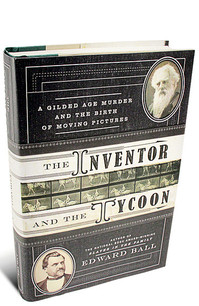
Edison, Not Muybridge, Remains the Father of Hollywood

TheInventorAndTheTycoonBK2013-05-12.jpg

Source of book image: online version of the WSJ review quoted and cited below.

(p. A13) Wish it though we might, this strangely off-center Briton isn’t really the Father of Hollywood, nor even a distant progenitor of “Avatar.” The famous time-lapse images that he took for Stanford, proving that a horse does take all four hoofs off the ground while galloping–and the tens of thousands of photographs that he went on to make of birds flying and people sneezing or bending over and picking things up–were soon so comprehensively overtaken by newer technologies (lenses, shutters, celluloid) that his stature as a proto-movie-maker was soon reduced to a way-station. His contribution was technically interesting but hardly seminal at all. The tragic reality is that Thomas Edison, with whom Muybridge was friendly enough to propose collaboration, retains the laurels–though, as Mr. Ball points out with restrained politeness, Muybridge might have fared better had he been aware of Edison’s reputation for “borrowing the work of others and not returning it.”

For the full review, see:
SIMON WINCHESTER. “BOOKSHELF; Lights, Camera, Murder; The time-lapse photos Muybridge took in the 19th century were technically innovative, but they didn’t make him the Father of Hollywood.” The Wall Street Journal (Thurs., February 6, 2013): A13.
(Note: the online version of the review has the date February 6, 2013.)

The book under review is:
Ball, Edward. The Inventor and the Tycoon: A Gilded Age Murder and the Birth of Moving Pictures. New York: Doubleday, 2013.