(p. B2) First Solar’s solar-panel business, which is focused on large solar installations that feed electricity to power companies, is dependent on government subsidies awarded to such developments.
. . .
But some worry that First Solar isn’t well positioned for industry trends. The global solar-power market is moving toward rooftop solar-power systems, rather than the large-scale utility power plants where First Solar’s products are most effective, said Jesse Pichel, an analyst at Jefferies Group Inc.
“This was a market leader, but its technology is being usurped or surpassed by the Chinese,” said Mr. Pichel. “Their product is not competitive in the most economic and sustainable solar market, which is rooftop.”
Bill Gates. Source of caption and photo: online version of the WSJ article quoted and cited below.
(p. R2) MR. GATES: . . .
The next miracle is nuclear energy. The plants that are out in the world today are basically generation-one and -two plants. There’s a few generation-three plants. The thing I’m investing in is a fourth-generation design. MR. MURRAY: Can you explain a little bit about how this technology works? MR. GATES: The part of uranium that’s fissile–when you hit it with a neutron, it splits in two–is about 0.7%. The reactors we have today are burning that 0.7%. There was a concept that you would do a different type of reactor that would make a bunch of another element called plutonium, and then you would pull that out and then you would burn that. That’s called breeding in a fast reactor. But plutonium is nuclear-weapons material, it’s messy, and the processing you have to get through is not only environmentally difficult, it’s extremely expensive.
The concept of the TerraPower reactor is that in the same reactor, you both burn and breed. Instead of making plutonium and then extracting it, we take uranium–the 99.3% that you normally don’t do anything with–we convert that and we burn it. The 99.3% is cheap as heck, and there’s a pile of it sitting in Paducah, Kentucky, that’s enough to power the United States for hundreds and hundreds of years.
“SUBTERRANEAN; William A. DiMichele in the Springfield Coal. The dark mass is a coal seam; the lighter shale above is interrupted by a fossil tree stump.” Source of caption and photo: online version of the NYT article quoted and cited below.
(p. D3) In the clammy depths of a southern Illinois coal mine lies the largest fossil forest ever discovered, at least 50 times as extensive as the previous contender.
. . .
“Effectively you’ve got a lost world,” said Howard Falcon-Lang, a paleontologist at Royal Holloway, University of London, who has explored the site. “It’s the closest thing you’ll find to time travel,” he added.
. . .
The reach of the Springfield forest should allow scientists to undertake ecosystem-wide analyses in a way never before possible in landscapes so ancient, and such studies may help them predict the effects of global warming today.
“With our own CO2 rises and changes in climate,” said Scott D. Elrick, a team member from the Illinois State Geological Survey, “we can look at the past here and say, ‘It’s happened before.’ ”
Today, we burn the scale trees of the Carboniferous by the billions: they have all turned to coal. Newly discovered, the Springfield forest is already crumbling to bits, as coal-mine ceilings quickly do after exposure. But with continued mining, more ceilings are being revealed every day.
“You have to dig to find fossils, going inside the anatomy of the planet,” Dr. Johnson said. “Bill DiMichele realizes he has an entire industry digging for him, creating a tunnel into an ancient world.”
(p. B3) . . . , Discovery Communications — which owns the Discovery Channel, Animal Planet, the Science Channel and others — announced in early April that it was shutting down Planet Green, a four-year-old channel that featured environmental programming. The channel floundered with low ratings and what executives said were a lack of entertaining eco-themed shows.
The report by Kerry Sanders was broadcast on the NBC Nightly News on June 20, 2012.
The transcript below was posted by NBC. I corrected a few typos and omissions (e.g., the posted transcript omitted that much of the funding had come from private grants), but I have not checked the whole transcript.
>>> In Florida tonight the race is on to save a precious natural resource, coral reefs. we can sometimes forget they are living things. after being damaged by everything from rising ocean temperatures to storms and fishing nets, environmental experts are stepping in big time to help. our report from nbc’s kerry sanders.
>> reporter: a quarter mile off the coast of fort lauderdale, down 25 feet so the seabed, scientists have taken a tiny experiment that began more than six years ago and turned it into a massive accomplishment.
>> no one thought it was possible. we proved them wrong.
>> reporter: corals, impossible to ongrow artificially in the environment are now thriving. researchers say it’s a very simple idea, coral is grown in an underwater nursery, then it’s harvested. i joined the team snipping two-inch long cuttings, like pruning a rose. with a nail glued into the rhinestone they are held in place. zip ties hold the ties to the nail. in two weeks the coral has anchored itself growing in the very spots where it was disappearing. from the coast off south florida as far south as the virgin islands, the first 8,000 coral can you get are taking hold saving endangered elkhorn and stag horn coral.
>> after it was listed it helped our funding.
>> reporter: Funding came from private grants and even federal stimulus money to protect this natural resource, prized for supporting an abundant fish life and attracting tourism.
>> They protect our coastlines from storms, without these reefs breaking up wave energy, our erosion on the beach would be much more substantial.
>> reporter: Coral making a comeback one clipping at a time. Kerry Sanders, NBC News off the coast of Fort Lauderdale.
(p. 194) Sam Walton is my pick for America’s greatest entrepreneur of the twentieth century.
He not only built the world’s largest retailing empire and the single most valuable company in America, he created the institution with the greatest muscle to do good today.
Source:
Wyly, Sam. 1,000 Dollars and an Idea: Entrepreneur to Billionaire. New York: Newmarket Press, 2008.
The YouTube video embedded above was from a CBS Evening News broadcast in June 2012. It illustrates the difficulty of the government successfully selecting the technologies, and companies, that will eventually prove successful. (The doctrine that government can and should do such selection is often called “industrial policy.”)
The Obama administration has bet billions of tax dollars on lithium ion batteries for electric vehicles that A123 Systems won $249 million of. But as Sharyl Attkisson reports, expensive recalls and other setbacks have put substantial doubt in the company’s ability to continue.
(p. 7) . . . is this what an emergent technology looks like before it crosses the valley of death?
“Face it, this is not an easy task,” said Brett Smith, assistant research director at the Center for Automotive Research in Ann Arbor, Mich. “You still have an energy storage device that’s not ready for prime time. You still have the chicken and egg problem with the charging infrastructure. That’s not to say it’s not viable over the long run. But the hype is gone and the challenges are still there.”
The market for all-electric and plug-in electric cars in the United States is tiny, amounting to fewer than 20,000 sales last year out of total light-vehicle sales of 12.8 million. Even in optimistic forecasts, plug-in vehicles will account for less than 5 percent of the global market by 2025.
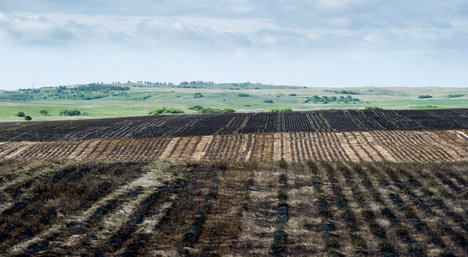
“A grassland field in North Dakota that was burned and then seeded with soybeans. More than one million acres have become farmland in the state since 2007.” Source of caption and photo: online version of the NYT article quoted and cited below.
(p. A13) By guaranteeing income, farmers say, crop insurance removes almost any financial risk for planting land where crop failure is almost certain.
“When you can remove nearly all the risk involved and guarantee yourself a profit, it’s not a bad business decision,” said Darwyn Bach, a farmer in St. Leo, Minn., who said that he is guaranteed about $1,000 an acre in revenue before he puts a single seed in the ground because of crop insurance. “I can farm on low-quality land that I know is not going to produce and still turn a profit.”
. . .
Environmentalists, hunting groups and even some farmers say the prospect of expanding insurance will only speed the push to turn grasslands into farms.
. . .
The existing crop insurance subsidy ballooned to $7.3 billion last year from $951 million in 2000, or about $1.2 billion adjusted for inflation, according to another G.A.O. report released in April. The costs of the program have risen as the value of crops has increased. Over the next 10 years, a Congressional Budget Office study estimates, the premium subsidy for the existing program will cost about $90 billion.
“This is better than a government bailout,” said Steve Ellis, vice president of the Taxpayers for Common Sense, a budget watchdog group in Washington. “A bailout is a one-time thing when something bad happens. But crop insurance keeps giving, good or bad. And it’s about to give even more.”
(p. 192) The chain was called Michaels. I’d never heard of it but, as George related its ancestry, I became more and more intrigued. You see, once upon a time it had been a Ben Franklin store, and therein lies a story.
Back in 1877, Edward and George Butler, brothers from Boston, came up with a new concept for retailing. Instead of setting up a specialty shop to sell one line of items–like shoes or dresses or kitchen supplies–they set up a store where they could sell all sorts of stuff. This was the very beginning of department stores, except that they weren’t yet called that. They were called variety stores, and they carried a large assortment of low-cost goods. Then the Butlers set up a “five-cent counter,” where everything cost a nickel. It worked in Boston, so they expanded westward and called it Ben Franklin Stores.
Three-quarters of a century later, in the days when America was just starting to move westward with the automobile, there were no shopping malls or big national retail chains. What you found in every town, especially in small-town America, was a variety store, like Ben Franklin’s. In Lake Providence, we had Morgan and Lindsey’s, where you could buy everything from paper napkins to thimbles, birthday cards, curtain hooks, and boxes of chocolates. The Butlers’ idea of a nickel counter became so popular and widespread that these places came to be nicknamed “five-and-dimes” or “five-and ten-cent” stores.
(p. 193) While some of them became the heart of Main Street America, others grew to become legendary department stores, like Macy’s in New York, Wanamaker’s in Philadelphia, and Lehman’s in Chicago. Still others merged into chains to compete with Ben Franklin Stores. That’s how JC Penney’s was born.
Source:
Wyly, Sam. 1,000 Dollars and an Idea: Entrepreneur to Billionaire. New York: Newmarket Press, 2008.