Property Rights Would Allow American Indians to Prosper

(p. A19) President Barack Obama courted the Indian vote. During the campaign, he visited Montana’s Crow Reservation last May and was adopted into the tribe under the Crow name “One Who Helps People Throughout the Land.” There he said, “Few have been ignored by Washington for as long as Native Americans,” and vowed to improve their economic opportunities, health care and education.

Two vital steps in this direction are to strengthen property rights and the rule of law on reservations. Virtually every study of international development shows that both of these are crucial to prosperity. Indian country is no different. The effect of insecure property rights is evident on a drive through any western reservation. When you see 160 acres overgrazed and a house unfit for occupancy, you can be sure the title to the land is held by the federal government bureaucracy.
. . .

My own research, published in the Journal of Law and Economics, shows that for tribes with state jurisdiction, per capita income grew 20% faster between 1969 and 1999 than for their counterparts under tribal court jurisdiction. All Indians are less likely than whites to get home loans, but the likelihood of a loan rejection falls by 50% on reservations under state jurisdiction.
. . .

Mr. Obama’s rallying cry was “change,” and that is exactly what he needs to bring about in Indian policy. The first Americans deserve to be freed from the bureaucratic shackles that have made them victims, and allowed to establish property rights and legal systems that can make them victors.

For the full commentary, see:
TERRY L. ANDERSON. “OPINION; Native Americans Need the Rule of Law.” The Wall Street Journal (Mon., MARCH 16, 2009): A19.
(Note: ellipses in original.)
“It Is No Time to Concede”

BeckerGaryCartoon2009_07_10.jpg

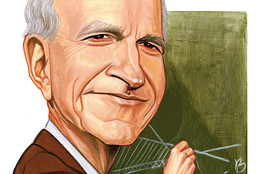
Gary Becker. Source of caricature: online version of the WSJ interview quoted and cited below.

(p. A9) “What can we do that would be beneficial? [One thing] is lower corporate taxes and businesses taxes and maybe taxes in general. Particularly, you want to lower the tax on capital so you raise the after-tax return to investing and get more investing going on.”
. . .
What Mr. Becker has seen over a career spanning more than five decades is that free markets are good for human progress. And at a time when increasing government intervention in the economy is all the rage, he insists that economic liberals must not withdraw from the debate simply because their cause, for now, appears quixotic.
As a young academic in 1956, Mr. Becker wrote an important paper against conscription. He was discouraged from publishing it because, at the time, the popular view was that the military draft could never be abolished. Of course it was, and looking back, he says, “that taught me a lesson.” Today as Washington appears unstoppable in its quest for more power and lovers of liberty are accused of tilting at windmills, he says it is no time to concede.

For the full interview, see:
MARY ANASTASIA O’GRADY. “OPINION: THE WEEKEND INTERVIEW; Now Is No Time to Give Up on Markets.” The Wall Street Journal (Sat., MARCH 21, 2009): A9.
(Note: ellipsis added.)

Gary Becker_2009_07_10.jpg Gary Becker. Source of photo: http://larryevansphotography.com/Gary%20Becker_2.jpg

People Do Not Appreciate the Entrepreneur’s Accomplishment

(p. A17) Bertrand de Jouvenel, writing in 1951 about popular attitudes toward income inequality in “The Ethics of Redistribution”:

The film-star or the crooner is not grudged the income that is grudged to the oil magnate, because the people appreciate the entertainer’s accomplishment and not the entrepreneur’s, and because the former’s personality is liked and the latter’s is not. They feel that consumption of the entertainer’s income is itself an entertainment, while the capitalist’s is not, and somehow think that what the entertainer enjoys is deliberately given by them while the capitalist’s income is somehow filched from them.

Source:
“Notable & Quotable.” The Wall Street Journal (Thurs., MARCH 5, 2009): A17.
(Note: italics in original.)

Original source of de Jouvenel quote:
Jouvenel, Bertrand de. The Ethics of Redistribution. Indianapolis, IN: Liberty Fund Inc., 1990 (originally published by Cambridge University Press in 1951).

“Eminent Domain as an Instrument Against the Weak”

LittlePinkHouseBK.jpg

Source of book image: http://www.dichosbooks.com/images/33353510.jpg

(p. A13) Roughly 70% of Americans own their own homes, a statistic that goes a long way toward explaining why the Supreme Court’s ruling in 2005 in Kelo v. City of New London was so widely reviled. Before Kelo, most Americans probably took it for granted that their home was their castle, protected by the Constitution from arbitrary seizure by government. The Fifth Amendment’s takings clause says: ” . . . nor shall private property be taken for public use, without just compensation.”

In Kelo, a majority of five justices came up with an extremely broad interpretation of “public use.” The high court’s four liberal members, joined by the ever-changeable Anthony Kennedy, ruled that government has the right to seize a private home for virtually any purpose — including handing it over to private developers.
. . .
“Little Pink House” is a modern morality tale. It shows how the politically powerful can use eminent domain as an instrument against the weak. Justice Sandra Day O’Connor said it best in her dissent in Kelo: “The fallout from this decision will not be random.” She predicted that “the government now has license to transfer property from those with fewer resources to those with more.” The beneficiaries, she wrote, are likely to be those citizens “with disproportionate influence and power in the political process.”
Owning property is one of Americans’ most basic constitutional rights. It’s too bad Susette Kelo didn’t get to exercise hers.

For the full review, see:
MELANIE KIRKPATRICK. “Bookshelf; Evicted, But Not Without a Fight; The government took her home. The Supreme Court approved.” Wall Street Journal (Mon., Jan. 26, 2009): A13.
(Note: ellipsis in first paragraph quote was in original; ellipsis between paragraphs was added.)

The book being reviewed, is:
Benedict, Jeff. Little Pink House. New York: Grand Central Publishing, 2009.

Leading Entrepreneurs “Are Chosen for Performance Alone”

(p. 5) Far from being greedy, America’s leading entrepreneurs– with some unrepresentative exceptions–display discipline and self-control, hard work and austerity that excel that in any college of social work, Washington think tank, or congregation of bishops. They are a strange riffraff, to be sure, because they are chosen not according to blood, credentials, education, or services rendered to the establishment. They are chosen for performance alone, for service to the people as consumers.

Source:
Gilder, George. Recapturing the Spirit of Enterprise: Updated for the 1990s. updated ed. New York: ICS Press, 1992.

Obama EPA Censors Global Warming Skeptic

CarlinAlan2009-07-05.jpg

“Alan Carlin, 35-year Environmental Protection Agency veteran.” Source of caricature and caption: online version of the WSJ article quoted and cited below.

(p. A11) In March, the Obama EPA prepared to engage the global-warming debate in an astounding new way, by issuing an “endangerment” finding on carbon. It establishes that carbon is a pollutant, and thereby gives the EPA the authority to regulate it — even if Congress doesn’t act.

Around this time, Mr. Carlin and a colleague presented a 98-page analysis arguing the agency should take another look, as the science behind man-made global warming is inconclusive at best. The analysis noted that global temperatures were on a downward trend. It pointed out problems with climate models. It highlighted new research that contradicts apocalyptic scenarios. “We believe our concerns and reservations are sufficiently important to warrant a serious review of the science by EPA,” the report read.
The response to Mr. Carlin was an email from his boss, Al McGartland, forbidding him from “any direct communication” with anyone outside of his office with regard to his analysis. When Mr. Carlin tried again to disseminate his analysis, Mr. McGartland decreed: “The administrator and the administration have decided to move forward on endangerment, and your comments do not help the legal or policy case for this decision. . . . I can only see one impact of your comments given where we are in the process, and that would be a very negative impact on our office.” (Emphasis added.)
Mr. McGartland blasted yet another email: “With the endangerment finding nearly final, you need to move on to other issues and subjects. I don’t want you to spend any additional EPA time on climate change. No papers, no research etc, at least until we see what EPA is going to do with Climate.” Ideology? Nope, not here. Just us science folk. Honest.

For the full commentary, see:

KIMBERLEY A. STRASSEL. “OPINION: POTOMAC WATCH; The EPA Silences a Climate Skeptic.” The Wall Street Journal (Fri., JULY 3, 2009): A11.

(Note: ellipsis in original; italics added by Strassel.)

Today’s Middle Class Citizens of the U.S. Are Better Off Than Emperor Tiberius, Emperor Napoleon, and Saint Thomas Aquinas

In conversation at the HES meeting in Denver, Pete Boettke mentioned that the opportunity cost of blogging can be very high.
The passage below is from a draft of a key chapter of a long-awaited book authored by Berkeley economist and world-renowned blogger Brad DeLong. (At least in this case, Boettke is right.)

(p. 3) Could the Emperor Tiberius have eaten fresh grapes in January? Could the Emperor Napoleon have crossed the Atlantic in a night, or gotten from Paris to London in two hours? Could Thomas Aquinas have written a 2000-word letter in two hours–and then dispatched it off to 1,000 recipients with the touch of a key, and begun to receive replies within the hour? Computers, automobiles, airplanes, VCR’ s, washing machines, vacuum cleaners, telephones, and other technologies–combined with mass production–give middle-class citizens of the United States today degrees of material wealth–control over commodities, and the ability to consume services–that previous generations could barely imagine.

Source:
DeLong, J. Bradford. “Cornucopia: The Pace of Economic Growth in the Twentieth Century.” NBER Working Paper, w7602, 2000.

“No Amount of Dancing Will Help You Learn More Algebra”

WhyDontStudentsLikeSchoolBK.jpg

Source of book image: online version of the WSJ article quoted and cited below.

(p. A13) . . . , Mr. Willingham shows how experiments support his claims.

The trendy notion that each person has a unique learning style comes under an especially withering assault. “How should I adjust my teaching for different types of learners?” asks Mr. Willingham’s hypothetical teacher. The disillusioning reply: “No one has found consistent evidence supporting a theory describing such a difference. . . . Children are more alike than different in terms of how they think and learn.”
It turns out that while education gurus were promoting the uplifting vision of all students being equal in ability but unique in “style,” researchers were testing the theory behind it. In one experiment, they presented vocabulary words to students classified as “auditory learners” and “visual learners.” Half the words came in sound form, half in print. According to the learning-styles theory, the auditory learners should remember the words presented in sound better than the words presented in print, and vice-versa for the visual learners.
But this is not what happened: Each type of learner did just as well with each type of presentation. Why? Because what is being taught in most of the curriculum — at all levels of schooling — is information about meaning, and meaning is independent of form. “Specious,” for instance, means “seemingly logical, but actually fallacious” whether you hear it, see it or feel it out in Braille. Mr. Willingham makes a convincing case that the distinction between visual, auditory and kinesthetic learners (who supposedly learn best when body movement is involved) is a specious one. At some point, no amount of dancing will help you learn more algebra.

For the full review, see:
CHRISTOPHER F. CHABRIS. “Bookshelf; How to Wake Up Slumbering Minds
Will the discoveries of neuroscientists help us to think, learn and remember?.” Wall Street Journal (Mon., APRIL 27, 2009): A13.

(Note: the initial ellipsis was added; the ellipsis internal to the first full paragraph, was in the original.)

The book being reviewed, is:
Willingham, Daniel T. Why Don’t Students Like School?: A Cognitive Scientist Answers Questions About How the Mind Works and What It Means for the Classroom. San Francisco: Jossey-Bass, 2009.

Most Entrepreneurial Tycoons “Begin as Rebels and Outsiders”

(p. 8) Because entrepreneurship overthrows establishments rather than undergirds them, the entrepreneurial tycoons mostly begin as rebels and outsiders. Often they live in out-of-the-way places– like Bentonville, Arkansas; Omaha, Nebraska; or Mission Hills, Kansas–mentioned in New York, if at all, as the punch lines of comedy routines. When these entrepreneurs move into high society, they are usually inheritors on the way down.

Source:
Gilder, George. Recapturing the Spirit of Enterprise: Updated for the 1990s. updated ed. New York: ICS Press, 1992.

Government Regulatory Costs Impede Energy Innovation

MetcalfeRobert_National_Medal_of_Technology.jpg

Robert Metcalfe receiving the National Medal of Technology in 2003. Source of photo: http://en.wikipedia.org/wiki/Robert_Metcalfe

The author of the commentary quoted below is famous in the history of information technology. His Harvard dissertation draft on packet switching was rejected as unrealistic. So he left the academy and became the main innovator responsible for making packet switching a reality, through the ethernet.
(He is also the “Metcalfe” behind “Metcalfe’s Law” about the value of a network increasing at a faster rate than the increase in the network’s size.)

(p. A15) . . . new small reactors meet important criteria for nuclear power plants. With no control rods to jam, they are far safer than the old models — you might well call them nuclear batteries. By not using weapons-grade enriched fuels, they are nonproliferating. They minimize nuclear waste. And they’re economical.
. . .
As venture capitalists, we at Polaris might have invested in one or two of these fission-energy start-ups. Alas, we had to pass. The problem with their business plans weren’t their designs, but the high costs and astronomical risks of designing nuclear reactors for certification in Washington.
The start-ups estimate that it will cost each of them roughly $100 million and five years to get their small reactor designs certified by the Nuclear Regulatory Commission. About $50 million of each $100 million would go to the commission itself. That’s a lot of risk capital for any venture-backed start-up, especially considering that not one new commercial nuclear reactor design has been approved and built in the United States for 30 years.
. . .

As we learned by building the Internet, fiercely competitive teams of research professors, graduate students, engineers, entrepreneurs and venture capitalists are the best drivers of technological innovation — not big corporations, and certainly not government bureaucracies. So, if it’s cheap and clean energy we want, we should clear the way for fission energy start-ups. We should lower the barriers at the Nuclear Regulatory Commission for the approval of new nuclear reactors, especially the new small ones. In particular, we should drop the requirement that the commission be reimbursed for reconsidering new fission reactor designs.

For the full commentary, see:
BOB METCALFE. “The New Nuclear Revolution; Safe fission power is our future — if regulators allow it..” Wall Street Journal (Weds., JUNE 24, 2009): A15.
(Note: ellipses added.)

Free-Range Pork Carries More Disease

(p. A19) Is free-range pork better and safer to eat than conventional pork? Many consumers think so. The well-publicized horrors of intensive pig farming have fostered the widespread assumption that, as one purveyor of free-range meats put it, “the health benefits are indisputable.” However, as yet another reminder that culinary wisdom is never conventional, scientists have found that free-range pork can be more likely than caged pork to carry dangerous bacteria and parasites. It’s not only pistachios and 50-pound tubs of peanut paste that have been infected with salmonella but also 500-pound pigs allowed to root and to roam pastures happily before butting heads with a bolt gun.

The study published in the journal Foodborne Pathogens and Disease that brought these findings to light last year sampled more than 600 pigs in North Carolina, Ohio and Wisconsin. The study, financed by the National Pork Board, discovered not only higher rates of salmonella in free-range pigs (54 percent versus 39 percent) but also greater levels of the pathogen toxoplasma (6.8 percent versus 1.1 percent) and, most alarming, two free-range pigs that carried the parasite trichina (as opposed to zero for confined pigs). For many years, the pork industry has been assuring cooks that a little pink in the pork is fine. Trichinosis, which can be deadly, was assumed to be history.
. . .
Let’s not forget that animal domestication has not been only about profit. It’s also been about making meat more reliably available, safer to eat and consistently flavored. The critique of conventional animal farming that pervades food discussions today is right on the mark. But it should acknowledge that raising animals indoors, fighting their diseases with medicine and feeding them a carefully monitored diet have long been basic tenets of animal husbandry that allowed a lot more people to eat a lot more pork without getting sick.

For the full commentary, see:
JAMES E. McWILLIAMS. “Free-Range Trichinosis.” The New York Times (Fri., April 10, 2009): A19.
(Note: ellipsis added.)