Coffee Facilitated the Age of Enlightenment

(p. 54) Coffee is a stimulant that has been clinically proven to improve cognitive function—particularly for memory-related tasks—during the first cup or two. Increase the amount of “smart” drugs flowing through individual brains, and the collective intelligence of the culture will become smarter, if enough people get hooked. Create enough caffeine-abusers in your society and you’ll be statistically more likely to launch an Age of Reason. That may itself sound like the self-justifying fantasy of a longtime coffee-drinker, but to connect coffee plausibly to the Age of Enlightenment you have to consider the context of recreational drug abuse in seventeenth-century Europe. Coffee-drinkers are not necessarily smarter, in the long run, than those who abstain from caffeine. (Even if they are smarter for that first cup.) But when coffee originally arrived as a mass phenomenon in the mid-1600s,it was not seducing a culture of perfect sobriety. It was replacing alcohol as the daytime drug of choice. The historian Tom Standage writes in his ingenious A History of the World in Six Glasses:

The impact of the introduction of coffee into Europe during the seventeenth century was particularly noticeable since the most common beverages of the time, even at breakfast, were weak “small beer” and wine. . . . Those who drank coffee instead of alcohol began the day alert and stimulated, rather than relaxed and mildly inebriated, and the quality and quantity of work improved. . . . Western Europe began to emerge from an alcoholic haze that had lasted for centuries.

Source:
Johnson, Steven. The Invention of Air: A Story of Science, Faith, Revolution, and the Birth of America. New York: Riverhead Books, 2008.
(Note: ellipses in original.)

Unintended Consequences in Medicine

SalkInnoculatingSonAgainstPolio.jpg “Jonas Salk, right, inoculates his son against polio as his wife, left, looks on.” Source of caption and photo: online version of the WSJ quoted and cited below.

(p. W9C) “The Polio Crusade” will stir many memories with its account of successful efforts to eradicate the disease whose fear factor, we’re told, was second only to that of the atom bomb. (Monday 9-10 p.m. ET on PBS’s “American Experience” series, but check local listings.) The documentary also tells less-familiar, and sometimes disturbing, stories about the birth of modern fund-raising techniques, and old testing techniques.
. . .
Since the virus is spread most effectively by mouth, or through contact with byproducts of the intestinal tract, the improved hygiene of the 20th century should have led to a decrease in polio infections. The opposite happened. First in Europe and then in America, a disease which had barely registered on the medical radar began to strike more and more people, culminating in a U.S. record of nearly 58,000 cases in 1952.
The explanation for this seemingly counterintuitive symbiosis between cleanliness and disease is astonishing, yet simple. In a germier age, newborns were likely to be exposed to the polio virus very early in life, when they still had immunity conferred by their mother in the womb. When improved hygiene pushed back the time of exposure to a later age, or even to adulthood, many people were by then defenseless.

For the full review, see:
NANCY DEWOLF SMITH. “TELEVISION; In a Time of Plague.” The Wall Street Journal (Tues., JANUARY 30, 2009): W9C.
(Note: ellipsis added.)

Schramm Sees the Donor as the Only Real Stakeholder of a Foundation

SchrammCarl2009-04-10.jpg

Carl Schramm. Source of image: online version of the WSJ interview article quoted and cited below.

(p. A9) . . . who are the real stakeholders in foundations? Mr. Schramm can think of only one: the donor. “At Kauffman I think the trustees and I are very, very clear: We work for Mr. Kauffman,” says Mr. Schramm, acknowledging that his boss passed away in 1993. Kauffman not only left extensive writings but also videotape of himself describing how he wanted the foundation to operate. Mr. Schramm says that one board member told him he was hired because he was the only candidate who had read Kauffman’s book.
. . .
. . . within a year of taking over, Mr. Schramm began a serious overhaul of the foundation. He laid off about half of its 150-person staff and cut off funding to some of its biggest grantees, many in Kansas City. There was a public outcry from local nonprofits and from some former members of the board. One told the New York Times that “Carl doesn’t seem to understand that there isn’t an ‘I’ in team.” It reached the point where Missouri’s then attorney general, Jeremiah Nixon, launched an extensive investigation. He determined that Mr. Schramm had not led the foundation astray. What ultimately saved his job, says Mr. Schramm, were the detailed writings that Kauffman left before his death.
“What happened was not atypical in foundations. Often around 10 years after the death of the donor there’s a moment of truth.” People who were close to the donor will say, “Yes, he said that but he didn’t mean that.” Mr. Schramm concludes: “If there was one piece of advice I’d give to someone who was starting a foundation it is this: Think very, very hard of the long term and write down what you want your foundation to look like in 30 years or 40 years.”
Despite the fact that the foundation’s endowment has fallen by $722 million since the end of 2007, Mr. Schramm sees this as Kauffman’s “moment.” While “no one hopes for a recession,” it’s during economic crises that entrepreneurs “challenge companies that have gotten big and lazy.” The downturn, he says, will even challenge Kauffman to “think about how we can do our work better, like every business.” In fact, Mr. Schramm adds, “The only people immune from thinking hard in moments like this are in government.”

For the full interview, see:

NAOMI SCHAEFER RILEY. “Opinion; THE WEEKEND INTERVIEW with Carl Schramm; Giving Capitalism Its Due.” Wall Street Journal (Sat., APRIL 4, 2009): A9.

(Note: ellipses added.)

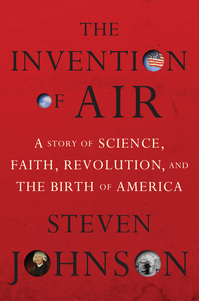
Steven Johnson’s The Invention of Air

InventionOfAirBK.jpg

Source of book image: http://stevenberlinjohnson.typepad.com/photos/uncategorized/2008/09/10/invention_final_81908.jpg

Steven Johnson’s The Ghost Map, about the determined entrepreneurial detective work that uncovered the cause of cholera, is one of my all-time favorite books, so I am now in the mode of reading everything else that Steven Johnson has written, or will write.
The most recent book, The Invention of Air, is not as spectacular as The Ghost Map, but is well-written on a thought-provoking topic. It focuses on Joseph Priestley’s role in the American Revolution. Priestley is best known as an early chemist, but Johnson paints him as a poly-math whose science was of a piece with his philosophy, politics and his religion.
Johnson’s broader point is that for many of the founding fathers, science was not a compartment of their lives, but part of the whole cloth (hey, it’s my blog, so I can mix as many metaphors as I want to).
And the neat bottom line is that Priestley’s method of science (and polity) is the same broadly empirical/experimental/entrepreneurial method that usually leads to truth and progress.
Along the way, Johnson makes many amusing and thought-provoking observations, such as the paragraphs devoted to his coffee-house theory of the enlightenment. (You see, coffee makes for clearer thinking than beer.)

The book:
Johnson, Steven. The Invention of Air: A Story of Science, Faith, Revolution, and the Birth of America. New York: Riverhead Books, 2008.

French Labor Holds Management Hostage—Literally

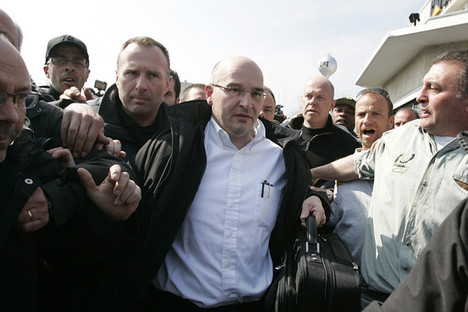
PolutnikNicolasFrenchHostage2009-04-10.jpg “French Caterpillar executive Nicolas Polutnik, center, with workers after his release Wednesday.” Source of caption and photo: online version of the WSJ article quoted and cited below.

(p. B1) PARIS — Of the 22,000 workers Caterpillar Inc. plans to lay off this year, the French ones have perhaps the most radical tactic for negotiating their severance deals.

In an aggressive, and peculiarly French, negotiating strategy, they held their managers hostage. The workers detained the director of their plant and four other managers for about 24 hours this week. Workers released them only after the company agreed to resume talks with unions and a government mediator on how to improve compensation for workers who are being laid off.
. . .
Jérôme Pélisse, a sociologist, surveyed 3,000 companies in 2004 and found that 18 of them had experienced an executive detention in the prior three years.

For the full story, see:
DAVID GAUTHIER-VILLARS and LEILA ABBOUD. “In France, the Bosses Can Become Hostages.” Wall Street Journal (Fri., APRIL 3, 2009): B1 & B5.
(Note: ellipsis added.)

Union Dynamited “True Industrial Freedom”

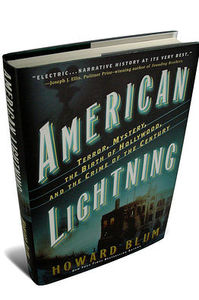
AmericanLightningBK.jpg

Source of book image: online version of the WSJ review quoted and cited below.

(p. A23) The turn-of-the-20th-century war of capital and labor is not even half-remembered now. But the glum slab of the Los Angeles Times building will remind anyone who cares to look. The antiunion rallying cry of “True Industrial Freedom” is carved deeply into its façade. Completed in 1935, the building is a cenotaph for the 21 nonunion pressmen and linotype operators who were blown up on an early October morning in 1910 and died in a storm of fire and collapsing masonry.

The dynamiting of the Los Angeles Times was, for Howard Blum in “American Lightning,” the war’s decisive engagement. After it, a national campaign of union-led terrorism was exposed; labor sympathizers who defended the bombers were proved to be gullible (if not dishonest); and the political force of American socialism was wrecked. Reputations were wrecked, too, principally that of Clarence Darrow, who was then a renowned labor lawyer.
. . .
In 1910, Los Angeles was a young boomtown aching for water and respectability. To the owner of the Los Angeles Times, Harrison Gray Otis, respectability included making sure that the city was uninfested by union labor. It was an era of deep enmity and suspicion between business and labor, when it was not uncommon for strikes to end in riots and death. Otis and the Times preached the open shop with such vehemence that it was almost inevitable that they would become targets of prounion wrath.
The dynamite conspiracy unraveled when a second, unexploded bomb in Los Angeles was found to match another bomb discovered a month earlier by a Burns operative in a rail yard in Peoria, Ill. Burns tied the evidence to a campaign of terror against the National Erectors Association, a union-busting alliance of builders. The target of the association’s animus was the union shop in general and the Structural Iron Workers Union in particular. John McNamara was the union’s secretary-treasurer. His brother James was a union agent. Their weapons against the association and its allies were nitroglycerine and dynamite.

For the full review, see:
D.J. WALDIE. “Bookshelf; Dynamite and Deadlines.” The Wall Street Journal (Tues., SEPTEMBER 16, 2008): A23.
(Note: ellipsis added.)

The reference to the book under review, is:
Blum, Howard. American Lightning. New York: Crown Publishers, 2008.

FDR’s “Mucking About in the Economy Crowded Out Private Investment”

DinnerLineDepression2009-04-10.jpg

“Men lining up for free dinner in New York in the early days of the Great Depression.” Source of caption and photo: online version of the NYT article quoted and cited below.

(p. C1) In this interpretation Roosevelt is a well-meaning but misguided dupe who not only prolonged the Depression but also exacerbated it.
. . .
Amity Shlaes, a syndicated columnist who works at the Council on Foreign Relations, helped ignite this latest revisionist spurt with her 2007 book, “The Forgotten Man: A New History of the Great Depression.”
“The deepest problem was the intervention, the lack of faith in the marketplace,” she wrote, lumping Herbert Hoover and Roosevelt together as overzealous government meddlers.
. . .
(p. C7) Nonetheless, they argue that most of his mucking about in the economy crowded out private investment and antagonized the business world, and thus delayed recovery.
Unemployment remained high throughout the decade until World War II, Ms. Shlaes told conference attendees, because the uncertainty created by Roosevelt’s continual tinkering paralyzed private investors.
When the federal government keeps changing the rules, it’s like having Darth Vader in control, John H. Cochrane, a professor of finance at the University of Chicago Booth School of Business, said during a panel. “I have changed the deal,” he intoned like Vader, the “Star Wars” villain. “Pray I don’t change it any further.”
. . .
“No episode in American history has been so misinterpreted as the Great Depression,” declared Richard K. Vedder, an economist at Ohio University. By artificially keeping prices and wages high, he argued, both Hoover and Roosevelt prevented the economy from adjusting, which is why unemployment remained in double digits until the United States entered the war.
Anna Schwartz, who collaborated with Milton Friedman on a classic study of the Depression, and the Nobel Prize winner Robert E. Lucas Jr. argued that the idea of stimulating the economy with federal spending is a fairy tale. Government spending just crowds out private investment, they asserted; the money supply is the only thing that matters.
. . .
At the final panel, a questioner asked at what point on the 1930s timeline is the United States right now.
. . .
To Ms. Shlaes, the best analogy is 1937 — “the depression within the Depression” — when the unemployment rate shot back up to the middle and high teens after falling. “The economy wanted to recover,” she said, but the government’s interventions ended up paralyzing the business world.
. . .
Mr. Vedder playfully offered another analogy: the recession of 1920. Why was that slump, over and done with by 1922, so much shorter than the following decade’s? Well, for starters, he said, President Woodrow Wilson suffered an incapacitating stroke at the end of 1919, while his successor, Warren G. Harding, universally considered one of the worst presidents in American history, preferred drinking, playing poker and golf, and womanizing, to governing. “So nothing happened,” Mr. Vedder said.
Of course Mr. Vedder does not wish ill health — or obliviousness — on any chief executive. Still, in his view, when you’re talking about government intervention in the economy, doing nothing is about the best you can hope for from any president.

For the full story, see:

PATRICIA COHEN. “New Deal Revisionism: Theories Collide.” The New York Times (Sat., April 3, 2009): C1 & C7
.
(Note: ellipses added.)

The full reference on on Shlaes’ excellent book, is:
Shlaes, Amity. The Forgotten Man: A New History of the Great Depression. New York: HarperCollins, 2007.

Instead of Government Money, Benson “Just Wanted the Opportunity to Compete”

BensonJim.jpg

“Jim Benson” Source of caption and photo: online version of the WSJ obituary quoted and cited below.

(p. A10) “A number of people had told me they wanted to start space businesses,” Mr. Huntress says, “but they always wanted government money. Jim said he didn’t want any government money. He just wanted the opportunity to compete. That got my attention.”

Mr. Benson, who died Oct. 10 at age 63 of a brain tumor, put it directly: “If we’re going to space to stay, space has to pay.”

He thought he’d found a business model. “We offer FedEx-like package delivery rides,” he proclaimed in 1999. He imagined getting customers like NASA itself and the armed forces, as well as scientists and industry. Always looking for an angle, he also envisioned a more terrestrial use for his rockets: sending a package from San Jose, Calif., to Taipei in 20 minutes.

With organizational ability he developed at software start-ups in the 1980s, Mr. Benson assembled a team of mostly young engineers plus some NASA veterans and set to work. To avoid high development costs, he used off-the-shelf technologies and designs. He quickly landed several contracts, including one from the University of California at Berkeley for ChipSat, a small satellite built for carrying scientific instruments to study interstellar gas. It cost $7 million to build — peanuts in space bucks — and has continued to function since its 2003 launch.

For the full obituary, see:
STEPHEN MILLER. “REMEMBRANCES; Jim Benson (1945 – 2008); Rocket Man Ran a Proper Business, But Loftiest Plans Were Ill-Starred.” The Wall Street Journal (Sat., OCTOBER 18, 2008): A10.

How Ayn Rand Matters Today

(p. A7) Ayn Rand died more than a quarter of a century ago, yet her name appears regularly in discussions of our current economic turmoil. Pundits including Rush Limbaugh and Rick Santelli urge listeners to read her books, and her magnum opus, “Atlas Shrugged,” is selling at a faster rate today than at any time during its 51-year history.
. . .
Rand . . . noted that only an ethic of rational selfishness can justify the pursuit of profit that is the basis of capitalism — and that so long as self-interest is tainted by moral suspicion, the profit motive will continue to take the rap for every imaginable (or imagined) social ill and economic disaster. Just look how our present crisis has been attributed to the free market instead of government intervention — and how proposed solutions inevitably involve yet more government intervention to rein in the pursuit of self-interest.
Rand offered us a way out — to fight for a morality of rational self-interest, and for capitalism, the system which is its expression. And that is the source of her relevance today.

For the full commentary, see:
YARON BROOK. “Is Rand Relevant?” Wall Street Journal (Sat., MARCH 14, 2009): A7.
(Note: ellipses added.)

“The Vast Inefficiencies of Public Sector Airports”

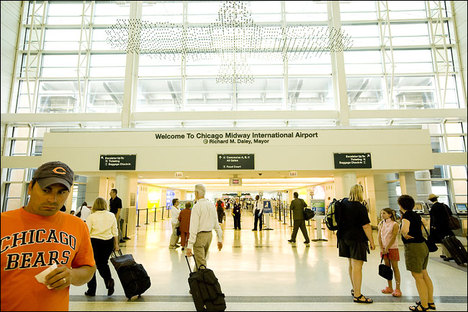
MidwayAirport2009-02-15.jpg “One aviation expert said the Midway deal was a way to overcome inefficiencies of public airports.” Source of caption and photo: online version of the NYT article quoted and cited.

(p. A16) CHICAGO — Midway Airport is poised to become the first large privately run hub airport in the country, officials said Tuesday, after an investment group bid $2.52 billion to win rights to a long-term lease.
. . .
An aviation expert at the Brookings Institution, Clifford Winston, said he saw the deal’s attractiveness as helping to overcome “the vast inefficiencies of public sector airports.”
“The Midway experiment is important,” Mr. Winston said, “but it’s only a tiny step.”

For the full story, see:
SUSAN SAULNY. “In Chicago, Private Firm Is to Run Midway Airport.” The New York Times (Weds., October 1, 2008): A16.
(Note: ellipsis added.)

Entrepreneurs Are the Main Source of Economic Growth

(p. 144) The reason the system of capitalism without capitalists is failing throughout most of Europe is that it misconceives the essential nature of growth. Poring over huge aggregations of economic data, economists see the rise to wealth as a slow upward climb achieved through the marginal productivity gains of millions of workers, through the slow accumulation of plant and machinery, and through the continued improvement of “human capital” by advances in education, training, and health. But, in fact, all these sources of growth are dwarfed by the role of entrepreneurs launching new companies based on new concepts or technologies. These gains generate the wealth that finances the welfare state, that makes possible the long-term investments in human capital that are often seen as the primary source of growth.

Source:
Gilder, George. The Spirit of Enterprise. 1 ed. New York: Simon and Schuster, 1984.