Doctors Rejected Pasteur’s Work

Whether in science, or in entrepreneurship, at the initial stages of an important new idea, the majority of experts will reject the idea. So a key for the advance of science, or for innovation in the economy, is to allow scientists and entrepreneurs to accumulate sufficient resources so that they can make informed bets based on their conjectures, and on their tacit knowledge.
A few entries ago, Hager recounted how Leeuwenhoek faced initial skepticism from the experts. In the passage below, Hager recounts how Pasteur also faced initial skepticism from the experts:

(p. 44) If bacteria could rot meat, Pasteur reasoned, they could cause diseases, and he spent years proving the point. Two major problems hindered the acceptance of his work within the medical community: First, Pasteur, regardless of his ingenuity, was a brewing chemist, not a physician, so what could he possibly know about disease? And second, his work was both incomplete and imprecise. He had inferred that bacteria caused disease, but it was impossible for him to definitively prove the point. In order to prove that a type of bacterium could cause a specific disease, precisely and to the satisfaction of the scientific world, it would be necessary to isolate that one type of bacterium for study, to create a pure culture, and then test the disease-causing abilities of this pure culture.

Source:
Hager, Thomas. The Demon under the Microscope: From Battlefield Hospitals to Nazi Labs, One Doctor’s Heroic Search for the World’s First Miracle Drug. New York: Three Rivers Press, 2007.

Sobell Admits He and Julius Rosenberg Really Were Spies for the Soviets

SobellMortonAtAge91.jpg “Morton Sobell, 91, at his home in the Riverdale section of the Bronx.” Source for caption and photo: online version of the NYT article quoted and cited below.

The left has long chastised the right, for having wrongly persecuted the Rosenbergs. Score one for the right:

(p. A1) In 1951, Morton Sobell was tried and convicted with Julius and Ethel Rosenberg on espionage charges. He served more than 18 years in Alcatraz and other federal prisons, traveled to Cuba and Vietnam after his release in 1969 and became an advocate for progressive causes.

Through it all, he maintained his innocence.
But on Thursday, Mr. Sobell, 91, dramatically reversed himself, shedding new light on a case that still fans smoldering political passions. In an interview, he admitted for the first time that he had been a Soviet spy.
And he implicated his fellow defendant Julius Rosenberg, in a conspiracy that delivered to the Soviets classified military and industrial information and what the American government described as the secret to the atomic bomb.
In the interview with The New York Times, Mr. Sobell, who lives in the Riverdale neighborhood of the Bronx, was asked whether, as an electrical engineer, he turned over military secrets to the Soviets during World War II when they were considered allies of the United States and were bearing the brunt of Nazi brutality. Was he, in fact, a spy?
“Yeah, yeah, yeah, call it that,” he replied. “I never thought of it as that in those terms.”
Mr. Sobell also concurred in what has become a consensus among historians: that Ethel Rosenberg, who was executed with her husband, was aware of Julius’s espionage, but did not actively participate. “She knew what he was doing,” he said, “but what was she guilty of? Of being Julius’s wife.”

For the full story, see:
SAM ROBERTS. “57 Years Later, Figure in Rosenberg Case Says He Spied for Soviets.” The New York Times (Fri., September 12, 2008): A1 & A14.
(Note: all of the part quoted above, appeared on p. A1.)
(Note: the online version of the article has the slightly different title “For First Time, Figure in Rosenberg Case Admits Spying for Soviets.”)

Government Regulation Kills the River City Star

We enjoyed several cruises on the River City Star over the past many years. Apparently no more.
It is silly to think that Homeland Security regulations can make us significantly safer when traveling on the River City Star.
I judge the risks as small, and the best way to prepare for whatever risks there are, would be to take the sorts of steps advocated by Amanda Ripley in her book The Unthinkable. One of the main lessons of her book is that it is not primarily government regulations and professionals that make us safer, but the alertness and preparation of regular people.
Maybe Homeland Security disagrees with my assessment of the risks. But who are they to tell me what risks I am not permitted to take? (That’s what they are in effect doing when they increase the costs of sailing the River City Star to the point that it is turned into a non-sailing restaurant.)

(p. 1B) The River City Star will make its final voyage Thursday to a new home in Plattsmouth, where it will become a floating restaurant. Two new riverboats will replace it along Omaha’s riverfront.
The Star, previously called the Belle of Brownville, operated as an excursion boat for cruises for more than 40 years.
Larry Richling, the boat’s most recent owner, said he decided to sell the boat because federal regulations for boats capable of carrying more than 300 passengers became too costly after the 9/11 terrorist attacks.
The smaller boats, each with a capacity of 149 passengers, fall in a different category with fewer regulations, he said, and will be cheaper to operate.
. . .
(p. 2B) “There’s nothing wrong with the boat. The boat is in fantastic condition,” Richling said.
Richling said he would have had to invest at least $500,000 in the River City Star to meet Homeland Security Department requirements, but those requirements won’t apply if it is permanently docked.

For the full story, see:
CHRISTINE LAUE. “River City Star Going South; Boat Will Become a Plattsmouth Restaurant.” Omaha World-Herald (Thursday, December 4, 2008): 1B-2B.
(Note: ellipsis added.)
(Note: the online version of the title was: “River City Star Making Final Voyage.”)

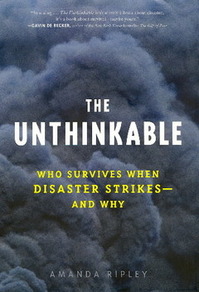
Regular Citizens Perform Vast Majority of Disaster Rescues

UnthinkableBK.jpg

Source of book image: http://www.cleveland.com/arts/index.ssf/2008/06/the_book_the_unthinkable_expla.html

The most important message of this book is a very important message indeed. That message is that overwhelmingly, disaster survival and rescue depends on the actions of regular people, not the actions of professional lifesavers. (Very often, the professionals cannot get there quickly enough, or in sufficient numbers, to get the job done.)
This message, is itself worth the price of the book—if it were sufficiently understood, it would have enormous implications for individual preparedness, and government policy. (Think about the implications, for instance, for whether individual regular people should be allowed to carry guns.)

(p. xiii) These days, we tend to think of disasters as acts of God and government. Regular people only feature into the equation as victims, which is a shame. Because regular people are the most important people at a disaster scene, every time.

In 1992, a series of sewer explosions caused by a gas leak ripped through Guadalajara, Mexico’s second largest city. The violence came from below, rupturing neighborhoods block by block. Starting at 10:30 A.M., at least nine separate explosions ripped open a jagged trench more than a mile long. About three hundred people died. Some five thousand houses were razed. The Mexican Army was called in. Rescuers from California raced to help. Search-and-rescue dogs were ordered up.
But first, before anyone else, regular people were on the scene saving one another. They did incredible things, these regular people. They lifted rubble off survivors with car jacks. They used garden hoses to force air into voids where people were trapped. In fact, as in most disasters, the vast majority of rescues were done by ordinary folks. After the first two hours, very few people came out of the debris alive. The search and rescue dogs did not arrive until twenty-six hours after the explosion.

Source:
Ripley, Amanda. The Unthinkable: Who Survives When Disaster Strikes – and Why. New York: Crown Publishers, 2008.

Fred Thompson Satirizes Current Economic Bailout Policies

ThompsonFredOnTheEconomyDec2008.jpg Source of image: screen capture from the Fred Thompson video commentary described, and linked-to, below.

My brother Eric alerted me to a wise and witty video commentary by former Senator Fred Thompson satirizing current government bailout policies. The video has been posted to multiple locations. Here is the link to the posting on YouTube:
http://www.youtube.com/watch?v=RKc4XFK0iVY

“The Authorities Were Shocked” at Private Airport Success

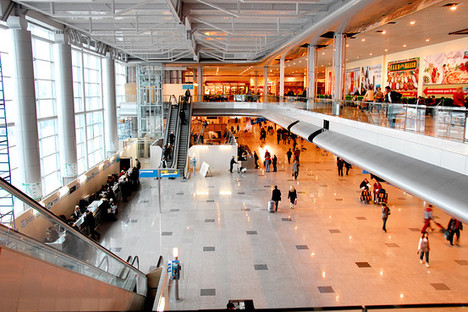
DomodedovoAirportMoscow.jpg “Investors renovated a terminal at Domodedovo and oversaw construction of a train line to Moscow.” Source of caption and photo: online version of the WSJ article quoted and cited below.

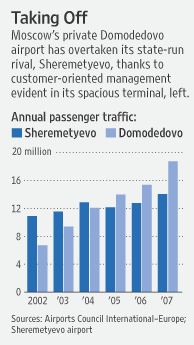
(p. B9) MOSCOW — A heated battle for passengers between the Russian capital’s main airports offers an unlikely model of competition for the aviation industry.

In most cities, airports are monopolies. Even in cities that have more than one, including New York, Paris and Tokyo, airports are usually owned by the same operator. That means airlines can rarely make the kind of choices passengers take for granted, such as choosing an airport for its efficiency, shopping or lounges.
Not so in Moscow, where two international airports, Domodedovo and Sheremetyevo, owned by rival organizations, battle for business. The result is lower fees, better service and fast-improving facilities all around.
Domodedovo Airport, for example, recently convinced several top airlines to make it their Russian base, thanks to a major modernization that added more than 20 new restaurants, jewelry boutiques and a shop where passengers can rent DVDs to watch in booths.
Sheremetyevo Airport responded by building a fast rail link to Moscow, complete with a Starbucks at the airport station.
Moscow’s airport rivalry highlights a paradox of the global aviation industry: Airlines compete fiercely with each other for customers, but they face many monopolist suppliers, such as air-traffic control systems, fuel distributors and airports. Resulting costs and poor services get passed on to travelers.
. . .
During Russia’s privatization drive of the 1990s, local investors bought Domodedovo, which was previously Moscow’s airport serving Soviet Central Asia. The investors, grouped into an upstart charter-airline operator, East Line Group, renovated a terminal at Domodedovo and oversaw construction of a train line to Moscow.
East Line charged airlines landing and operating fees that undercut Sheremetyevo by around 30%. For passengers, Domodedovo’s rail link guaranteed a 40-minute trip to downtown Moscow. Private Russian carriers, largely frozen out of Aeroflot’s base at Sheremetyevo, expanded quickly at the spacious Domodedovo.
East Line’s big break came in 2003, when British Airways announced it would switch from Sheremetyevo to Domodedovo.
“The authorities were shocked that a major airline would leave the government airport,” recalls Daniel Burkard, BA’s former country manager for Russia.

For the full story, see:
DANIEL MICHAELS. “Moscow Points the Way With Airport Competition; While Most Nations Sport Monopolies, Rivalry Between Two Russian Gateways Ushers in Improvements for Carriers, Travelers.” The Wall Street Journal (Mon., DECEMBER 1, 2008): B9.
(Note: ellipsis added.)

MoscowAirportTrafficGraph.gif

Source of graph: online version of the WSJ article quoted and cited above.

“Inebriated with the Exuberance of His Own Verbosity”

Elegant verbal wit is highly entertaining, so long as one is not being skewered by it. I lack the erudition to either affirm or refute the accuracy of Benjamin Disraeli’s wonderful description of rival William Gladstone:

A sophistical rhetorician, inebriated with the exuberance of his own verbosity, and gifted with an egotistical imagination that can at all times command an interminable and inconsistent series of arguments to malign an opponent and to glorify himself.

Source: I first heard part of this description quoted by Patrick Allitt in a lecture on Gladstone and Disraeli. I found the quotation, as well as the attribution below, online at:
http://www.enotes.com/famous-quotes/a-sophistical-rhetorician-inebriated-with-the

Attribution: Benjamin Disraeli (1804-1881), British statesman, author. Speech, July 27, 1878, Knightsbridge, London. Quoted in Times (London, July 29, 1878). Referring to Prime Minister Gladstone. On another occasion, Disraeli said of Gladstone, “He has not a single redeeming defect.”

(Note: I thank Phil Copson for pointing out that in my original posting, I erred in reversing the a and the e in Disraeli’s name. I have now corrected the error.)

I Was Wrong: Apparently the U.S. Auto Industry Does Have a Prayer

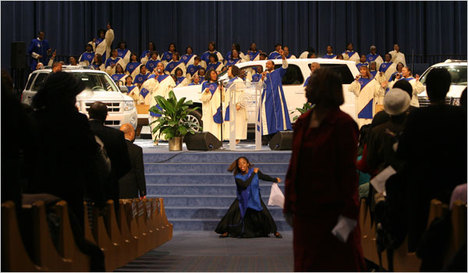
PrayingAutoIndustryMiracle.jpg“PRAYING FOR A MIRACLE.   S.U.V.’s sat on the altar of Greater Grace Temple, a Pentecostal church in Detroit, as congregants prayed to save the auto industry.” Source of the caption and photo: online version of the NYT article quoted and cited below.

The process of creative destruction, requires that failed businesses be allowed to fail, so that the resources (labor and capital) devoted to the failed businesses, can be devoted to more productive uses.
The Danny DeVito character in “Other People’s Money” makes this point in a speech near the end, in which he says that the Gregory Peck character has just delivered a “prayer for the dead” in calling for continued support for a dead business that is technologically obsolete.
On a more personal level, we have always bought cars from Honda and Toyota, because we sincerely believe that they build better cars than Detroit does. By what right does the government force taxpayers to prop up companies whose products have been rejected in the marketplace?
When the economic and moral arguments for bailout fail, all that is left for a failed industry is prayer (and politics)—one more reason to believe that the opportunity cost of prayer, is high.

(p. A19) DETROIT — The Sunday service at Greater Grace Temple began with the Clark Sisters song “I’m Looking for a Miracle” and included a reading of this verse from the Book of Romans: “I consider that our present sufferings are not worth comparing with the glory that will be revealed in us.”

Pentecostal Bishop Charles H. Ellis III, who shared the sanctuary’s wide altar with three gleaming sport utility vehicles, closed his sermon by leading the choir and congregants in a boisterous rendition of the gospel singer Myrna Summers’s “We’re Gonna Make It” as hundreds of worshipers who work in the automotive industry — union assemblers, executives, car salesmen — gathered six deep around the altar to have their foreheads anointed with consecrated oil.

While Congress debated aid to the foundering Detroit automakers Sunday, many here whose future hinges on the decision turned to prayer.

Outside the Corpus Christi Catholic Church, a sign beckoned passers-by inside to hear about “God’s bailout plan.”

For the full story, see:
NICK BUNKLEY. “Detroit Churches Pray for ‘God’s Bailout’.” The New York Times (Mon., December 8, 2008): A19.
(Note: The photo of the top appeared on p. A1 of the print edition of the December 8, 2008 NYT; also, the online version of the article has a date of Dec. 7 instead of the Dec. 8 date of the print version.)

PrayingAutoIndustryMiracle2.jpg“Worshipers at Greater Grace Temple, a Pentecostal church in Detroit, prayed on Sunday for an automobile industry miracle.” Source of the caption and photo: online version of the NYT article quoted and cited above.

Amateur Leeuwenhoek Made Huge Contribution to Science

(p. 40) Antoni van Leeuwenhoek was a scientific superstar. The greats of Europe traveled from afar to see him and witness his wonders. It was (p. 41) not just the leading minds of the era—Descartes, Spinoza, Leibnitz, and Christopher Wren—but also royalty, the prince of Liechtenstein and Queen Mary, wife of William III of Orange. Peter the great of Russia took van Leeuwenhoek for an afternoon sail on his yacht. Emperor Charles of Spain planned to visit as well but was prevented by a strong eastern storm.

It was nothing that the Dutch businessman had ever expected. He came from an unknown family, had scant education, earned no university degrees, never traveled far from Delft, and knew no language other than Dutch. At age twelve he had been apprenticed to a linen draper, learned the trade, then started his own business as a fabric merchant when he came of age, making ends meet by taking on additional work as a surveyor, wine assayer, and minor city official. He picked up a skill at lens grinding along the way, a sort of hobby he used to make magnifying glasses so he could better see the quality of fabrics he bought and sold. At some point he got hold of a copy of Micrographia, a curious and very popular book by the British scientist Robert Hooke. Filled with illustrations, Micrographia showed what Hooke had sen through a novel instrument made of two properly ground and arranged lenses, called a “microscope.”  . . .   Micrographia was an international bestseller in its day. Samuel Pepys stayed up until 2:00 A.M. one night poring over it, then told his friends it was “the most ingenious book that I ever read in my life.”

Van Leeuwenhoek, too was fascinated. He tried making his own microscopes and, as it turned out, had talent as a lens grinder. His lens were better than anyone’s in Delft; better than any Hooke had access to; better, it seemed, than any in the world.  . . .  

(p. 42) Then, in the summer of 1675, he looked deep within a drop of water from a barrel outside and became the first human to see an entirely new world. In that drop he could make out a living menagerie of heretofore invisible animals darting, squirming, and spinning.

Source:
Hager, Thomas. The Demon under the Microscope: From Battlefield Hospitals to Nazi Labs, One Doctor’s Heroic Search for the World’s First Miracle Drug. New York: Three Rivers Press, 2007.
(Note: ellipses added.)

The example above is consistent with Baumol’s hypotheses about formal education mattering less, in the initial stages of great discoveries. (And maybe even being a hindrance).
See:
Baumol, William J. “Education for Innovation: Entrepreneurial Breakthroughs Versus Corporate Incremental Improvements.” In Innovation Policy and the Economy, edited by Adam B. Jaffe, Josh Lerner and Scott Stern, 33-56. Cambridge, Mass.: MIT Press, 2005.

The example is also consistent with Terence Kealey’s claim that important science can often arise as a side-effect of the pursuit of business activity.
See:
Kealey, Terence. The Economic Laws of Scientific Research. New York: St. Martin’s Press, 1996.

In Amsterdam: Expecting the Spanish Inquisition

Gregorius.jpg

A cartoon of the cartoonist who calls himself Gregorius Nekschot. Source of the photo: online version of the WSJ article quoted and cited below.

(p. W1) Amsterdam
On a sunny May morning, six plainclothes police officers, two uniformed policemen and a trio of functionaries from the state prosecutor’s office closed in on a small apartment in Amsterdam. Their quarry: a skinny Dutch cartoonist with a rude sense of humor. Informed that he was suspected of sketching offensive drawings of Muslims and other minorities, the Dutchman surrendered without a struggle.
“I never expected the Spanish Inquisition,” recalls the cartoonist, who goes by the nom de plume Gregorius Nekschot, quoting the British comedy team Monty Python. A fan of ribald gags, he’s a caustic foe of religion, particularly Islam. The Quran, crucifixion, sexual organs and goats are among his favorite motifs.
Mr. Nekschot, whose cartoons had appeared mainly on his own Web site, spent the night in a jail cell. Police grabbed his computer, a hard drive and sketch pads. He’s been summoned for further questioning later this month by prosecutors. He hasn’t been charged with a crime, but the prosecutor’s office says he’s been under investigation for three years on suspicion that he violated a Dutch law that forbids discrimination on the basis of race, religion or sexual orientation.
The cartoon affair has come as a shock to a country that sees itself as a bastion of tolerance, a tradition forged by grim memories of bloody conflict between Catholics and Protestants. The Netherlands sheltered Jews and other refugees from the Spanish Inquisition, and Calvinists fleeing persecution in France. Its thinkers helped nurture the 18th-century Enlightenment. Prostitutes, marijuana and pornography have been legal for decades.
“This is serious. It is about freedom of speech,” says Mark Rutte, the leader of a center-right opposition party. Some of Mr. Nekschot’s oeuvre is “really disgusting,” he says, “but that is free speech.”
. . .
Mr. Nekschot, who calls the investigation “surreal,” says, “Not even Monty Python could have come up with this.” (His pen name, Gregorius Nekschot, is a mocking tribute to Gregory IX, a 13th-century pope who set up a Vatican department to hunt down and execute heretics. Nekschot means “shot in the neck” in Dutch.) Some Muslim groups have voiced dismay at his arrest as well. The head of an organization of Moroccan preachers in Holland said authorities seemed “more afraid” of offending Islam than Muslims.
. . .
The cartoonist blames his woes on what he calls Holland’s “political correctness industry,” a network of often state-funded organizations set up to protect Muslims and other minority groups. One of these, an Internet monitoring group known as MDI, says it received dozens of complaints about the cartoonist’s mockery of Islam and first reported him to the prosecutor’s office in 2005.
“We’re not sure what he does is illegal, but there is a possibility that it is not legal,” says the group’s head, Niels van Tamelen. Many of the complaints, he says, came from followers of a controversial Muslim convert called Abdul-Jabbar van de Ven.
Mr. Van de Ven caused an uproar after the 2004 murder of Mr. Van Gogh, when he seemed to welcome the killing on national TV. He said Mr. Wilders, the anti-immigrant legislator, also deserved to die, preferably from cancer. Mr. Nekschot, appalled by the outburst, caricatured the convert as a fatwa-spewing fanatic.

For the full story, see:
ANDREW HIGGINS. “Why Islam Is Unfunny for a Cartoonist; The arrest of a controversial Dutch cartoonist has set off a wave of protests. The case is raising questions for a changing Europe about free speech, religion and art.” The Wall Street Journal (Sat., JULY 12, 2008): W1 & W6.
(Note: ellipses added.)

Reason for Success of U.S. Economy: “We Let People Fail”

McCain’s chief economic adviser and entrepreneur-expert Hotz-Eakin offered some cogent comments on the trend toward more government bailouts at the taxpayers’ expense:

(p. A6) Mr. Obama is by no means an activist in the Japanese mold, said Douglas Holtz-Eakin, an economic adviser to John McCain’s presidential campaign. But as a whole, policies crafted to address distinct problems in the auto, energy and banking sectors are merging into a broader policy that would pick some winners and losers, preserve entire industries and shape consumer choices.

“We’re backing into industrial policy in an emergency to correct massive market failures,” said Jared Bernstein, an economist at the liberal Economic Policy Institute who has worked with the president-elect’s economic team.
. . .
“The reason the U.S. economy was so successful for so long was not because we did things so well. It was because we let people fail.” Mr. Hotz-Eakin said. “This is dangerous at some very deep level.”

For the full story, see:
JONATHAN WEISMAN. “Wider U.S. Interventions Would Yield Winners, Losers as Industries Realign.” The Wall Street Journal (Thurs., NOVEMBER 20, 2008): A6.
(Note: ellipsis added.)
(Note: the final paragraph was in the print edition, but was deleted from the online version.)