
3-D Printers Promise Big Benefits for Consumers

3Dprinter.jpg

“Lower-price 3-D printers like this one from Z Corp. are spawning new businesses.”  Source of caption and photo:  online version of the WSJ article quoted and cited below.


Neil Gershenfeld has argued that in the not-too-distant-future, ordinary people will have the ability fabricate objects of their own design, in their own home.  His lab at MIT has been developing prototypes to fulfil this vision.  The 3-D printers discussed in the article quoted below, are the earliest exemplars of this vision, to make it to the market.

If this vision is realized, the benefits to consumers could be immense, in terms of variety of products, speed in obtaining products, and consumer control over what is consumed.


(p. B1)  The expansion by 3-D printers into manufacturing is happening thanks to a steady drop in the price of printers, improvements in the materials they can handle and a proliferation in the amount of 3-D data that can be turned into objects.

Historically, the printers cost hundreds of thousands of dollars and were made by a handful of small companies including Z Corp. and Stratasys Inc. But now those and other new companies are producing more-affordable machines priced below $20,000, a change that has radically expanded sales.

The 3-D printing industry is about 20 years old, and in the past two years alone, it has sold around 8,000 machines, or 36% of the industry’s two-decade world-wide sales total of 22,000, according to consulting firm Wohlers Associates.

And sales are likely to increase further: A Pasadena, Calif., venture called Desktop Factory Inc. has already taken 350 pre-orders for a $5,000 3-D printer it plans to roll out next year, says Cathy Lewis, CEO of the company. About 40% of those orders are from universities and 35% from small businesses, she says. The company predicts printers could start finding their way into homes in five years or so.


For the full story, see:

ROBERT A. GUTH.  “How 3-D Printing Figures To Turn Web Worlds Real.”  The Wall Street Journal  (Weds., December 12, 2007):  B1.


The reference to the Gershenfeld book is: 

Gershenfeld, Neil.  Fab: The Coming Revolution on Your Desktop–from Personal Computers to Personal Fabrication.  New York:  Basic Books, 2005.
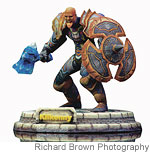

WorldWarcraftFigure.jpg

“World of Warcraft figure made with a 3-D printer.”  Source of caption and photo:  online version of the WSJ article quoted and cited above.
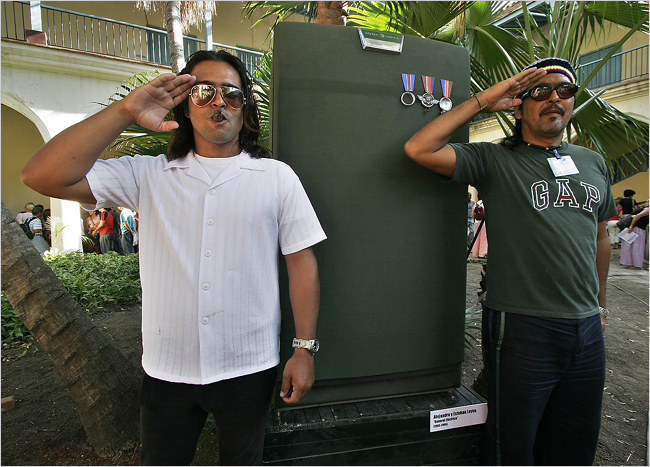

Cubans Salute General Eléctrico

      “Two artists, Alejandro Leyva, left, and Esteban Leyva, with their “General Eléctrico,” found a new use for an old appliance.”  Source of caption and photo:  online version of the NYT article quoted and cited below. 


(p. 3)  In their decades of isolation from the American economy and from global prosperity, Cubans have been taught to take pride in the way they have kept grandiose old mechanical marvels running — ancient Cadillacs and Russian-built Ladas included.

“They took away my señor and replaced him with a little guy,” said a 47-year-old cook who lives in the Reparto Zamora district in western Havana. Welcoming a visitor to her kitchen, she pointed to the slim, white Chinese-made Haier that had taken the place of the bulky, pink Frigidaire that had been in her family for 24 years.

She called herself Moraima Hernández, but indicated with a wink that she was concealing her real name — the only way she felt able to speak without fear of retaliation. Well, up to a point. She declined to say why she felt Mr. Castro was casting a shadow over items as banal as household appliances.

Instead, she simply opened the Haier to reveal its meager contents: bottles of tap water, a few eggs, mustard, half an avocado and some “textured picadillo,” soy protein mixed with a bit of ground beef.

Her old refrigerator was so big, she said nostalgically, that two legs of pork could fit inside.

. . .

Inspired by the ingenuity it took to keep American refrigerators working so long, a group of Cuban artists last year transformed 52 of them into art. They put on a show called “Instruction Manual” that was a big hit in Cuba and is making the rounds in Europe this year.

In the show, the artists Alejandro and Esteban Leyva pinned medals on an old G.E. refrigerator, painted it olive drab and named it “General Eléctrico.” Another artist, Alexis Leyva, installed oars on his refrigerator, drawing on the politically loaded symbol of the homemade boats Cubans use to leave the island illegally. Others were made into cars, skyscrapers a Trojan horse and a jail cell.

Ernesto García Peña, a painter, turned his into an eroticized female image. “In this heat,” he explained, “the refrigerator is almost worshiped for its role as an absolute necessity of modern life. We treat it with very special affection.”


For the full story, see: 

SIMON ROMERO.  “THE WORLD; In Cuba, a Politically Incorrect Love of the Frigidaire.”  The New York Times , Week in Review Section  (Sun., September 2, 2007):  3.

(Note:  ellipses added.)


  “Cold War Relic.   A 1950s-era American refrigerator dominates one woman’s Havana apartment.”  Source of caption and photo:  online version of the NYT article quoted and cited above. 


Local Food May Have Larger Carbon Footprint

HuntsPointMarketBronx.jpg

“Produce at the huge Hunts Point Market in the Bronx. Researchers at the University of California, Davis, have been challenging assumptions about the carbon footprint of local foods versus those that are transported long distances.”  Source of caption and photo:  online version of the NYT article quoted and cited below. 


(p. 11)  The local food, or locavore, movement has so much momentum that some of the food glitterati have declared that such food is better than organic.

But now comes a team of researchers from the University of California, Davis, who have started asking provocative questions about the carbon footprint of food. Those questions threaten to undermine some of the feel-good locavore story line, not to mention my weekend forays for produce. (A carbon footprint is a measure of the impact of human activities on the environment in terms of the amount of greenhouse gases produced.)

While the research is not yet complete, Tom Tomich, director of the University of California Sustainable Agriculture Research and Education Program, said the fact that something is local doesn’t necessarily mean that it is better, environmentally speaking.

The distance that food travels from farm to plate is certainly important, he says, but so is how food is packaged, how it is grown, how it is processed and how it is transported to market.

Consider strawberries. If mass producers of strawberries ship their product to Chicago by truck, the fuel cost of transporting each carton of strawberries is relatively small, since it is tucked into the back along with thousands of others.

But if a farmer sells his strawberries at local farmers’ markets in California, he ferries a much smaller amount by pickup truck to each individual market. Which one is better for the environment?

Mr. Tomich said a strawberry distributor did the math on the back of an envelope and concluded that the Chicago-bound berries used less energy for transport.


For the full story, see:

ANDREW MARTIN.  “THE FEED; If It’s Fresh and Local, Is It Always Greener?”  The New York Times, SundayBusiness Section  (Sun., December 9, 2007):  11.


Recent Years Were Not as Hot as Thought


HotestYearsGraph.gif    Source of graph:  online version of the NYT article quoted and cited below.


(p. 19)  Never underestimate the power of the blogosphere and a quarter of a degree to inflame the fight over global warming.

A quarter-degree Fahrenheit is roughly the downward adjustment NASA scientists made earlier this month in their annual estimates of the average temperature in the contiguous 48 states since 2000. They corrected the numbers after an error in meshing two sets of temperature data was discovered by Stephen McIntyre, a blogger and retired business executive in Toronto. Smaller adjustments were made to some readings for some preceding years.

All of this would most likely have passed unremarkably if Mr. McIntyre had not blogged that the adjustments changed the rankings of warmest years for the contiguous states since 1895, when record-keeping began.

Suddenly, 1934 appeared to vault ahead of 1998 as the warmest year on record (by a statistically meaningless 0.036 degrees Fahrenheit). In NASA’s most recent data set, 1934 had followed 1998 by a statistically meaningless 0.018 degrees. Conservative bloggers, columnists and radio hosts pounced. “We have proof of man-made global warming,” Rush Limbaughtold his radio audience. “The man-made global warming is inside NASA.”

Mr. McIntyre, who has spent years seeking flaws in studies pointing to human-driven climate change, traded broadsides on the Web with James E. Hansen, the NASA team’s leader. Dr. Hansen said he would not “joust with court jesters” and Mr. McIntyre posited that Dr. Hansen might have a “Jor-El complex” — a reference to Superman’s father, who foresaw the destruction of his planet and sent his son packing.


For the full story, see: 

ANDREW C. REVKIN.  "Quarter-Degree Fix Fuels Climate Fight."  The New York Times, Main Section  (Sunday,  August 26, 2007):  19.


Schumpeter in The Age of Turbulence


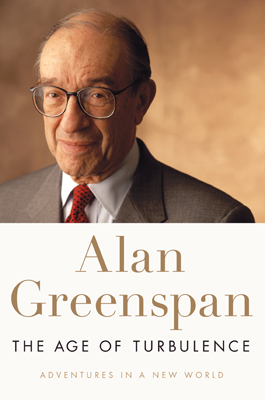
AgeOfTurbulenceBK.jpg    Source of book image:  http://us.penguingroup.com/nf/Book/BookDisplay/0,,9781594201318,00.html#  


Joseph Schumpeter was born on this date in 1883.

Alan Greenspan’s much-discussed memoir, is full of thoughtful discussions of Schumpeter’s central mesage of creative destruction.  Here are a few lines from the first of those discussions:


(p. 48)  Working with heavy industry gave me a profound appreciation of the central dynamic of capitalism.  “Creative destruction” is an idea that was articulated by the Harvard economist Joseph Schumpeter in 1942.  LIke many powerful ideas, his is simple:  A market economy will incessantly revitalize itself from within by scrapping old and failing businesses and then reallocating resources to newer, more productive ones.  I read Schumpeter in my twenties and always thought he was right, and I’ve watched the process at work through my entire career. 


The reference to Greenspan’s book is:

Greenspan, Alan. The Age of Turbulence: Adventures in a New World Economic Flexibility. New York: Penguin Press, 2007. 


Early Humans Resiliently Innovated to Survive During Climate Cooling

 SouthAfricaMap.jpg

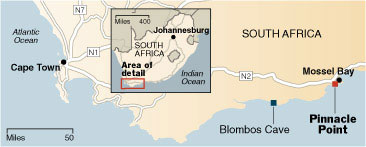
Source of map:  online version of the NYT article quoted and cited below.


(p. A6)  Previous research had indicated that human ancestors had for ages depended solely on terrestrial plants and animals. Both fossil and genetic data show that modern humans evolved 150,000 to 200,000 years ago, but archaeological evidence for the emergence of modern behavior in technology, creativity, symbolic thinking and lifestyles is sparse.

But six years ago, at Blombos Cave, near Pinnacle Point, archaeologists uncovered 77,000-year-old tools along with pigments and engraved stones suggesting symbolic behavior, a sign of early creativity. Now, at the Pinnacle Point cave site, the shellfish remains reveal another important innovation.

. . .

Forced to seek new sources of food, some of the people migrated to the shore in search of “famine food.” At Pinnacle Point, the discovery team reported, they feasted on a variety of marine life, brown mussels, giant periwinkles and whelks.

So on the southern shore of Africa, Dr. Marean said in a statement issued by Arizona State, a small population of cave-dwelling modern humans struggled and survived through the prevailing cold, eating shellfish and developing somewhat advanced technologies.


For the full story, see:

JOHN NOBLE WILFORD.  “Key Human Traits Tied to Shellfish Remains.”  The New York Times  (Thurs., October 18, 2007):  A6.

(Note:  ellipses added.)


Bill Gates Misreads Adam Smith’s Theory of Moral Sentiments


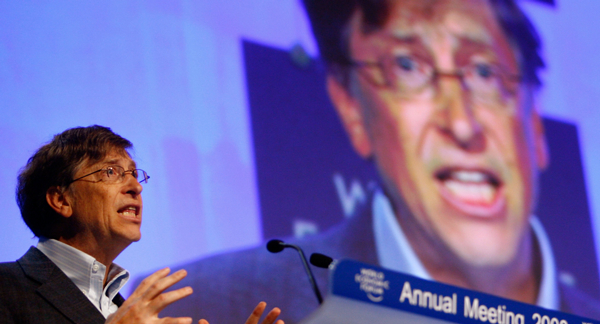
GatesDavos2008.jpgBill Gates speaking at the Davos meetings in Switzerland on January 24, 2008.  Source of the photo: http://graphics8.nytimes.com/images/blogs/dealbook/davos2008/gates600.jpg


The German scholars used to call it “Das Adam Smith Problem”:  how to reconcile the Adam Smith’s Theory of Moral Sentiments with his later Wealth of Nations.  One alleged inconsistency is the advocacy of altruism in the former, and the advocacy of self-interest in the latter.  

But a closer reading of The Theory of Moral Sentiments solves the problem.  Smith thought a case could be made for altruism, but only toward those we know really well, which primarily meant one’s own family, and maybe also others in one’s community who one knows well.  The reason is that altruism works only when we know very well the situation and values of those who we propose to help.  Otherwise, we may end up doing more harm than good.

So when Gates embarks on global altruism, he should be careful in citing Smith for support.


The passage quoted below discusses Bill Gates’s interpretation of Adam Smith:

(p. A15)  Key to Mr. Gates’s plan will be for businesses to dedicate their top people to poor issues — an approach he feels is more powerful than traditional corporate donations and volunteer work. Governments should set policies and disburse funds to create financial incentives for businesses to improve the lives of the poor, he plans to say today. “If we can spend the early decades of the 21st century finding approaches that meet the needs of the poor in ways that generate profits for business, we will have found a sustainable way to reduce poverty in the world,” Mr. Gates plans to say.

In the interview, Mr. Gates was emphatic that he’s not calling for a fundamental change in how capitalism works. He cited Adam Smith, whose treatise, “The Wealth of Nations,” lays out the rationale for the self-interest that drives capitalism and companies like Microsoft. That shouldn’t change, “one iota,” Mr. Gates said.

But there’s more to Adam Smith, he added. “This was written before ‘Wealth of Nations,'” Mr. Gates said, flipping through a copy of Adam Smith’s 1759 book, “The Theory of Moral Sentiments.” It argues that humans gain pleasure from taking an interest in the “fortunes of others.” Mr. Gates will quote from that book in his speech today.

Talk of “moral sentiments” may seem surprising from a man whose competitive drive is so fierce that it drew legal challenges from antitrust authorities. But Mr. Gates said his thinking about capitalism has been evolving for years. He outlined part of his evolution from software titan to philanthropist in a speech last June to Harvard’s graduating class, recounting how when he left Harvard in 1975 he knew little of the inequities in the world. A range of experiences including trips to Africa and India have helped raise that awareness.

In the Harvard speech, Mr. Gates floated the idea of “creative capitalism.” But at the time he had only a “fuzzy” sense of what he meant. To clarify his thinking, he decided to prepare the Davos speech.

For the full story, see:

ROBERT A. GUTH.  “Bill Gates Issues Call For Kinder Capitalism; Famously Competitive, Billionaire Now Urges Business to Aid the Poor.”  The Wall Street Journal   (Thurs., January 24, 2008):  A1 & A15.


One good article that discusses some of the issues in my initial commentary is:

Coase, Ronald H.  “Adam Smith’s View of Man.”  In Essays on Economics and Economists.  Chicago:  University of Chicago Press, 1995.


CharitableFoundationsTop10.gif


Source of the graphic:  online version of the WSJ article quoted and cited above.


The Spontaneous Order of Houston Tunnels


   "The three major sections of the tunnel system are connected under the building at 919 Milam Street in downtown Houston."  Source of caption and photo:  online version of the NYT article cited below. 


Houston is one of the most vibrant, free-wheeling cities in the United States.  It is the only major city that does not have zoning laws,  (See:   Bernard Siegan’s Land Use Without Zoning.)

The tunnels of Houston appear to be another great example of what Hayek called "spontaneous order." 


(p. A14) HOUSTON, Aug. 20 — Where is everybody? 

Seared by triple-digit heat and drenched by tropical storms, midday downtown Houston appears eerily deserted, the nation’s fourth-largest city passing for a ghost town.

On the street, that is.

But below, there are tunnels at the end of the light — nearly seven color-coded miles of them connecting 77 buildings — aswarm with Houstonians lunching, shopping and power-walking in dry, air-chilled comfort.

. . .

It was not centrally planned; it just grew, inspired by Rockefeller Center in New York. But it is not connected to a transit network. And, befitting Texans’ distrust of government, most of it is private; each segment is controlled by the individual building owner who deigns to allow the public access during business hours — and then locks the doors on nights and weekends. Some parts, like those belonging to the former Enron buildings now leased by Chevron, are closed to outsiders altogether.

Few claim mastery of the labyrinth.

“It’s one of Houston’s best-kept secrets,” said Sandra Lord, widely known as the Tunnel Lady, a Yankee transplant who dispels the mysteries for $10 a head and roams the downtown underworld with proprietary aplomb, sometimes stopping strangers to ask, “And you are?” Corporations pay Ms. Lord to orient new employees below ground, and nearly 45,000 natives and visitors have taken her Discover Houston Tours since 1988.

. . .

Ms. Lord, a writer and Houston historian, traced the origins of the tunnels to Ross Sterling, an oilman and governor during the Depression, who, inspired by Rockefeller Center, linked two of his downtown buildings underground in the early 1930s. Soon after, an entertainment entrepreneur, Will Horwitz, connected three of his vaudeville and movie theaters to save on air-conditioning.

And the tunnels grew from there, despite the private expense of digging connections. The oil bust of the 1980s forced many building owners to compete for business with amenities like tunnels.

Many were flooded by Tropical Storm Allison in 2001, prompting installation of submarine-type doors with inflatable rubber insulation for airtight seals.


For the full story, see: 

RALPH BLUMENTHAL.  "It’s Lonesome in This Old Town, Until You Go Underground."  The New York Times  (Tues., August 21, 2007):  A14.

(Note:  ellipses added.)


Top photo shows "Sandra Lord, owner of Discover Houston Tours, leading a tunnel excursion . . . "  Bottom photo shows a map of the tunnels.  Source of caption and photo:  online version of the NYT article cited above. 


Government Pushing Fluorescent Bulbs with Hazardous Mercury


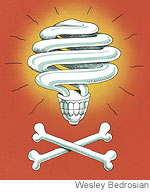
BulbSkull.jpg    Source of image:  online version of the WSJ article quoted and cited below.


(p. D1)  As part of the government’s focus on energy and the environment, Americans are urged to buy compact fluorescent light bulbs, which use only about 25% of the energy and last up to 10 times as long as traditional incandescent bulbs. Nearly 300 million such bulbs were sold in U.S. in 2007, compared with 100 million two years earlier, according to the Department of Energy.

. . .

Yet unlike traditional incandescent bulbs, these bulbs contain mercury, a metal hazardous to human health and the environment. Consumers are urged not to toss them in the trash. In some states, such as California, it’s illegal to throw them away; they must be recycled. Still, many cities and towns don’t have recycling programs for the bulbs, and consumers aren’t sure what to do with them.


For the full story, see: 

SARA SCHAEFER MUÑOZ.  “The Dark Side Of ‘Green’ Bulbs Disposing of Fluorescents, Electronics Releases Toxins; Companies Tout Recycling.” The Wall Street Journal  (Thurs., January 24, 2008):  D1.  

(Note:  ellipsis added.)


Google and Microsoft Seek to Shift Health Care Power to Consumers


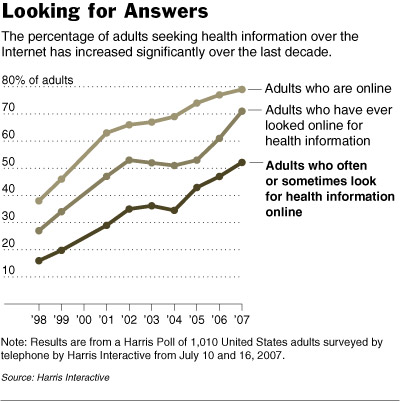
InternetHealthGraph.jpg    Source of graph:  online version of the NYT article cited below. 


(p. C1)  In politics, every serious candidate for the White House has a health care plan. So too in business, where the two leading candidates for Web supremacy, Google and Microsoft, are working up their plans to improve the nation’s health care.

. . .

(p. C8)  If the efforts of the two big companies gain momentum over time, that promises to accelerate a shift in power to consumers in health care, just as Internet technology has done in other industries.

Today, about 20 percent of the nation’s patient population have computerized records — rather than paper ones — and the Bush administration has pushed the health care industry to speed up the switch to electronic formats. But these records still tend to be controlled by doctors, hospitals or insurers. A patient moves to another state, for example, but the record usually stays.

The Google and Microsoft initiatives would give much more control to individuals, a trend many health experts see as inevitable. “Patients will ultimately be the stewards of their own information,” said John D. Halamka, a doctor and the chief information officer of the Harvard Medical School.

Already the Web is allowing people to take a more activist approach to health. According to the Harris survey, 58 percent of people who look online for health information discussed what they found with their doctors in the last year.

It is common these days, Dr. Halamka said, for a patient to come in carrying a pile of Web page printouts. “The doctor is becoming a knowledge navigator,” he said. “In the future, health care will be a much more collaborative process between patients and doctors.”

Microsoft and Google are hoping this will lead people to seek more control over their own health records, using tools the companies will provide.


For the full story, see: 

STEVE LOHR.  "Dr. Google and Dr. Microsoft."  The New York Times  (Tues., August 14, 2007):  C1 & C8.

(Note:  ellipsis added.)


Unhappy Italians: “More Fear than Hope”


    "A priest passes an abandoned garage covered with graffiti in Milan. Italy’s malaise, an economic, political, and social funk, was summed up in a recent poll: Italians report themselves to be the least happy people in Western Europe."  Source of caption and photo:  online verison of the NYT article quoted and cited below. 
 

(p. A1)  ROME — All the world loves Italy because it is old but still glamorous. Because it eats and drinks well but is rarely fat or drunk.  Because it is the place in a hyper-regulated Europe where people still debate with perfect intelligence what, really, the red in a stoplight might mean.

But these days, for all the outside adoration and all of its innate strengths, Italy seems not to love itself.   The word here is “malessere,” or “malaise”; it implies a collective funk — economic, political and social — summed up in a recent poll: Italians, despite their claim to have mastered the art of living, say they are the least happy people in Western Europe.

“It’s a country that has lost a little of its will for the future,” said Walter Veltroni, the mayor of Rome and a possible future center-left prime minister.  “There is more fear than hope.”

. . .

. . .   In 1987, Italy celebrated its economic parity with Britain.  Now Spain, which joined the European Union only a year earlier, may soon overtake it, and Italy has fallen behind Britain.

Italy’s low-tech way of life may enthrall tourists, but Internet use and commerce here are among the lowest in Europe, as are wages, foreign investment and growth. Pensions, public debt and the cost of government are among the highest.

. . .

(p. A18)  . . .  entrepreneurs complain that they are alone. Politicians offered little help making Italy competitive, and this remains a major impediment to making their gains grow. Businesses want less bureaucracy, more flexible labor laws and large investments in infrastructure to make moving goods around easier.

. . .  

. . .   Many worry . . . that Italy may share the same fate as the Republic of Venice, based in what many say is the most beautiful of cities, but whose domination of trade with the Near East died with no culminating event. Napoleon’s conquest in 1797 only made it official.

Now it is essentially an exquisite corpse, trampled over by millions of tourists.  If Italy does not shed its comforts for change, many say, a similar fate awaits it: blocked by past greatness, with aging tourists the questionable source of life, the Florida of Europe.

. . .  

. . .   “We have reached a point where hoping for some kind of white knight coming in saying, ‘We’ll sort you out,’ is over.”

“We Italians have our destiny in our hands more than ever before,” he said.


For the full story, see: 

IAN FISHER  "In a Funk, Italy Sings an Aria of Disappointment."  The New York Times  (Thurs., December 13, 2007):  A1 & A18.

(Note:  ellipses added.)