Accepting an 80% Pay Cut for a Chance to Defy Death


   David Sinclair (left) and Christoph Westphal (right).  Source of photo:  online version of the NYT article cited below.


Humans are often risk-averse, but are also often willing to accept greater risk, in the pursuit of a really important goal. 


SIRTRIS PHARMACEUTICALS wants to sell you the elixir of youth. Yet the company’s founders are neither cranks nor quacks, but include a well-regarded Harvard scientist and a serial entrepreneur. 

Imagine a pill, derived from a compound found in something as benign as red wine, that treated the most feared and debilitating diseases of aging: illnesses like diabetes, neurodegenerative conditions like Alzheimer’s and Parkinson’s, and many forms of cancer. Imagine, furthermore, that this pill had no injurious side effects. Imagine, finally, that the pill’s only side effect conferred what human beings have always wanted: an increase in life span. That’s what Sirtris wants to create.

. . .

Mr. Sinclair, who at the relatively youthful age of 37 is already renowned for his investigations into how we grow old, discovered in 2003 that a molecular compound called resveratrol, found in red wine and other plant products, extends the life span of mice by as much as 24 percent and the life span of other animals, such as flies and fish, by as much as 59 percent.

Dr. Westphal, a self-described “geek” who relaxes by reading papers in academic journals like Nature and Science, was stunned by Mr. Sinclair’s discovery, and visited him in his lab to discuss the implications for drug development. The two soon decided to start a company.

“I figured if there’s going to be one chance that I’d take an 80 percent pay cut to be the C.E.O. of a company rather than general partner in a venture firm, then this was it,” Dr. Westphal, 39, told me when I visited Sirtris’s offices in Cambridge, Mass. “If we’re right on this one, everyone’s going to want to take these drugs and they’re going to treat many of the major diseases of Western society.”

. . .

“Nobody knows why we age,” Mr. Sinclair explained to me. “We’re working on genes that increase fitness and defenses against diseases. The body mounts those defenses when it’s under adversity. Caloric restriction is one of those triggers and the molecules we’re developing are also one of those triggers.”

Dr. Westphal and Mr. Sinclair stress that they are not working to “cure” aging, a condition that, so far at least, is common to all humanity and that most physicians do not consider a disease. “Curing aging is not an endpoint the federal drug agency would recognize,” Dr. Westphal says dryly. Instead, both men say, they are working to ameliorate the diseases of aging.

While Mr. Sinclair has bragged that resveratrol is as “close to a miraculous molecule as you get,” much uncertainty surrounds his research and the commercialization of his discovery faces many challenges.

. . .

Sirtris hopes to have its first drugs in commercial production by 2012 or 2013. While that may seem far off, it’s wonderfully fast for the biopharmaceutical industry, where development is onerously slow, difficult and uncertain.

This speed of research and development owes much to Dr. Westphal’s energy and Mr. Sinclair’s ambition.

“For as long as I can remember, I’ve wanted to develop drugs that combat diseases of aging,” Mr. Sinclair says. “As soon as I realized I was mortal, I started to worry. I set a goal to see if we could make drugs that would target the diseases of aging in my lifetime. I didn’t know it would be possible at all — and I didn’t know it would happen so quickly.”


For the full story, see: 

JASON PONTIN.  "SLIPSTREAM; An Age-Defying Quest (Red Wine Included)."  The New York Times, Section 3  (Sun., July 8, 2007):  3.

(Note:  ellipses added.)


FDA Hurts Consumers with New Burdens on Small Firms Making Proven Drugs


  "Larry Blansett, chief executive of the Blansett Pharmacal Company, sells a wide range of what he calls legacy drugs."  Source of caption and photo:  online version of the NYT article cited below.


(p. C1)  In the 1970s, Larry Blansett was producing a wide array of prescription cough syrups, antihistamine tablets and pain killers at the company he co-founded, UAD Laboratories. But the Food and Drug Administration was not keeping a close watch.

Mr. Blansett continues to sell the same range of products at his latest venture, the Blansett Pharmacal Company, which employs about 90 people in North Little Rock, Ark. “We grew gradually at first, but are now a national company,” he said.

Now, however, the F.D.A. has begun to crack down on the thousands of drugs that have never had to go through the agency’s stringent approval process, many of them made by small companies like Blansett Pharmacal. And those companies are crying foul.

. . .

Perry Cole, executive director of the Branded Pharmaceutical Association, . . .  said these drugs — the makers call them legacy drugs and define them as (p. C5) drugs that have been prescribed for at least 25 years and have gained a history for safety and efficacy — were far safer than many prescription drugs of recent vintage, like Viagra, which he said had been associated with hundreds of premature deaths.

. . .

The agency began its campaign against the makers of unapproved drugs in June 2006, and immediately began ordering companies that made products that it deemed potentially hazardous to file new drug applications or take them off the market.

In December, for example, it told firms to stop making unapproved products containing quinine, which has been used since the 1600s to treat malaria. The one company that made an approved quinine product, Qualaquin, was the Mutual Pharmaceutical Company of Philadelphia, and the F.D.A’s action, in effect, granted Mutual a temporary monopoly.


For the full story, see:

BRENT BOWERS. "Small Business; A Headache for Small Drug Makers."  The New York Times (Thurs., October 18, 2007): C1 & C5.

(Note:  ellipses added.)


77,000 Die from Lack of Tort Reform


   Source of report cover image:  http://www.pacificresearch.org/pub/sab/entrep/2007/Jackpot_Justice/index.html


(p. A18)  How does the legal system extract such an astounding amount from our economy? We applied the rent-seeking theory of transfers from economic science to pick up where past studies — including the highly regarded Tillinghast-Towers Perrin study — leave off. We began by examining the static costs of litigation — including annual damage awards, plaintiff attorneys’ fees, defense costs, administrative costs and deadweight costs from torts such as product liability cases, medical malpractice litigation and class action lawsuits. The annual static costs, $328 billion per year, are well in excess of previous Tillinghast estimates.

But $328 billion is only the beginning. After all, litigation doesn’t just transfer wealth, it also changes behavior, and often in economically unproductive ways. Any true estimate of the costs of America’s tort system must also include these dynamic costs of litigation — the impact on research and development spending, the costs of defensive medicine and the related rise in health-care spending and reduced access to health care, and the loss of output from deaths due to excess liability.

. . .

Based on data from previous studies, we determined that more than 77,000 people would have been alive today and contributing to the workforce, but are not because of a failure to enact comprehensive tort reforms in the states. The cost of foregone output from these lost workers is more than $7 billion each year.

What we’re left with, then, are annual dynamic costs of $537 billion resulting from our litigation system. Add that to the static costs of $328 billion and you arrive at the total of over $865 billion per year.


For the full commentary, see: 

LAWRENCE J. MCQUILLAN and HOVANNES ABRAMYA.  "The Tort Tax."  The Wall Street Journal (Tues., March 27, 2007):  A18.

(Note:  ellipsis added.)


McQuillan, Abryamyan, along with Anthony P. Archie, have co-authored a report entitled Jackpot Justice: The True Cost of America’s Tort System that elaborates on many of the issues sketched in the commentary excerpted above  You can download a free PDF copy at:  http://www.pacificresearch.org/pub/sab/entrep/2007/Jackpot_Justice/Jackpot_Justice.pdf


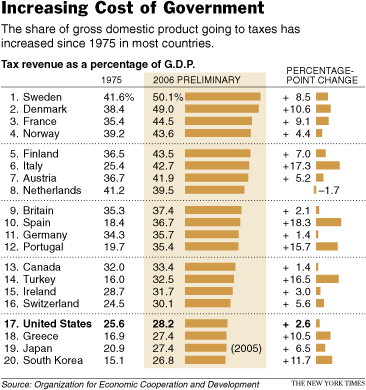
Cost of Government Grew by 20% Since 1975


TaxesIncreaseGraph.gif   Source of graph:  online version of the NYT article quoted and cited below.
 

(p. C3)  After dipping briefly in the first years of this decade, taxes are growing again around the world, the Organization for Economic Cooperation and Development said yesterday.

Taxes in 2005 equaled the previous peak year of 2000, the organization said, when by one measure 36.2 percent of gross domestic product in 30 industrial countries, including the United States, went to taxes at all levels of government.

The organization, which is based in Paris, said that when final figures are in for 2006, they will most likely show a new peak.

The report defines taxes as “compulsory, unrequited payments to general government.”

The cost of government has risen by about 20 percent since 1975, when taxes accounted for less than 30 percent of the gross domestic product of the organization’s member countries.

. . .

Taxes in the United States — from the federal income tax and Social Security tax to local property levies — rose to 28.2 percent in 2006, from 25.6 percent of gross domestic product in 1975, the O.E.C.D. said. It reported that American taxes peaked at 29.9 percent in 2000, slipped to 26 percent in 2004 and then began rising again, a finding consistent with recent statistical tables released by the Internal Revenue Service.


For the full story, see: 

DAVID CAY JOHNSTON.  "Taxes in Developed Nations Reach 36% of Gross Domestic Product."  The New York Times   (Thurs., October 18, 2007):  C3.

(Note:  ellipsis added.)


Motorola Hurt By Failing to Leapfrog Itself


MotorolaStockRazrBurn.gif   Source of graph:  online version of the WSJ article cited below.
 

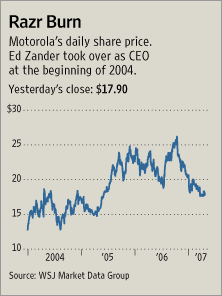
Clayton Christensen, in a series of books, has highlighted why it is difficult for a successful incumbent to prepare a successor for its own winning product.  The Motorola case below is another example.

Note, though, that Motorola’s failure is not the understandable one of failing to prepare what Christensen calls a "disruptive innovation."  If the story below is right, it is a case of the less understandable failure to continue to deliver with what Christensen calls "sustaining innovation."


(p. A1)  A year ago, Motorola Inc. appeared headed for a third straight year of rich profits under Chief Executive Ed Zander, driven by its hit cellphone the Razr. "A lot of you are always asking what is after the Razr," Mr. Zander said in an April 2006 conference call after another quarter of 30%-plus growth. "I say more Razrs."

But behind the scenes, Motorola was working furiously to get a successor phone to market by the second half of 2006, according to people familiar with the matter. When it failed to do so, profit margins on handsets narrowed and the company swung to a loss. Key executives left. And as the stock slid, activist investor Carl Icahn built up a position and began campaigning for a board seat to address what he called Motorola’s "operational problems."

Motorola’s travails illustrate the risks for a company that rides high with a big consumer hit. Amid its success with the Razr, it fell behind on developing a phone with the next generation of technology. Missing a beat is especially hazardous in cellphones, where it can take two to three years to develop a new line.

. . .

(p. A14)  As the Razr grew hot, some former designers and engineers say Motorola repeated mistakes it had made a decade earlier with another big hit, the compact flip-top phone known as the StarTAC. That phone was a huge seller, but it also was an analog phone, and its popularity blinded the company to an industry shift to digital technology. Similarly, while Motorola was selling countless Razrs, competitors were hard at work on more sophisticated products for 3G networks.

Motorola put engineers and designers who could have been working on new products on the Razr and its derivatives, some former executives say. "All resources went to feeding the beast," says a former Motorola designer. "Suddenly, you created this thing that requires a lot of energy and attention." Other former executives dispute that the focus on the Razr diverted work from other products and contend Motorola was right to ride the still-popular Razr as long as possible.


For the full story, see: 

CHRISTOPHER RHOADS and LI YUAN.  "DROPPED CALL; How Motorola Fell A Giant Step Behind; As It Milked Thin Phone, Rivals Sneaked Ahead On the Next Generation."   The Wall Street Journal  (Fri., April 27, 2007):  A1  & A14. 

(Note:  ellipsis added.)


The most complete source of Christensen’s theory and examples is:  

Christensen, Clayton M., and Michael E. Raynor. The Innovator’s Solution: Creating and Sustaining Successful Growth. Boston, MA: Harvard Business School Press, 2003.


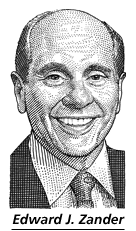
ZanderEdMotorolaCEO.gif  Motorola CEO.  Source of image:  online version of the WSJ article cited above.


 

New Farm Bill Is Sweet for Sugar Industry, but Sour for Sugar Consumers


  "Sugar being processed at the Louisiana Sugar Cooperative mill in St. Martinville, La."  Source of caption and photo:  online version of NYT article quoted and cited below. 


(p. C1)  A little-noticed provision in the new farm bill working its way through Congress would oblige the Agriculture Department to buy surplus domestic sugar caused by the expected influx of Mexican sugar next year. Then the government would sell it, most likely at a steep discount, to ethanol producers to add to their fermentation tanks. The Bush administration is fighting the measure.

Sugar producers say the cost would be relatively low and the plan would help keep prices at a level they consider fair. As a side benefit, the deal would allow the nation to produce more ethanol to mix with gasoline, displacing some foreign oil, they say.

But ethanol producers are unenthused. And the plan is drawing fire from opponents of agricultural subsidies and from longtime critics of the sugar in- (p. C4) dustry, who complain that producers already have one of the best deals in American agriculture.

“It’s a tax burden without a benefit that distorts both the ethanol market and the food-ingredient market,” said Richard E. Pasco, counsel for the Sweetener Users Association, a lobby group for food companies that use sugar. “And guess who will pay the price? Taxpayers and consumers.”

. . .

The measure would be grafted onto an existing sugar policy so complex that even many farmers have trouble understanding it. The government limits the supply of sugar through production quotas and import restrictions, and it uses financial mechanisms to set an effective price floor.

The system does not cost taxpayers money directly, a point of pride for the industry. But it costs consumers money in the form of higher sugar prices. The system has been subjected to withering criticism for decades, but the sugar lobby has clout on Capitol Hill. Sugar producers donated $2.7 million in campaign contributions to House and Senate incumbents in 2006, more than any other group of food growers, according to the Center for Responsive Politics, a Washington group.

The new farm bill would retain much of the existing system, which sugar producers defend on the ground that virtually every country with a domestic sugar industry has strong protections. But it would add more guarantees, including one that would assure American producers 85 percent of the market no matter how much sugar comes in from abroad.


For the full story, see: 

CLIFFORD KRAUSS.  "Seeing Sugar’s Future in Fuel."  The New York Times   (Thurs., October 18, 2007):  C1 & C4.

(Note:  ellipsis added.)


SugarFarmingMap.jpg   Source of graphic:  online version of NYT article cited above.


Hong Kong Dim Sum Lovers Rebuke Government


     "Wong Yuen enjoying breakfast at a Hong Kong restaurant. The government, he says, "shouldn’t be telling anyone how dim sum should be served.""   Source of caption and photo:  online version of the NYT article quoted and cited below.


Longtime dim sum lovers are indignant.

"The government is putting its thumb on every part of citizens’ lives, and it shouldn’t be telling anyone how dim sum should be served," said Wong Yuen, a retired mechanic and truck driver who says he has eaten dim sum every morning for the last two decades. "People can make their own decisions. If it’s unhealthy, they can eat less. They don’t need the government to tell them."


For the full story, see: 

KEITH BRADSHER.  "HONG KONG JOURNAL; Dim Sum Under Assault, and Devotees Say ‘Hands Off’."  The New York Times  (Thurs., April 28, 2005):  A4.


Doctors Seek New Business Models to Avoid Paperwork and Insurance Regulation


   "Dr. Steven Meed works for Sickday Medical House Calls, a service in Manhattan."  Source of caption and photo:  online version of the NYT article quoted and cited below.


“We have that perfect storm. The current system doesn’t work well for patients or physicians,” said Dr. Rick Kellerman, a doctor who works in Wichita, Kan., and is president of the American Academy of Family Physicians. "More doctors are coming up with new home business practice models. They’re exasperated with paperwork and insurance regulation.”

The demand for primary care physicians outweighs the supply in many cities, so patients can wait weeks, and even months, for appointments, and hospital emergency rooms are becoming overloaded with nonemergency cases. Health insurance premiums, meanwhile, have continued to rise.

Some doctors are doing things like taking only house-call appointments or operating “micropractices” in which they work without front-office staff and nurses and see their patients in a smaller one-room office, Dr. Kellerman said.

When making house calls, “you get paid,” said Dr. Steven Meed, one of eight New York physicians working for Sickday Medical House Calls, which started last year and serves patients in Manhattan. “The paperwork overhead is kept at a minimum, the fee is fixed and it’s not going to be reduced.”


For the full story, see:

JENNIFER ALSEVER. "SPENDING; Retro Medicine: Doctors Making House Calls (for a Price)."  The New York Times, SundayBusiness Section  (Sun., September 23, 2007):  6.


MeedStevenHouseCalls2.jpg  "He took the subway, top, to travel to the apartment of a patient, Kayla McDermott, who had a sore throat."  Source of caption and photos:  online version of the NYT article cited above.

 

Incentives for Organ Donations Would Save Lives


SatelSally.jpg    Sally Satel is a medical doctor and a resident scholar at the Amerrican Enterprise Institute.  Source of photo:  http://www.aei.org/publications/filter.all,pubID.25785/pub_detail.asp


(p. A12)  At the annual meeting of The American Society of Transplant Surgeons this winter a straw poll revealed that 80 to 85% were in favor of studying incentives for living donors, according to society president Arthur Matas. In 2003, the American Medical Association testified on behalf of legislation that would have permitted pilot studies of incentives for deceased organs.

The public seems receptive as well, according to a new Gallup poll on attitudes toward donation of organs after death. The most striking results were among 18 to 34 year olds wherein an impressive 34% said that incentives would make them "more likely" to donate while 6% said less likely.  . . .

. . .

The idea of combining organ donation with material gain can make people queasy. Yet the mix of financial and humanitarian motives is commonplace. No one objects, for example, to a tax credit for charitable contributions–a financial incentive to complement the "pure" motive of giving to others. The great teachers who enlighten us and the doctors who heal us inspire no less gratitude because they are paid. An increase in the supply of kidneys will ameliorate suffering and prevent needless death. This is more important than whether an organ has been given freely or for material gain.  . . .


For the full commentary, see: 

Satel, Sally.  "Doing Well By Doing Good."  The Wall Street Journal  (Fri, March 16 2007):  A12.

(Note:  ellipses added.)


The Internet Adds Value for Restaurant Consumers and Efficiency for Restaurant Owners


   Source of graph:  online version of the NYT article cited below.


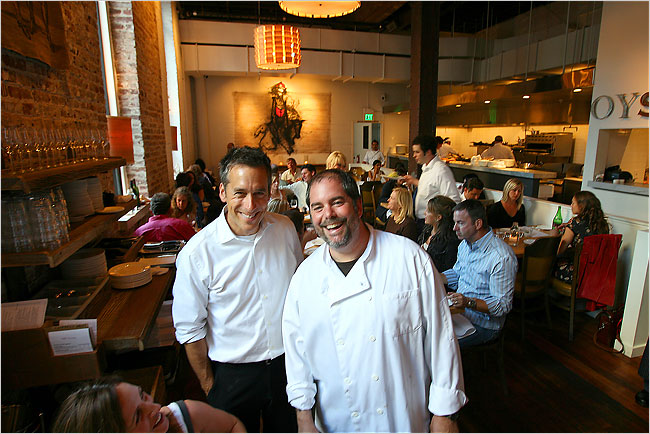
(p. C1)  SAN FRANCISCO, June 17 — Town Hall, one of the busiest restaurants in this food-crazed city, seems the very model of old-fashioned dining. Patrons who arrive to claim their reserved seats are greeted by a hostess who consults a piece of paper with the day’s reservations and leads her guests to the appointed table.  

But upstairs, in the restaurant’s office, a different scene is playing out. In a veritable mission-control setting, a reservationist answers eight phone lines while seated in front of two computers that log reservations and hold an archive of past and future electronic bookings.

The software also reveals the idiosyncrasies of thousands of guests. The restaurant staff knows in advance, for instance, that a regular always insists on a table under a particular piece of artwork. They know about another person’s request for kosher food — but only when dining in certain company. And there is the guest so reliably late that staff members know to add 45 minutes to the reservation time.

After decades of relying on telephones to book tables, and piles of index cards — or a maitre d’hotel’s memory — to collect information about diners and their quirks, the restaurant business has finally gone unabashedly high-tech.

Technology may not make it any easier for diners to get a reservation at the most sought-after spots, like the French Laundry in Yountville, Calif., or Babbo in New York City. But the perseverance of a San Francisco-based company called OpenTable, which has come to dominate the business of online restaurant reservations, is making it much easier for restaurants to manage reservations and improve customer service.

. . .

(p. C5)  Making a reservation through OpenTable costs the diner nothing. And it reduces the inconvenience. Say you want a table on short notice at a busy Manhattan restaurant — Danny Meyer’s Union Square Cafe. Placing a phone call there usually requires calling during business hours, enduring loud jazz for hold music, and talking with a reservationist for a while before finding an acceptable time. OpenTable might give you the same results, but it will do the work in 10 seconds.

. . .

Many of the restaurants discovered that they had to surrender to the automation because their popularity suffered if they did not.

“It was a long, long time before that was proven,” said Bill Gurley, a Silicon Valley venture capitalist whose company, Benchmark, has invested $21.6 million in OpenTable over the years.

It took three years for OpenTable to seat its one-millionth diner. But now, the company seats two million diners every month. And Zagat, the restaurant rating service, has adopted OpenTable for reservations made through its site, zagat.com


For the full story, see: 

KATIE HAFNER.  "Restaurant Reservations Go Online."  The New York Times   (Mon., June 18, 2007):  C1 & C5.

(Note:  ellipses added.)


   "Doug Washington, left, and Mitchell Rosenthal are partners in Salt House in San Francisco, one of 7,000 restaurants using OpenTable."  Source of caption and photo:  online version of the NYT article cited above.


“Musing on the Sameness of Princes and Paupers”


   King Edward’s suite is enjoyed by Münster, Germany resident Henriette Heussner.  Source of photo:  online version of the NYT article quoted and cited below.


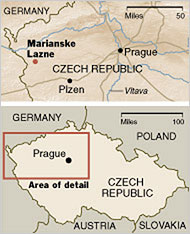
(p. A4) MARIANSKE LAZNE, Czech Republic — Anybody with a little cash in this quaint and quiet spa town can take a bath fit for a king.

Edward VII of Britain visited this bucolic corner of Bohemia six times during his short reign and each time took a bath in the Royal Cabin, as his private bathroom at the Nove Lazne hotel is still called. For about $45, you can, too.

. . .

King Edward’s Royal Cabin, a spacious Turkish-bath-style suite, is outfitted with a metal alloy tub and a medieval-looking oaken chair that serves as a toilet and a scale.

. . .

The windows are as delicately painted as a church’s stained glass, and the walls richly decorated with a tropical mural, just as they were in Edwardian days. Angels wearing miters look down from the ceiling.

Lying in the bath, staring up at the same blue parrot that King Edward surely contemplated on the opposite wall, one cannot help musing on the sameness of princes and paupers and those who are somewhere in between.

Tiny bubbles like the carbonation on a soda straw collect on the skin, and larger bubbles percolate around the bather, producing a peculiarly pleasant sensation.

An archaic water heater in a corner of the room clanks contentedly, keeping the bath at what the hotel staff call an “optimal” 97 degrees. The smell of the water is sulfuric and slightly metallic.

Much history and many baths have passed since the king bathed here. In the end, everyone grabs the same metal handle that he did to hoist himself up and out of the tub.


For the full story, see: 

CRAIG S. SMITH.  "MARIANSKE LAZNE JOURNAL; This Year at Marienbad, They’re Still Taking the Waters."  The New York Times  (Tues., July 3, 2007):  A4.

(Note:  ellipses added.)


CzechMap.jpg   Source of maps:  online version of the NYT article cited above.