Social Scientists Prefer Articles that Contain Bogus Math

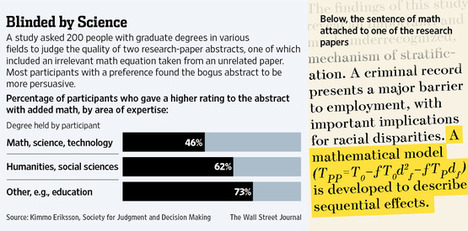
MathBiasGraphic2013-01-12.jpgSource of graphic: online version of the WSJ article quoted and cited below.

(p. A2) . . . research has shown that even those who should be especially clear-sighted about numbers–scientific researchers, for example, and those who review their work for publication–are often uncomfortable with, and credulous about, mathematical material. As a result, some research that finds its way into respected journals–and ends up being reported in the popular press–is flawed.

In the latest study, Kimmo Eriksson, a mathematician and researcher of social psychology at Sweden’s Mälardalen University, chose two abstracts from papers published in research journals, one in evolutionary anthropology and one in sociology. He gave them to 200 people to rate for quality–with one twist. At random, one of the two abstracts received an additional sentence, the one above with the math equation, which he pulled from an unrelated paper in psychology. The study’s 200 participants all had master’s or doctoral degrees. Those with degrees in math, science or technology rated the abstract with the tacked-on sentence as slightly lower-quality than the other. But participants with degrees in humanities, social science or other fields preferred the one with the bogus math, with some rating it much more highly on a scale of 0 to 100.
“Math makes a research paper look solid, but the real science lies not in math but in trying one’s utmost to understand the real workings of the world,” Prof. Eriksson said.

For the full story, see:
CARL BIALIK. “THE NUMBERS GUY; Don’t Let Math Pull the Wool Over Your Eyes.” The Wall Street Journal (Sat., January 5, 2013): A2.
(Note: ellipsis added.)
(Note: the online version of the story has the date January 4, 2013,)

A pdf of Eriksson’s published article can be downloaded from:
Eriksson, Kimmo. “The Nonsense Math Effect.” Judgment and Decision Making 7, no. 6 (November 2012): 746-49.

Steve Jobs Viewed Patents as Protecting Property Rights in Ideas

(p. 512) . . . Apple filed suit against HTC (and, by extension, Android), alleging infringement of twenty of its patents. Among them were patents covering various multi-touch gestures, swipe to open, double-tap to zoom, pinch and expand, and the sensors that determined how a device was being held. As he sat in his house in Palo Alto the week the lawsuit was filed, he became angrier than I had ever seen him:

Our lawsuit is saying, “Google, you fucking ripped off the iPhone, wholesale ripped us off.” Grand theft. I will spend my last dying breath if I need to, and I will spend every penny of Apple’s $40 billion in the bank, to right this wrong. I’m going to destroy Android, because it’s a stolen product. I’m willing to go to thermonuclear war on this. They are scared to death, because they know they are guilty. Outside of Search, Google’s products–Android, Google Docs–are shit.

A few days after this rant, Jobs got a call from Schmidt, who had resigned from the Apple board the previous summer. He suggested they get together for coffee, and they met at a café in a Palo Alto shopping center. “We spent half the time talking about personal matters, then half the time on his perception that Google had stolen Apple’s user interface designs,” recalled Schmidt. When it came to the latter subject, Jobs did most of the talking. Google had ripped him off, (p. 513) he said in colorful language. “We’ve got you red-handed,” he told Schmidt. “I’m not interested in settling. I don’t want your money. If you offer me $5 billion, I won’t want it. I’ve got plenty of money. I want you to stop using our ideas in Android, that’s all I want.” They resolved nothing.

Source:
Isaacson, Walter. Steve Jobs. New York: Simon & Schuster, 2011.
(Note: ellipsis added.)

Eastern Europeans Were Lab Rats in Stalin’s Monstrous Experiment

IronCurtainBK2013-01-11.jpg

Source of book image: http://media.cleveland.com/books_impact/photo/ironjpg-2761d5de1590effb.jpg

(p. C12) In a stunning follow-up to “Gulag,” Anne Applebaum takes readers back to the events that triggered the half-century-long standoff between the U.S. and the U.S.S.R. Instead of the usual aerial view, “Iron Curtain” re-creates what it was like on the ground for those who became the lab rats in Stalin’s monstrous social experiment.

For the full review essay, see:
Sylvia Nasar (author of passage quoted above, one of 50 contributors to whole article). “Twelve Months of Reading; We asked 50 of our friends to tell us what books they enjoyed in 2012–from Judd Apatow’s big plans to Bruce Wagner’s addictions. See pages C10 and C11 for the Journal’s own Top Ten lists.” The Wall Street Journal (Sat., December 15, 2012): passim (Nasar’s contribution is on p. C12).
(Note: the online version of the review essay has the date December 14, 2012.)

The book under review, is:
Applebaum, Anne. Iron Curtain: The Crushing of Eastern Europe, 1944-1956. New York: Doubleday, 2012.

Fiscal Stimulus Packages Did Not Stimulate

(p. 686) An empirical review of the three fiscal stimulus packages of the 2000s shows that they had little if any direct impact on consumption or government purchases. Households largely saved the transfers and tax rebates. The federal government only increased purchases by a small amount. State and local governments saved their stimulus grants and shifted spending away from purchases to transfers. Counterfactual simulations show that the stimulus-induced decrease in state and local government purchases was larger than the increase in federal purchases. Simulations also show that a larger stimulus package with the same design as the 2009 stimulus would not have increased government purchases or consumption by a larger amount. These results raise doubts about the efficacy of such packages adding weight to similar assessments reached more than thirty years ago.

Source:
Taylor, John B. “An Empirical Analysis of the Revival of Fiscal Activism in the 2000s.” Journal of Economic Literature 49, no. 3 (September 2011): 686-702.

Dr. William House “Faced Stern Opposition” to Bring Cochlear Implants to the Deaf

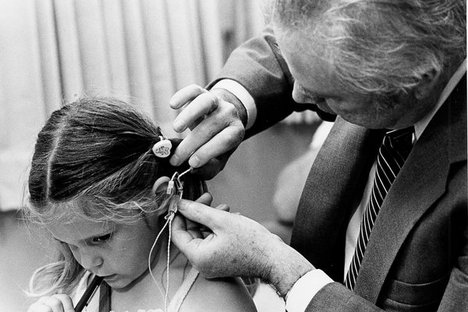
HouseAndHustedFirstCochlearImplant2013-01-12.jpg “Dr. William F. House in 1981 with Tracy Husted, the first pre-school-age child to get a cochlear implant.” Source of caption and photo: online version of the NYT obituary quoted and cited below.

(p. 34) Dr. William F. House, a medical researcher who braved skepticism to invent the cochlear implant, an electronic device considered to be the first to restore a human sense, died on Dec. 7 at his home in Aurora, Ore. He was 89.

. . .
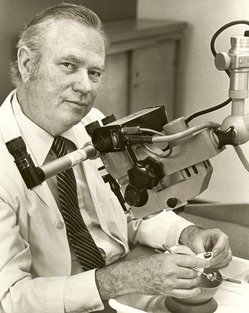
Dr. House pushed against conventional thinking throughout his career. Over the objections of some, he introduced the surgical microscope to ear surgery. Tackling a form of vertigo that doctors had believed was psychosomatic, he developed a surgical procedure that enabled the first American in space to travel to the moon. Peering at the bones of the inner ear, he found enrapturing beauty.
. . .
More than a decade would pass before the Food and Drug Administration approved the cochlear implant, but when it did, in 1984, Mark Novitch, the agency’s deputy commissioner, said, “For the first time a device can, to a degree, replace an organ of the human senses.”
One of Dr. House’s early implant patients, from an experimental trial, wrote to him in 1981 saying, “I no longer live in a world of soundless movement and voiceless faces.”
But for 27 years, Dr. House had faced stern opposition while he was developing the device. Doctors and scientists said it would not work, or not work very well, calling it a cruel hoax on people desperate to hear. Some said he was motivated by the prospect of financial gain. Some criticized him for experimenting on human subjects. Some advocates for the deaf said the device deprived its users of the dignity of their deafness without fully integrating them into the hearing world.
. . .
When his brother returned from West Germany with a surgical microscope, Dr. House saw its potential and adopted it for ear surgery; he is credited with introducing the device to the field. But again there was resistance. As Dr. House wrote in his memoir, “The Struggles of a Medical Innovator: Cochlear Implants and Other Ear Surgeries” (2011), some eye doctors initially criticized his use of a microscope in surgery as reckless and unnecessary for a surgeon with good eyesight.

For the full obituary, see:
DOUGLAS MARTIN. “Dr. William F. House, Inventor of Pioneering Ear-Implant Device, Dies at 89.” The New York Times, First Section (Sun., December 16, 2012): 34.
(Note: ellipses added.)
(Note: the online version of the obituary has the date December 15, 2012.)

Dr. House’s memoir is:
House, William F. The Struggles of a Medical Innovator: Cochlear Implants and Other Ear Surgeries. CreateSpace Independent Publishing Platform, 2011.
(Note: the copyright page of the book gives neither city nor name of publisher; the publisher in the reference is as given by Amazon.com.)

HouseWilliamInventorOfCochlearImplant2013-01-12.jpg

“Dr. William F. House sitting at an operating microscope.” Source of caption and photo: online version of the NYT obituary quoted and cited above.

Rupert Murdoch and Steve Jobs “Hit It Off Well”

(p. 508) Murdoch and Jobs hit it off well enough that Murdoch went to his Palo Alto house for dinner twice more during the next year. Jobs joked that he had to hide the dinner knives on such occasions, because he was afraid that his liberal wife was going to eviscerate Murdoch when (p. 509) he walked in. For his part, Murdoch was reported to have uttered a great line about the organic vegan dishes typically served: “Eating dinner at Steve’s is a great experience, as long as you get out before the local restaurants close.” Alas, when I asked Murdoch if he had ever said that, he didn’t recall it.

Source:
Isaacson, Walter. Steve Jobs. New York: Simon & Schuster, 2011.

Fragile Governments Cling to Failed Foreign Aid

AntifragileBK2013-01-11.jpg

Source of book image: http://si.wsj.net/public/resources/images/OB-VL312_bkrvta_DV_20121122124330.jpg

(p. C12) Nassim Nicholas Taleb’s “Antifragile” argues that some people, organizations and systems are resilient in the face of stress because they are able to alter themselves by adapting and learning. The converse is fragility, embodied in entities that are immovable even when faced with shocks or adversity. To my mind, an obvious example is how numerous governments and international agencies have clung to foreign aid as a tool to combat poverty even though aid has failed to deliver sustainable growth and meaningfully reduce indigence. And nation-states, which rest on one unifying vision of the nation, tend to be fragile, while city-states that adjust, adapt and constantly evolve tend to be antifragile. Mr. Taleb’s lesson: Embrace, rather than try to avoid, the shocks.

For the full review essay, see:
Dambisa Moyo (author of passage quoted above, one of 50 contributors to whole article). “Twelve Months of Reading; We asked 50 of our friends to tell us what books they enjoyed in 2012–from Judd Apatow’s big plans to Bruce Wagner’s addictions. See pages C10 and C11 for the Journal’s own Top Ten lists.” The Wall Street Journal (Sat., December 15, 2012): passim (Moyo’s contribution is on p. C12).
(Note: the online version of the review essay has the date December 14, 2012.)

The book under review, is:
Taleb, Nassim Nicholas. Antifragile: Things That Gain from Disorder. New York: Random House, 2012.

Governments Use “Financial Repression” to Lower Their Interest Payments on Debt

(p. 229) Carmen M. Reinhart, Jacob F. Kirkegaard, and M. Belen Sbrancia make a case for “Financial Repression Redux: Governments Are Once Again Finding Ways to Manipulate Markets to Hold Down the Cost of Financing Debt.” “Financial repression occurs when governments implement policies to channel to themselves funds that in a deregulated market environment would go elsewhere. . . . One of the main goals of financial repression is to keep nominal interest rates lower than they would be in more competitive markets. Other things equal, this reduces the government’s interest expenses for a given stock of debt and contributes to deficit reduction. (p. 230) However, when financial repression produces negative real interest rates (nominal rates below the inflation rate), it reduces or liquidates existing debts and becomes the equivalent of a tax–a transfer from creditors (savers) to borrowers, including the government . . .” “Financial repression contributed to rapid debt reduction following World War II. . . . It seems probable that policymakers for some time to come will be preoccupied with debt reduction, debt management, and efforts to keep debt servicing costs at a reasonable level. In this setting, financial repression, with its dual aims of keeping interest rates low and creating or maintaining captive domestic audiences, will continue to find renewed favor, and the measures and developments we have described and discussed are likely to be only the tip of a very large iceberg.”

Reinhart et al as quoted in:
Taylor, Timothy. “Recommendations for Further Reading.” Journal of Economic Perspectives 25, no. 4 (Fall 2011): 223-30.
(Note: ellipses added by Taylor.)

For the full Reinhart et al paper, see:
Reinhart, Carmen M., Jacob F. Kirkegaard, and M. Belen Sbrancia. “Financial Repression Redux.” Finance and Development 48, no. 2 (June 2011): 22-26.

Is Economics Major Nuts to Have Left Investment Banking?

BravermanJeffreyAndFatherUncleCousinNutBusiness2013-01-12.jpg “Jeffrey Braverman, right, stepped away from Wall Street to join his father, uncle and cousin in the family’s New Jersey nut business.” Source of caption and photo: online version of the NYT article quoted and cited below.

(p. B8) Ten years ago, Jeffrey Braverman was living the dream of many business school graduates. With a freshly minted bachelor’s degree in economics, he landed a job in 2002 at the Blackstone Group, a Wall Street firm specializing in private equity and investment banking.
Less than a year later, however, Mr. Braverman stepped away from Wall Street and returned to his family’s New Jersey nut business, the Newark Nut Company. It struck some as an odd choice: the family-owned company, which had been started by Mr. Braverman’s grandfather, Sol Braverman (known as Poppy), and had once employed 30 people, was down to two employees and two family members, Mr. Braverman’s father and his uncle.
Located in an indoor mall in a desolate part of Newark, the nut shop’s retail sales were fading and its wholesale business was, at best, stagnant. But Mr. Braverman harbored entrepreneurial ambitions.
At the beginning, he agreed to work with his father and uncle for a salary tied directly to how much new business he attracted. He focused on Internet sales and before long, they began to dwarf the existing business.
Now based in Cranford, N.J., the company has grown to more than 80 employees with more than $20 million in revenue, 95 percent of it online. The following is a condensed version of a recent conversation.
Q. Who leaves investment banking to work at a struggling family nut company?
A. Only someone nuts, right? My dad and my uncle both thought I was crazy. I was making more than they were at the time.
Q. Then why?
A. Have you ever read the book “Monkey Business”? It’s a fairly accurate profile of what it’s like to be in investment banking, at least at a junior level. You know, there’s this economic concept called deadweight loss, and I think a lot of investment banking is like that: it doesn’t really add anything to the world, to the economy. I just wanted to do more.
Q. I assume your father and uncle made you take a pay cut.
A. The one thing I did was, I didn’t want to take anything away from them. I structured it so that my compensation was 100 percent based on incremental profit improvement. So from their perspective, there wasn’t very much risk. I also got a small piece of the business. But at the time the business was worth nothing, book value. No one would have bought it.
Q. Did you have any experience in Internet sales?
A. In 1999, I was a freshman in college and I started our Web site, Nutsonline.com. I spent my second semester of freshman year working on that thing four or five hours a day. It kind of just trickled along. In 1999, very few people were buying from Amazon, so they certainly weren’t going to buy from Nutsonline. In 2000, I remember I set a goal: I wanted to do 10 orders a day.

For the full version of the condensed conversation, see:
IAN MOUNT. “Forsaking Investment Banking to Turn Around a Family Business.” The New York Times (Thurs., April 19, 2012): B8.
(Note: bold in original.)
(Note: the online version of the conversation has the date April 18, 2012.)

BravermanSolNutBusinessEarly1930s2013-01-12.jpg “Sol Braverman, Jeffrey’s grandfather, in the early 1930s.” Source of caption and photo: online version of the NYT article quoted and cited above.

The Project Entrepreneur: Never Say Die

(p. 485) . . . [Jobs] chafed at not being in control, and he sometimes hallucinated or be-(p. 486)came angry. Even when he was barely conscious, his strong personality came through. At one point the pulmonologist tried to put a mask over his face when he was deeply sedated. Jobs ripped it off and mumbled that he hated the design and refused to wear it. Though barely able to speak, he ordered them to bring five different options for the mask and he would pick a design he liked. The doctors looked at Powell, puzzled. She was finally able to distract him so they could put on the mask. He also hated the oxygen monitor they put on his finger. He told them it was ugly and too complex. He suggested ways it could be designed more simply. “He was very attuned to every nuance of the environment and objects around him, and that drained him,” Powell recalled.

Source:
Isaacson, Walter. Steve Jobs. New York: Simon & Schuster, 2011.
(Note: ellipsis and bracketed “Jobs” added.)

ExxonMobil’s “Honorable If Rigid Corporate Culture”

PrivateEmpireBK2013-01-11.jpg

Source of book image: online version of the NYT review quoted and cited way below.

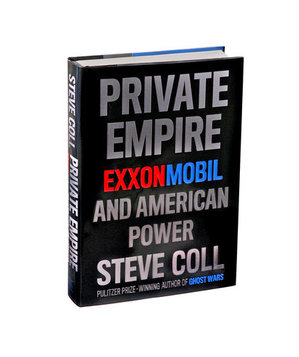
(p. C12) From Indiana to Indonesia, ExxonMobil is the multinational corporation that people love to hate. John D. Rockefeller’s creation is famed and feared for its discipline, its disregard for public opinion and its ability, year after year, to pump out the largest profits of any corporation on the planet. In “Private Empire,” Steve Coll provides a rare exploration of what makes a modern corporate giant tick and shows why the world looks different to the executives in the “God Pod” at ExxonMobil’s Texas headquarters than it might to you or me.

For the full review essay, see:
Marc Levinson. “Boardroom Reading of 2012.” The Wall Street Journal (Sat., December 15, 2012): C12.
(Note: the online version of the review essay has the date December 14, 2012.)

From another review of the same book:

“Private Empire” is meticulous, multi-angled and valuable. It is also, perhaps surprisingly, despite all the dark facts I have dumped above, impartial. Mr. Coll and his phlegmatic research assistants have interviewed more than 400 people, including Exxon Mobil’s longtime chief executive Lee R. Raymond, a legendarily hard character.

It’s among this book’s achievements that it attempts to view a dysfunctional energy world, as often as not, through Exxon Mobil’s eyes. The company is portrayed here, some egregious missteps aside, as possessing an honorable if rigid corporate culture that seeks to supply a product (unlike tobacco companies, to which it is often compared) that a functioning society actually must have.

For this full review, see:
DWIGHT GARNER. “Oil’s Dark Heart Pumps Strong.” The New York Times (Sat., April 27, 2012): C25 & C32(?).
(Note: the online version of the review essay has the date April 26, 2012 and has the title “BOOKS OF THE TIMES; Oil’s Dark Heart Pumps Strong; ‘Private Empire,’ Steve Coll’s Book on Exxon Mobil.”)

The book under review, is:
Coll, Steve. Private Empire: ExxonMobil and American Power. New York: The Penguin Press, 2012.